By positioning the rail line as a tech and renewable energy corridor, the agency hopes to increase revenue opportunities.



The California High-Speed Rail Authority is advancing an "asset commercialization strategy" that could position the corridor as a technology hub for data centers and other technology and energy projects, reports Joe Edwards in Newsweek.
According to a revised draft business plan from the agency, "By leveraging state-owned land for commercial development such as solar farms, battery storage, data centers, and fiber optic and transmission lines, the Authority can create new business income sources before operations, while also benefiting communities along the corridor." The initiative could bring in additional revenue to the struggling, multi-decade project, which is about to lay its first rails.
According to the document, the agency has identified "several complementary opportunities, particularly in areas such as renewable energy and technology infrastructure." At a June 1 public meeting, attendees expressed concerns about "water use, pollution, noise, fire risk and impacts on farmland."
Read the full story: California Eyes Data Center Plan To Help Fund High Speed Rail
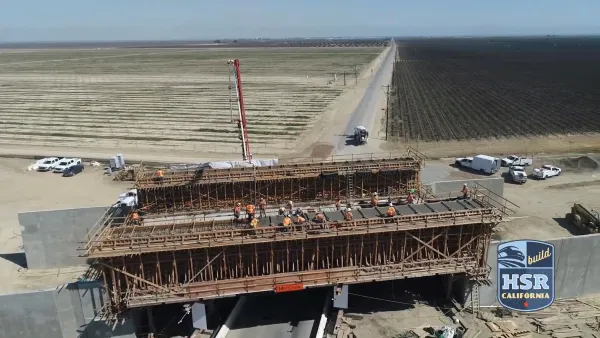
California High-Speed Rail Slashes $1.7B From 2026 Budget
The CHSRA plans to complete the Central Valley segment of the line and begin revenue service as soon as possible.

California Abandons Lawsuit Over Federal High-Speed Rail Funds
The state is taking a new approach to its high-speed rail project, saying the federal government is not a “reliable, constructive, or trustworthy partner.”
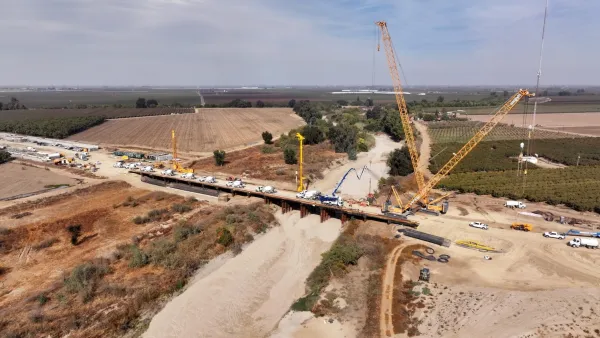
California High-Speed Rail Approves $3.4B Contract for Track Materials
The project is moving ahead despite the loss of $4 billion in federal funds earlier this year.

Desperate measures: Advocates weigh draining Lake Powell to fill Colorado River
Draining the reservoir could reduce evaporation losses by a couple hundred thousand acre-feet.

Eastern Nebraska is running out of electricity
Data centers and electrification are straining eastern Nebraska’s grid, throttling economic development.

Move over, LA: St. Louis gears up for Olympics, invests millions in downtown redevelopment
The Missouri city will host the 2028 Olympic soccer group stage and knockout matches.

‘No clear next steps’ for Chicago's permanent festival grounds
Eleventh Ward Ald. Nicole Lee has suggested Soldier Field as a possible location for the permanent event space.

California, Hawaii, Rhode Island approve housing propositions
Hawaii and Rhode Island each approved their sole proposition, while California approved two of its three.

Officials claim feds 'rushed' Amtrak environmental review
Amtrak plans to move their Chicago maintenance facility from an industrial area to a residential one.

FREE Course: Walkable City 1: Why Walkability?
After describing his path towards focusing on walkability as the essence of good planning, Jeff Speck marches through his five principal reasons for making more walkable places.
Reinventing Malls: Planning Alchemy—Turning Gray Fields Into Gold
The course focuses on the opportunities and imperatives that shape reinvention of mall sites.

City of Rosemead
Rutgers University, Edward J. Bloustein School of Planning and Public Policy
One Hundred Miles
University of Michigan School for Environment and Sustainability (SEAS)
Hunter College, City University of New York (CUNY)
The Architects Foundation
City of Cambridge
Montrose County
The Pocatello Development Authority