Move over, high speed rail. California might soon be getting bus rapid transit gone wild.


Who needs high speed rail when you can have high speed buses? Caltrans is investigating just that: high speed coaches that could run on freeways at speeds as high as 140 mph between San Francisco and Los Angeles, potentially cutting travel time to as little as three hours.
Hoodline reports that the idea hinges on new dedicated freeway lanes, custom-built stations, and buses specially engineered for high speeds and long stretches, and that officials warn that the safety challenges and cost of overhauling the freeway system could be major barriers.
"According to Caltrans, most U.S. freeways were built for design speeds of about 75 to 85 mph. Running buses at a steady 100 to 140 mph would not be as simple as posting a higher limit. It would require dedicated lanes, changes to roadway geometry and major vehicle redesign," writes Eric Tanaka for Hoodline, citing a report issued by Caltrans. "The report, requested by Ryan Snyder and authored by Mehdi Moeinaddini, lists high-speed-rated tires, multiple redundant braking systems, active suspension, advanced aerodynamics and vehicle-to-everything communications as basic requirements for safe operation."
Read the full story, below.
FULL STORY: Caltrans Floats 140-Mph ‘Bullet Buses’ To Zip Between San Francisco And L.A.

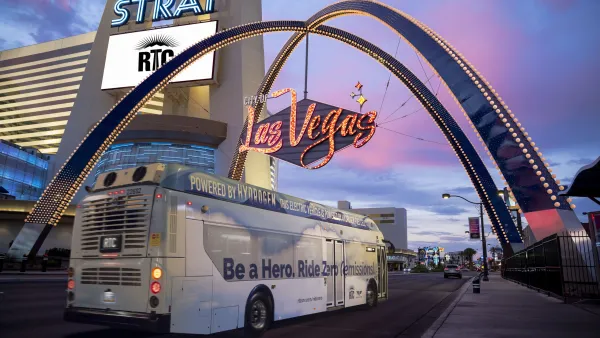
Las Vegas debuts new bus rapid transit
The project also brings widened sidewalks and more trees to the Maryland Parkway corridor.
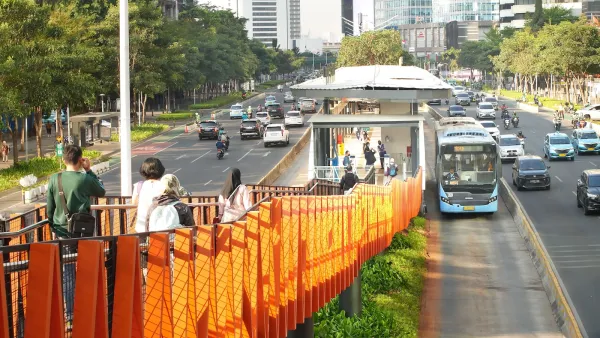
How Jakarta built the world's largest BRT system
Once known for total gridlock, the Indonesian capital has transformed itself into a public transit leader.

Atlanta's first BRT line opens April 18
MARTA officials say the line will operate like 'rail on rubber tires' and guarantee headways of 15 minutes or less.

Planetizen Federal Action Tracker
A weekly monitor of how Trump’s orders and actions are impacting planners and planning in America.

The state-sanctioned urbicide of Austin
People don’t kill cities. Freeways do.

US to reduce Colorado River water deliveries to Mexico
A new Colorado Treaty amendment reduces Mexico’s Colorado River water allocation by 250,000 acre feet.

5 New England states march closer to 800 megawatt wind energy project
Securing federal approval for the project may be complicated under the Trump administration, which has historically been hostile towards domestic wind power.

Baltimore to break ground on $50 million Transit Priority Project
The project will bring faster bus trips, safer streets and better bike connections to Baltimore.

Airbnb launches $250 million 'last-dollar financing' housing accelerator, makes first investment in Austin
The company will put $6.4 million towards affordable housing development in Texas’ capital.

FREE Course: Walkable City 1: Why Walkability?
After describing his path towards focusing on walkability as the essence of good planning, Jeff Speck marches through his five principal reasons for making more walkable places.
Reinventing Malls: Planning Alchemy—Turning Gray Fields Into Gold
The course focuses on the opportunities and imperatives that shape reinvention of mall sites.

Eagle County Government
Harvard University Graduate School of Design
Nashville Planning Department
The Architects Foundation
University of Cincinnati Online
The Pocatello Development Authority
The Urban Renewal Agency of the City of Pocatello
Journal of the American Planning Association