In one case, first responders waited 53 minutes to reach a Waymo support representative during an emergency.


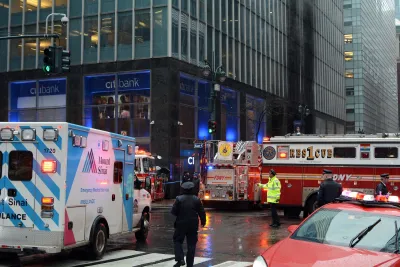
First responders in San Francisco and Austin say Waymo vehicles continue to struggle to navigate emergency situations — if anything, they're getting worse, writes Andre Nalin in Guessing Headlights.
"Officials say Waymo vehicles sometimes freeze, fail to interpret signals, or simply don’t react the way a human driver would, and in an emergency, that’s a real problem, not just an annoyance." In some cases, responders have lost precious minutes trying to call Waymo's support line to get vehicles out of the way. "One report even mentioned a 53-minute wait time to reach a representative, which is completely unacceptable in a time-critical situation."
In one high-profile case, a power outage in San Francisco caused over 1,000 Waymo vehicles to become stranded at intersections across the city, causing a flood of calls to 911. Around 60 Waymo cars had to be manually removed by emergency vehicles. "When 911 lines are forced to handle autonomous car issues, it diverts resources from real emergencies, and this kind of scenario keeps emergency management officials up at night."
This highlights a major challenge of self-driving cars: "Real-world driving is about understanding context, urgency, and human behavior, not merely following rules. That’s something humans do instinctively, but machines are still learning."
FULL STORY: First Responders Say Waymo’s Confusion With Emergency Vehicles Is Getting Worse

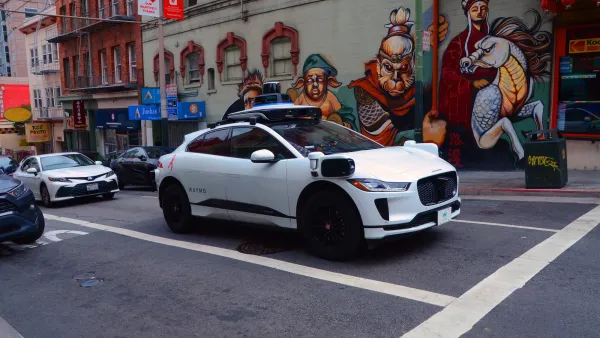
Feds say robotaxis interfering with first responders is a 'functional insufficiency,' demand solutions by August
The NHTSA issued a letter to autonomous carmakers, noting that 'Every second matters when law enforcement officers, firefighters, or paramedics are answering a call.'
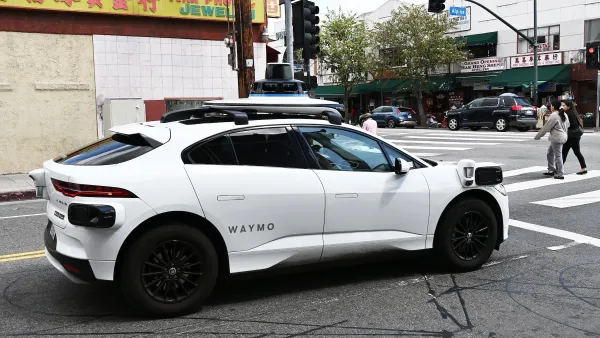
California cops will start ticketing robotaxis
The California DMV issued new guidance that allows law enforcement to give autonomous cars a "notice of noncompliance" when they break traffic laws.
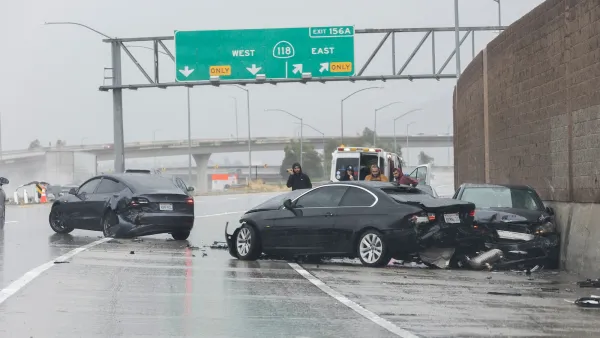
Tesla 'completely' redacts robotaxi crash reports
Reports submitted to the NHTSA also reveal differences in the types of crashes Tesla cars are involved in as opposed to its competitors.

Planetizen Federal Action Tracker
A weekly monitor of how Trump’s orders and actions are impacting planners and planning in America.

The state-sanctioned urbicide of Austin
People don’t kill cities. Freeways do.

US to reduce Colorado River water deliveries to Mexico
A new Colorado Treaty amendment reduces Mexico’s Colorado River water allocation by 250,000 acre feet.

5 New England states march closer to 800 megawatt wind energy project
Securing federal approval for the project may be complicated under the Trump administration, which has historically been hostile towards domestic wind power.

Baltimore to break ground on $50 million Transit Priority Project
The project will bring faster bus trips, safer streets and better bike connections to Baltimore.

Airbnb launches $250 million 'last-dollar financing' housing accelerator, makes first investment in Austin
The company will put $6.4 million towards affordable housing development in Texas’ capital.

FREE Course: Walkable City 1: Why Walkability?
After describing his path towards focusing on walkability as the essence of good planning, Jeff Speck marches through his five principal reasons for making more walkable places.
Reinventing Malls: Planning Alchemy—Turning Gray Fields Into Gold
The course focuses on the opportunities and imperatives that shape reinvention of mall sites.

Eagle County Government
Harvard University Graduate School of Design
Nashville Planning Department
The Architects Foundation
University of Cincinnati Online
The Pocatello Development Authority
The Urban Renewal Agency of the City of Pocatello
Journal of the American Planning Association