In this final installment of Transit Scheduling 101, we probe the purpose of a transit schedule… and when ditching one is the surprising key to delivering Good Transit.



Welcome to Transit Scheduling 101, a series in partnership with Chicago-based transit planner extraordinaire Joshua Woods, who authors Thoughts About Cities. A follow-up to his popular 2025 column, Transit Planning 101, Transit Scheduling 101 is the next installment in his journey to give you the transit planning boot camp you wish you got in planning school. Read the other installments of Transit Scheduling 101 here.
Welcome to the final installment of Transit Scheduling 101. I hope you’ve found the series informative and engaging. Over the course of the series we detailed how to turn an alignment and a list of expectations of a transit service into a bus and operator schedule that can hit the streets just as soon as the requisite vehicles and operators can be sourced.
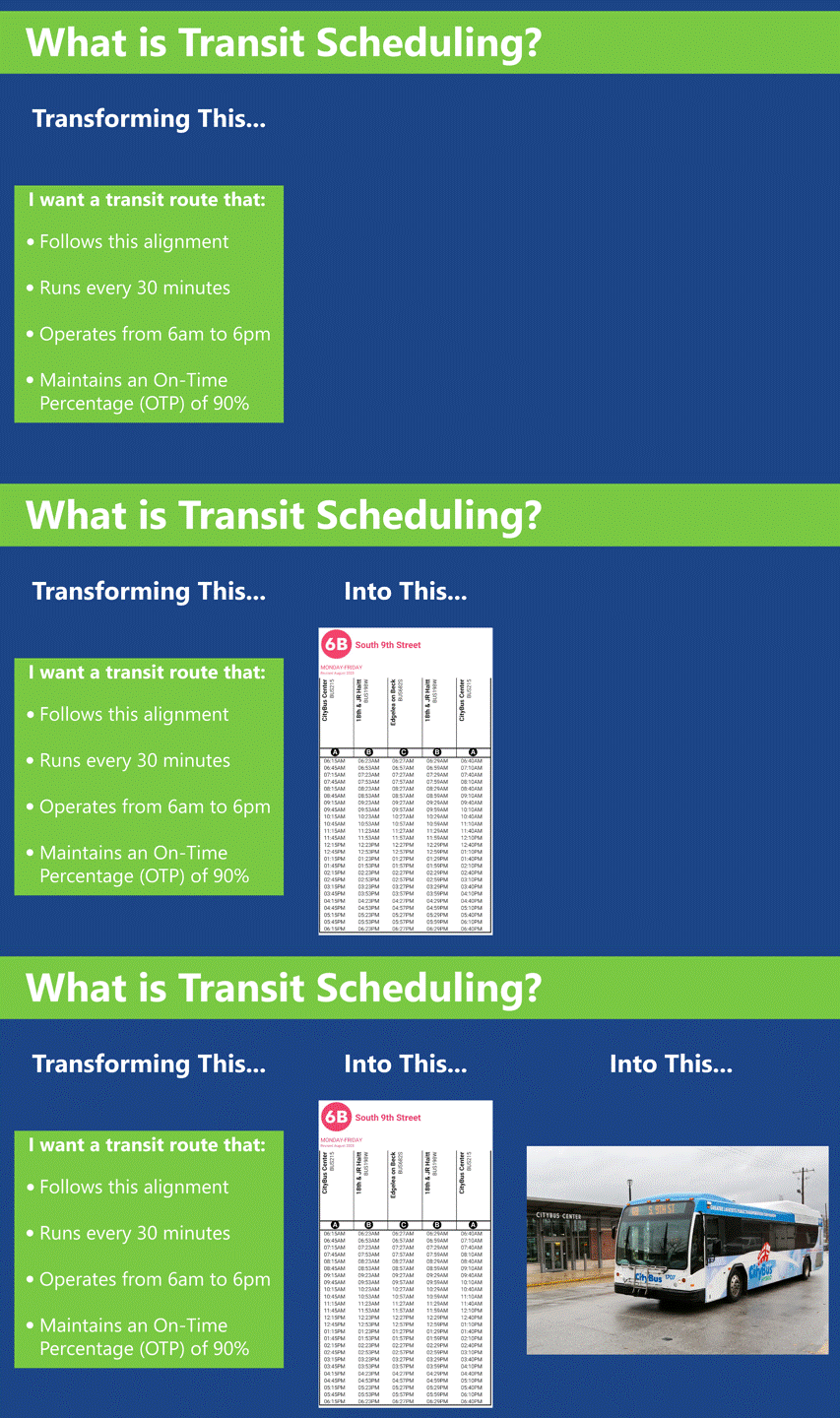
Along the way, we practiced the scheduling math necessary to quickly determine how many vehicles a route should take, detailed several methods for developing a runtime, and emphasized the importance of never cheating the layover if you want that route to deliver the reliability required of Good Transit.
Throughout the series, we leaned on publicly available resources like Google Maps, the National Transit Database, and Microsoft Excel (or Google Sheets) to develop our transit schedules. This was an intentional attempt to democratize the information that goes into planning and operating a broadly useful transit service. Hopefully the information presented over the course of Transit Scheduling 101, as well as the content covered in Transit Planning 101 can serve as a valuable tool in the effort to conspire for more Good Transit throughout the United States.
April’s lowkey spitting facts
In this final installment, we’re going to take a step back and consider what the schedule is as a tool, and when the rigidity the schedule offers might not be the best way to deliver Good Transit.
📖 First, an anecdote
While I was in undergrad, students rode the bus free and the local transit authority operated several “campus loops” that shuffled students around Purdue’s West Lafayette, IN campus. Most campus loops operated on a frequent schedule that they were, for the most part, able to maintain. The key exception was the Silver Loop, which was by far the busiest of the routes operated by the transit authority, including their non-campus routes.
The Silver Loop operated four articulated buses on a three mile loop, with buses coming every 5 to 8 minutes.

With the popularity of the route came quite a bit of volatility in the travel times. One lap was scheduled to take about 20 minutes, but a busy trip, say one that lined up with Purdue’s 10-minute passing period, might bog down with students and actually take 25 minutes. Once passing period ended, that same bus might complete its next trip in 15 minutes. As a result of this volatility, bus bunching was a perennial issue on the route.
For a while, there were efforts to tweak the schedules to better reflect reality, but the efforts were mostly in vain. Reality for the Silver Loop was just too dynamic to be captured by a static schedule. Eventually, an internal schedule was published for the Silver Loop to support the development of driver shifts, but once the driver got behind the wheel of the bus, the job was to just drive.

All Silver Loop buses were equipped with a tablet mounted in the driver’s area, which allowed each Silver Loop driver to see the location of the other buses on the route. With this information, the goal while driving the Silver Loop shifted from matching the schedule, to making sure you were about 5 minutes behind the bus in front of you. Catching up with the leading bus? Slow down a bit. Getting too far behind that bus? Speed up a bit. The schedule says you’re technically 25 minutes late? Who cares? As long as every stop along the route sees a bus every 5-8 minutes, I promise the passengers don’t.
With this change in approach, the Silver Loop switched from schedule-based operations to headway-based operations.
⏱️ Previous stop: Schedule-based operations
Over the course of the Transit Scheduling 101 series, our focus has been on schedule-based operations.
Schedule-Based Operations (n) - Transit operations approach where vehicles are operated to meet specific published departure and arrival times at designated stops or timepoints. Timeliness is measured by how well transit vehicles keep to the published departure and arrival times.
Schedule-based operations is the simplest and most common approach to transit operations. You tell the bus where and when it’s supposed to be, and check that it was there then, after the fact.

When buses come less frequently than say every 12-15 minutes, schedule-based operations are probably the correct choice. They allow you to schedule timed connections between services to keep people moving towards where they need to go¹. However, as transit service becomes more frequent, timed connections become less relevant. After all, there is another bus just a few minutes away (right?). The beauty of frequency is it unshackles the rider from the schedule. People don’t need to know the bus comes at 10:02 anymore, because they know the bus will be along in just a few minutes. Unfortunately, with increased frequency comes increased risk for a recurring, mid-level villain in transit operations: bus bunching.
If you’re operating at high frequencies, committed to schedule-based operations, and you operate in mixed traffic, prepare to get very comfortable with bus bunching.
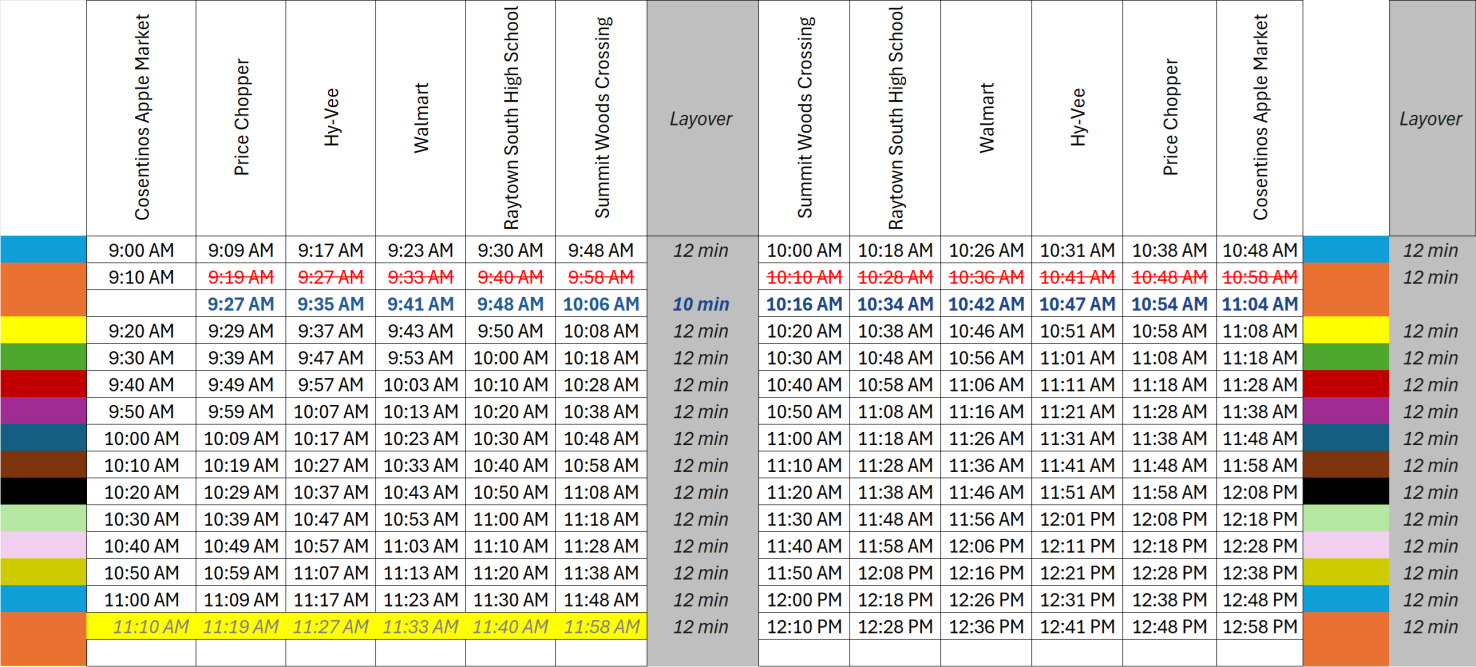
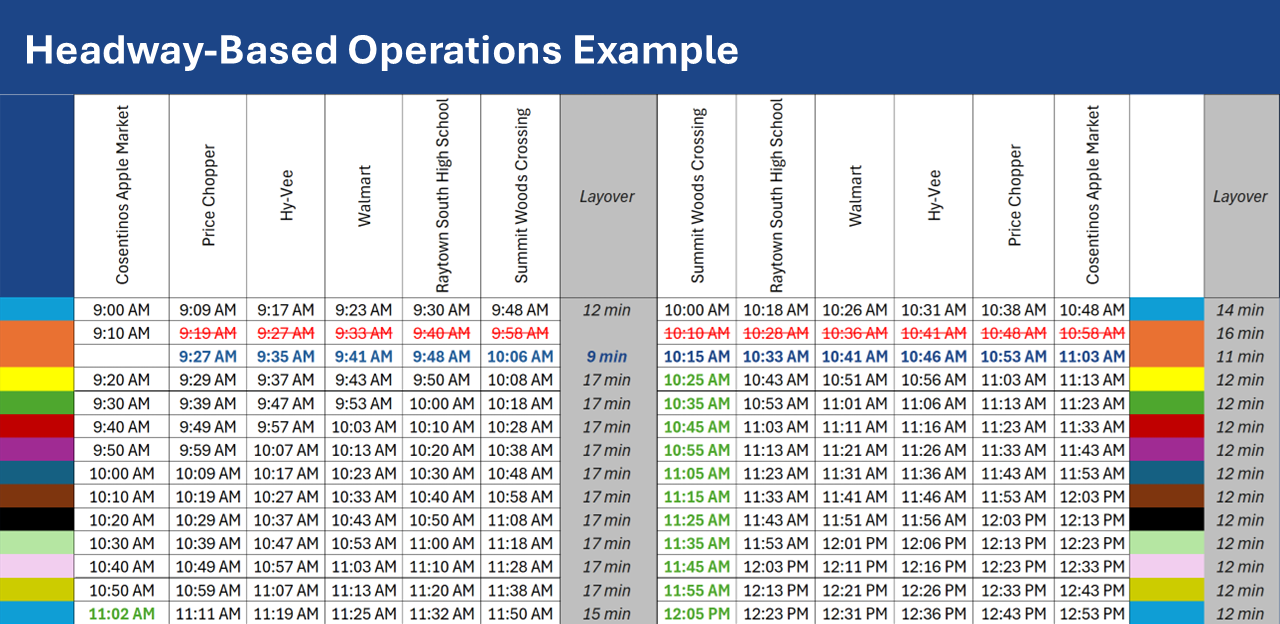
When buses come frequently, a bus doesn’t have to run all that late for the bus behind it to catch up. Take the sample, every-10-minute schedule for the 64 Raytown, below.

Somewhere between the start of the 9:10 (orange) trip and the first timepoint, the bus incurred an 8 minute delay. The bus is now 2 minutes ahead of the 9:20 (yellow) trip, and the 10:10 (orange) trip from Summit Woods is looking like it might depart late.
Under a schedule based approach, the bus driver is still aiming for that 10:10am departure, but that morning coffee is hitting and they need a minute. They get themselves prepared for the next run and get out of Summit Woods Crossing at 10:16am, only 6 minutes behind schedule. Assuming the bus doesn’t lose any more time, when the driver gets to Raytown South at 10:34 am, 16 minutes will have passed since the last bus came past the high school. The next bus will pass the high school in 4 minutes.
See the problem? If the passengers are unshackled from the schedule, then why should the transit operation be? If you’re picking up what I’m putting down, then it might be time to talk about headway-based operations.
↔️ Next stop: Headway based operations
Headway Based Operations (n) - Transit operations approach where vehicles are operated to maintain even spacing between vehicles, rather than strict adherence to specific timetable times. Timeliness is measured by the interval between buses.
Let’s look at the same 8 minute delay from before, but instead see how it might play out under headway-based operations.
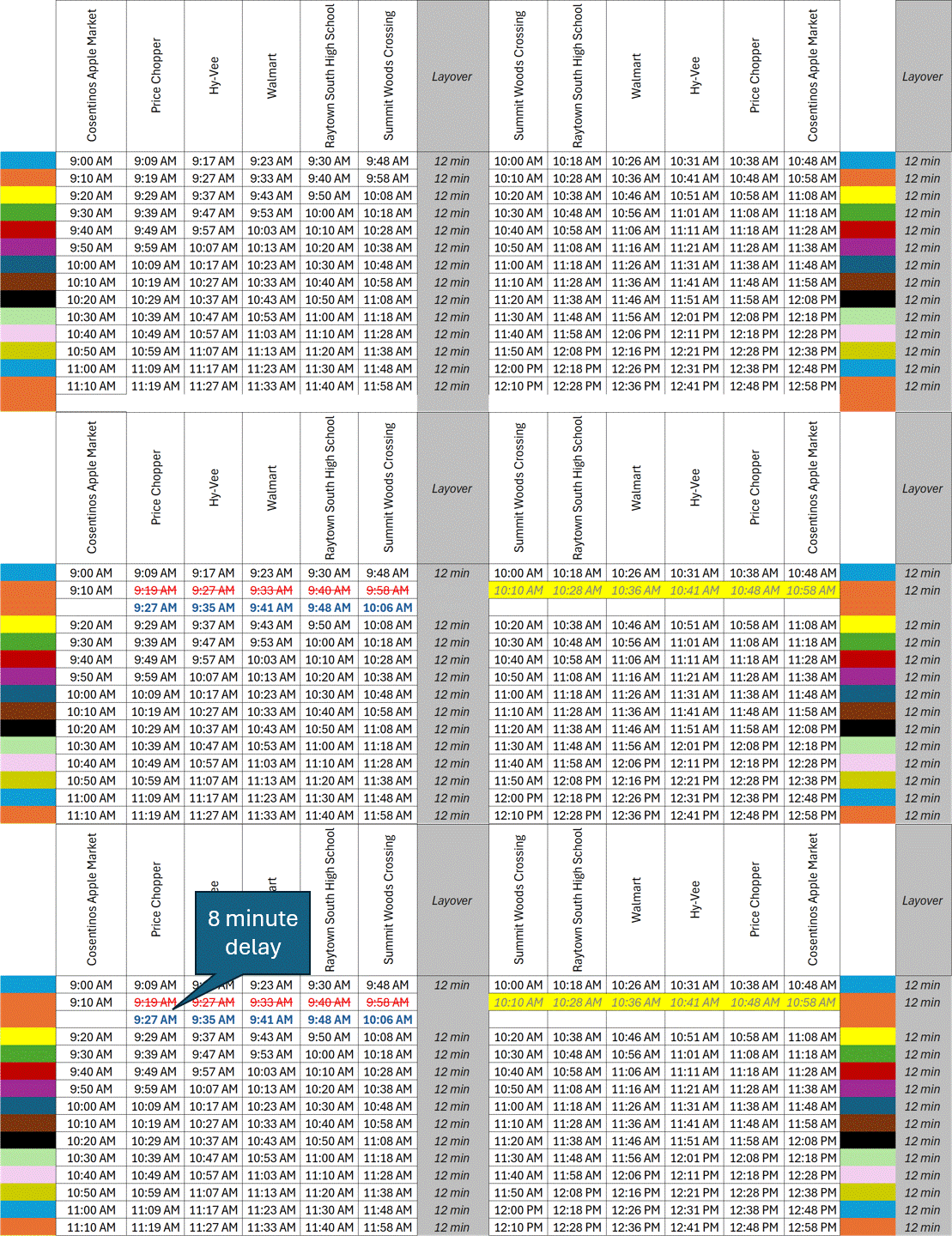
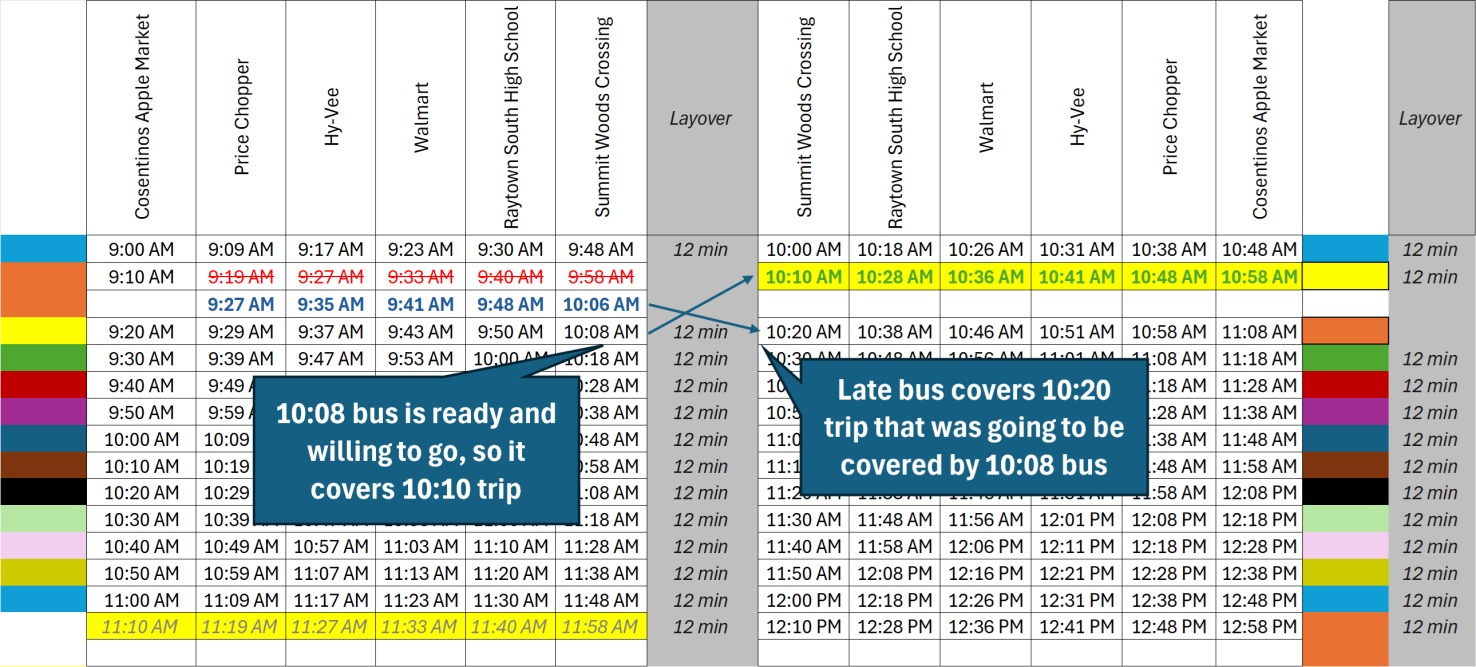
Under headway-based operations, the goal shifts from maintaining the schedule, to maintaining the headway. Let’s assume whatever system (human or technical) is monitoring the buses on Route 64 Raytown notices the problem. After checking that everything is ok with the driver and the bus, the system lets the driver know that their 10:10 trip is now a 10:15 trip, and adjusts the downstream headways accordingly.
The people waiting for the 10:10 bus see a 5 minute delay, but it’s business as usual for everybody else. They show up at the bus stop, and the bus shows up in a few minutes.
Alternatively, maybe the driver due to depart Summit Woods at 10:20 wants to keep moving and offers to cover the 10:10 trip. This gives the late driver a bit more time to reset from the stress of the delay, and preserves the headway. Even better! Since we know the route operates every 10 minutes, all day, these swapped around buses shouldn’t have a problem working back into the cadence of departures from Cosentinos down the line.
The beauty of headway-based operations is there are so many ways to do it. Maybe it’s a basic, driver information-based approach like the tablets that kept the Silver Loop buses spread out. Maybe there’s an automatic software checking the locations of the buses along a route and telling drivers when to depart from the ends of the line to maintain a consistent headway. Maybe there’s a supervisor at the end of the line manually keeping the buses spaced out. The options are limitless, but they all require the transit authority to take that first, scary step into uncertainty by abandoning things as we’ve always done them, to try something new.
💭 The purpose of a schedule?
The schedule offers a rigid model for the bus’s expected location throughout the day. As we’ve seen throughout this series, the act of building a schedule is a multi-step process that can be granular and time intensive. When the bus comes less frequently, this model is necessary for potential transit riders to know when specifically to expect a bus. However, as transit becomes more frequent, the specific when conveyed by the schedule becomes less relevant to the rider. If they showed up at the bus stop, and a bus turned up in 10 minutes or less, to them, the bus is on time. It doesn’t really matter if the schedule says the bus they caught was supposed to be at their stop 20 minutes ago. They went to the bus stop expecting a bus, and were met with a bus.
If we know this is how people interact with high frequency transit, and we know that high frequency transit can be difficult to manage via schedule-based operations, it begs the question: do we really need to dedicate the resources to the creation and maintenance of a schedule above a certain frequency?
We know from our scheduling math that it takes 10-12 vehicles to operate the 64 Raytown every 10 minutes. At a certain point, is it enough to set the span of service, do our transit math, manage the headways, and ditch the sometimes onerous exercise of building a schedule altogether? I certainly think this would allow for more nimble operations.
I’ll leave that question for you to ponder (and maybe for Transit Scheduling 102👀). Until then, remember:
"Policy is 10%, and implementation is 90%."
Michael Barber (How to Run A Government: So That Citizens Benefit and Taxpayers Don’t Go Crazy)

¹ Hub and spoke networks are built around these connections, making relatively low frequencies workable.


Fisticuffs: The argument AGAINST fare-free transit
If a terrible bus becomes free, will it truly free you?
Transit Scheduling 101: Building A Timetable ⌛
How to build a timetable without the need for specialized scheduling software in this installment of Transit Scheduling 101!
Transit Scheduling 101: Never Cheat the Layover!
Letting drivers take their bathroom break keeps buses running on time, prevents burnout, and might even save the world from tech-fueled social entropy. Why risk it?!

Planetizen Federal Action Tracker
A weekly monitor of how Trump’s orders and actions are impacting planners and planning in America.

The state-sanctioned urbicide of Austin
People don’t kill cities. Freeways do.

US to reduce Colorado River water deliveries to Mexico
A new Colorado Treaty amendment reduces Mexico’s Colorado River water allocation by 250,000 acre feet.

5 New England states march closer to 800 megawatt wind energy project
Securing federal approval for the project may be complicated under the Trump administration, which has historically been hostile towards domestic wind power.

Baltimore to break ground on $50 million Transit Priority Project
The project will bring faster bus trips, safer streets and better bike connections to Baltimore.

Airbnb launches $250 million 'last-dollar financing' housing accelerator, makes first investment in Austin
The company will put $6.4 million towards affordable housing development in Texas’ capital.

FREE Course: Walkable City 1: Why Walkability?
After describing his path towards focusing on walkability as the essence of good planning, Jeff Speck marches through his five principal reasons for making more walkable places.
Reinventing Malls: Planning Alchemy—Turning Gray Fields Into Gold
The course focuses on the opportunities and imperatives that shape reinvention of mall sites.

Eagle County Government
Harvard University Graduate School of Design
Nashville Planning Department
The Architects Foundation
University of Cincinnati Online
The Pocatello Development Authority
The Urban Renewal Agency of the City of Pocatello
Journal of the American Planning Association

