A popular measure of walkability only measures proximity, not safety or comfort.


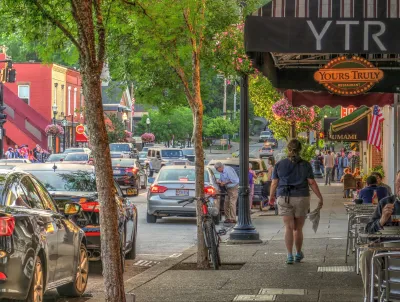
Early research from the Leeds School of Business reveals the limits of ‘walk scores,’ a metric often used by real estate websites to indicate the walkability of a neighborhood. The trouble with typical walk scores, explains Katy Marquardt Hill in an article for CU Boulder Today, is that they measure the proximity of stores, cafes, and parks — but not how comfortable or safe the walk there actually is.
To assess what makes people choose to walk or not walk to a destination, researchers studied anonymized travel data, tracking where people start and end their trips. “The way neighborhood amenities are arranged also influences whether people choose to walk, the researchers found. In already walkable neighborhoods, spreading shops and restaurants throughout several streets makes walking more enjoyable. In less walkable areas, clustering amenities along a single “main street” creates an attraction and encourages people to walk.”
According to Marquardt, “The findings have practical implications for urban planners, real estate developers and city officials.” They show that “targeted improvements like adding amenities along certain streets, improving pedestrian experience by adding trees or benches, or carefully locating parks, can make walking a more attractive option and potentially shift residents away from driving for short trips.” Seeing how people actually move through a city can help planners design places where people actually want to live. According to one lead researcher, “Designing a neighborhood should be human-centric. It’s not just about the map—it’s about the experience.”
Read the full story: Why walkable neighborhoods aren’t just about distance


The number of kids walking to school dropped from over 50% to 11% since the 1960s
Unsafe pedestrian infrastructure makes walking to school dangerous or impossible for a growing number of American students.

On the Tradeoffs Between Sunlight and Walkability
There are five kinds of streets in this world.

Austin Suburb Launches Walkability Study
Kyle, Texas is developing a Sidewalks Master Plan to improve walking facilities.

Planetizen Federal Action Tracker
A weekly monitor of how Trump’s orders and actions are impacting planners and planning in America.

California plans to bury El Niño’s downpour
If the state plays its cards right, it may be able to store a billion acre-feet of El Niño’s water in aquifers.

Chicago breaks ground on $3 billion megadevelopment
The new neighborhood, titled Foundry Park, will one day host 3,700 residences.

California High-Speed Rail Authority CEO resigns after $600,000 scandal
Under Ian Choudri, the authority used taxpayer dollars to fund first class flights and trips to nightclubs.

Want to study the Missouri River? Soon, you may need unanimous approval from 10 states
Legislation would require 10 governors’ permission to study or build projects moving water outside the basin.

Desperate measures: Advocates weigh draining Lake Powell to fill Colorado River
Draining the reservoir could reduce evaporation losses by a couple hundred thousand acre-feet.

FREE Course: Walkable City 1: Why Walkability?
After describing his path towards focusing on walkability as the essence of good planning, Jeff Speck marches through his five principal reasons for making more walkable places.
Reinventing Malls: Planning Alchemy—Turning Gray Fields Into Gold
The course focuses on the opportunities and imperatives that shape reinvention of mall sites.

City of Rosemead
Rutgers University, Edward J. Bloustein School of Planning and Public Policy
One Hundred Miles
Hunter College, City University of New York (CUNY)
The Architects Foundation
University of Cincinnati Online
City of Cambridge
Montrose County
The Pocatello Development Authority