New fare gates use sensors and higher panels to prevent people from passing without paying, but the tech had a “bumpy rollout” on its first day.


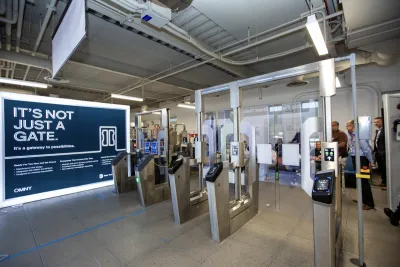
New York City’s Metropolitan Transportation Authority (MTA) has installed new fare gates at three subway stations in an effort to reduce fare evasion, reports Jaysha Patel for WABC.
The new gates use special sensors to detect people and objects and attempt to stop people who do not pay with clear closing panels. The gates are also designed to make it easier for people in wheelchairs or pushing strollers to pass through. “In the coming days, the gates will be rolled out to 20 stations, but eventually they will be at 150 stations.”
A New York Times article points out that the new gates had a “bumpy rollout” on their first morning, with at least one passenger able to push through without paying and one gate swinging closed onto a woman’s neck for several seconds. The city allocated over $1 billion to replacing old turnstiles with the new fare gates. The Citizens Budget Commission estimates the agency will save about $100 million in fare evasion losses in 2025.
FULL STORY: MTA unveils new turnstiles to crack down on subway fare evaders

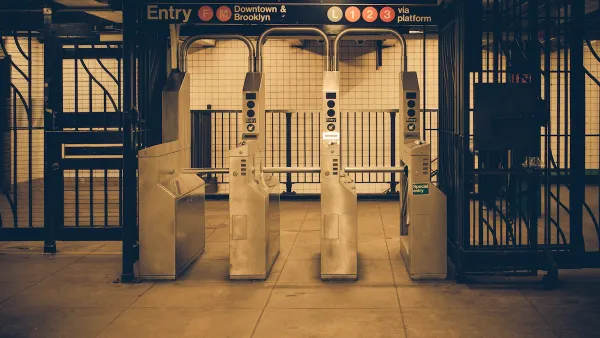
NYC Tests New Subway Gates to Limit Fare Evasion
The mayor has taken a strong interest in enforcing fare collection at the city’s transit stations.
Unlocking the full potential of NYC's Interborough Express
A few strategic investments could turn the IBX into an essential spine of the regional transportation network, not just another branch of New York's subway system.

MTA plans to outfit all buses with stroller storage by next year
All buses will have seats that flip up to allow for stroller storage or more standing room.

Planetizen Federal Action Tracker
A weekly monitor of how Trump’s orders and actions are impacting planners and planning in America.

The state-sanctioned urbicide of Austin
People don’t kill cities. Freeways do.

US to reduce Colorado River water deliveries to Mexico
A new Colorado Treaty amendment reduces Mexico’s Colorado River water allocation by 250,000 acre feet.

5 New England states march closer to 800 megawatt wind energy project
Securing federal approval for the project may be complicated under the Trump administration, which has historically been hostile towards domestic wind power.

Baltimore to break ground on $50 million Transit Priority Project
The project will bring faster bus trips, safer streets and better bike connections to Baltimore.

Airbnb launches $250 million 'last-dollar financing' housing accelerator, makes first investment in Austin
The company will put $6.4 million towards affordable housing development in Texas’ capital.

FREE Course: Walkable City 1: Why Walkability?
After describing his path towards focusing on walkability as the essence of good planning, Jeff Speck marches through his five principal reasons for making more walkable places.
Reinventing Malls: Planning Alchemy—Turning Gray Fields Into Gold
The course focuses on the opportunities and imperatives that shape reinvention of mall sites.

Eagle County Government
Harvard University Graduate School of Design
Nashville Planning Department
The Architects Foundation
University of Cincinnati Online
The Pocatello Development Authority
The Urban Renewal Agency of the City of Pocatello
Journal of the American Planning Association