Despite getting other details about the now-defunct program right, Google’s AI search summary continues to tell users they can receive a $7,500 federal tax credit for buying an EV.


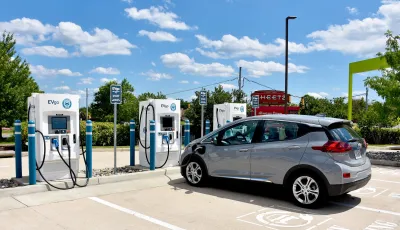
President Trump nixed the federal $7,500 EV tax credit, but Google’s AI search summary has yet to catch on to that fact, according to a Jalopnik piece by Andy Kalmowitz.
As Kalmowitz explains, the search bot can correctly identify the criteria for the now-defunct credit, but “seems pretty much unaware of the fact that the credit has now been dead and gone for well over a month.”
But this isn’t just an annoying glitch. The misinformation could lead people to make irreversible decisions about buying cars using incorrect information about tax credits. “Taking the strangeness up a notch, Google clearly knows what cars didn't qualify for the credit when it was killed off, so if you look up whether or not the Mustang Mach-E qualifies, it'll correctly identify that it doesn't. However, it says it doesn't because of a battery sourcing issue (which was true back in September). The search engine makes no mention of the credits being discontinued.”
Earlier this year, Jalopnik debunked another piece of misinformation in Google’s AI results, a widespread myth that Ford’s early use of uncleaned Spanish moss in its Model T cars led to bug infestations.
FULL STORY: Don't Listen To Google AI, The $7,500 EV Tax Credit Doesn't Exist Anymore


Bringing ‘Cute’ Tiny Cars to America Calls for Rethinking our Roadways
President Trump supports Japanese ‘kei’ cars, but experts say for them to catch on, we need to make major changes in our roadways and transportation infrastructure.
Analysis: Bigger cars are responsible for 10% of increase in pedestrian deaths
The New York Times offers a visual explanation of how larger vehicles make US roads more dangerous.
Study: Capping Vehicle Size Could Reduce Global Traffic Deaths by 40%
Limiting cars to 2020 sizes could save consumers up to 22% on gas, according to a new study.

Planetizen Federal Action Tracker
A weekly monitor of how Trump’s orders and actions are impacting planners and planning in America.

The state-sanctioned urbicide of Austin
People don’t kill cities. Freeways do.

US to reduce Colorado River water deliveries to Mexico
A new Colorado Treaty amendment reduces Mexico’s Colorado River water allocation by 250,000 acre feet.

5 New England states march closer to 800 megawatt wind energy project
Securing federal approval for the project may be complicated under the Trump administration, which has historically been hostile towards domestic wind power.

Baltimore to break ground on $50 million Transit Priority Project
The project will bring faster bus trips, safer streets and better bike connections to Baltimore.

Airbnb launches $250 million 'last-dollar financing' housing accelerator, makes first investment in Austin
The company will put $6.4 million towards affordable housing development in Texas’ capital.

FREE Course: Walkable City 1: Why Walkability?
After describing his path towards focusing on walkability as the essence of good planning, Jeff Speck marches through his five principal reasons for making more walkable places.
Reinventing Malls: Planning Alchemy—Turning Gray Fields Into Gold
The course focuses on the opportunities and imperatives that shape reinvention of mall sites.

Eagle County Government
Harvard University Graduate School of Design
Nashville Planning Department
The Architects Foundation
University of Cincinnati Online
The Pocatello Development Authority
The Urban Renewal Agency of the City of Pocatello
Journal of the American Planning Association