Many of the predictive models used by California’s transportation agency fail to account for post-pandemic travel patterns and induced demand.


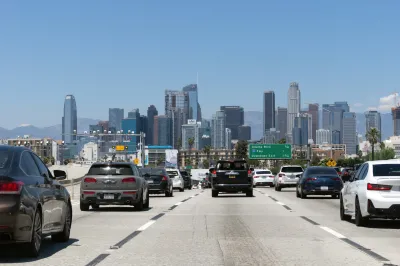
A review commissioned by Caltrans reveals that the California transportation agency’s travel demand models are often “outdated, poorly documented, and ill-suited to the purposes agencies sometimes use them for.”
As Leslie Vasquez-Guzman explains in an article for the State Smart Transportation Initiative, “Transportation agencies rely on models to forecast traffic and guide billions of dollars in infrastructure investment. Without updates, these tools risk locking in old assumptions about growth and travel behavior rather than helping agencies plan for a more sustainable and efficient future.”
The Caltrans analysis found that regional travel demand models had base years at least five years old that failed to reflect post-pandemic travel patterns. “Many were not able to account for key effects such as long-term induced travel—new driving that results from expanding road capacity.”
The report highlights the potential difference in outcomes between a forecast and real-world results once a project is built or not built. “To address these issues, Caltrans recommends several actions that could help guide modeling in other states. These include updating models with recent data, improving documentation and guidance for agencies, and testing for induced travel and land use changes. The report also calls for a model suitability checklist, better coordination among agencies, and updated standards for project-level modeling to improve consistency and transparency.”
FULL STORY: Caltrans review finds outdated and misunderstood models hinder project analysis

If You Build It, Cars Will Come: the Common-Sense Logic of 'Induced Demand'
Highway expansion has been shown, time and again, to increase traffic and congestion. Cities are finally getting the message.
Failing to Account for Induced Traffic, Even When the Public Demands It
Induced traffic occurs when new highway capacity speeds up traffic, allowing travelers to drive further, increasing sprawl. A review of major highway project plans finds that most fail to accurately account for induced travel effects.
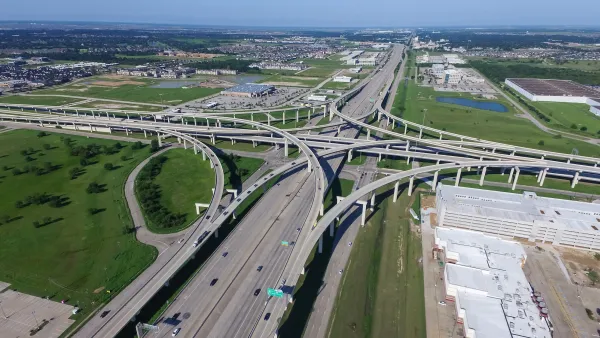
Induced demand is real: Commutes on Houston's 26-lane freeway take 51% longer after expansion
A massive freeway expansion only led to longer drive times, showing that building more lanes won't solve congestion.

Planetizen Federal Action Tracker
A weekly monitor of how Trump’s orders and actions are impacting planners and planning in America.

The state-sanctioned urbicide of Austin
People don’t kill cities. Freeways do.

US to reduce Colorado River water deliveries to Mexico
A new Colorado Treaty amendment reduces Mexico’s Colorado River water allocation by 250,000 acre feet.

Mamdani overhauls NYC's Vision Zero plan with 100 new policy goals
The overhaul aims to reduce traffic deaths and make streets safer for pedestrians, cyclists and drivers through lower speed limits, new safety infrastructure and more.

Amtrak not solely to blame for New Jersey commuter rail's unreliability, report finds
A new study from the Garden State Initiative found that NJ Transit’s budget grew 20% across a 4 year period, but reliability declined significantly over the same period.

EPA erases limits on planet-warming pollution from power plants
Under Monday’s plan, power plants would still have some limits on how much mercury, arsenic and other contaminants they can emit.

FREE Course: Walkable City 1: Why Walkability?
After describing his path towards focusing on walkability as the essence of good planning, Jeff Speck marches through his five principal reasons for making more walkable places.
Reinventing Malls: Planning Alchemy—Turning Gray Fields Into Gold
The course focuses on the opportunities and imperatives that shape reinvention of mall sites.

Eagle County Government
Harvard University Graduate School of Design
Nashville Planning Department
The Architects Foundation
University of Cincinnati Online
The Pocatello Development Authority
The Urban Renewal Agency of the City of Pocatello
Journal of the American Planning Association