Americans are driving less, and we have Gen Z to thank for it.


The latest Federal Highway Administration (FHWA) data reveals that driving trips are down in the United States, with the trend driven largely by younger people. “On a per capita basis, Americans are still driving less, down 2.3% since 2019,” writes Chris McCahill in the State Smart Transportation Initiative blog.
As McCahill points out, travel demand had flattened out even before the pandemic. “ow the data points to a new normal in which growth is slower, uneven, and increasingly shaped by changes in how people work, shop, and spend their free time.” Today, the average American drives 5 percent less than they did in 2004.“From 2017 to 2022, average daily trips among young adults fell nearly 50%, and their personal travel mileage dropped by 41%.”
According to the study, young people take fewer car trips that are longer on average, keeping their total VMT since 2017 roughly the same. “This pattern suggests people may be trading shorter, more frequent trips for fewer but longer ones—a shift consistent with Marchetti’s constant, the idea that the time people devote to travel each day tends to remain steady over time.”
For McCahill, this points to an opportunity for transportation planners to “rethink road design and investment priorities—planning for a future where traffic grows slowly, if at all.”
Read the full story: Driving trips are dropping, especially among young people
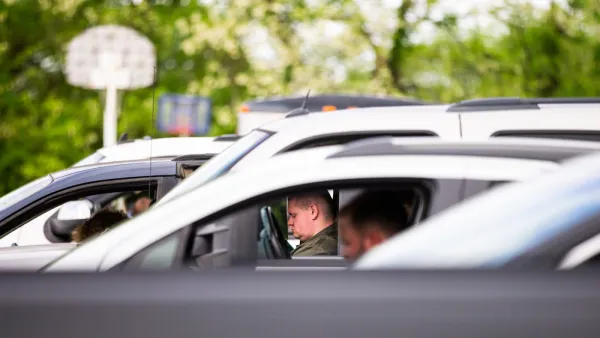
Study: Automobile Dependency Reduces Life Satisfaction
Automobile dependency has negative implications for wellbeing. This academic study finds that relying on a car for more than 50 percent of out-of-home travel is associated with significant reductions in life satisfaction.
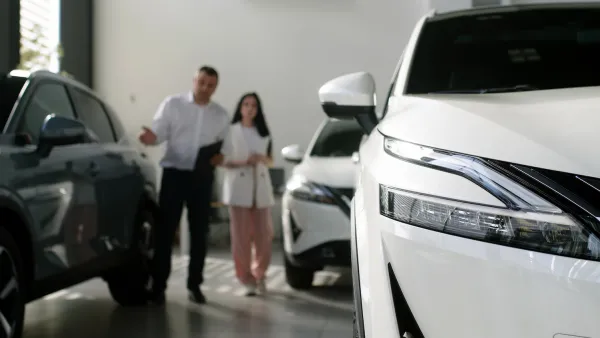
Trump’s Backlash to EVs Is Making All Cars More Expensive — Including Ones that use Gas
Uncertainty about vehicle standards and anti-renewable energy policies are raising the cost of both buying and maintaining a car.
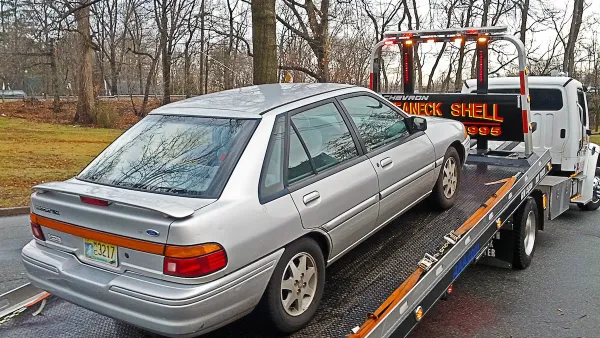
Car Loan Defaults Have Spiked 50%. With Repossession Rates Rising, How Will Americans Get to Work?
In 2024, 1.7 million cars were repossessed in the United States, the highest number since 2009.

Planetizen Federal Action Tracker
A weekly monitor of how Trump’s orders and actions are impacting planners and planning in America.

California plans to bury El Niño’s downpour
If the state plays its cards right, it may be able to store a billion acre-feet of El Niño’s water in aquifers.

Desperate measures: Advocates weigh draining Lake Powell to fill Colorado River
Draining the reservoir could reduce evaporation losses by a couple hundred thousand acre-feet.

US buildings threatened, destroyed by fires set to triple by 2060
Researchers found a high fire risk for socioeconomically vulnerable neighborhoods in the American West.

LA residents may be allowed to paint their own crosswalks
Councilwoman Katy Yaroslavsky put out a motion instructing the Los Angeles Department of Public Transportation to study the feasibility of allowing volunteers to paint crosswalks.

Dallas moves to overhaul its zoning code
The city's zoning reform will allow more multi-family and mixed-use developments.

FREE Course: Walkable City 1: Why Walkability?
After describing his path towards focusing on walkability as the essence of good planning, Jeff Speck marches through his five principal reasons for making more walkable places.
Reinventing Malls: Planning Alchemy—Turning Gray Fields Into Gold
The course focuses on the opportunities and imperatives that shape reinvention of mall sites.


City of Rosemead
Rutgers University, Edward J. Bloustein School of Planning and Public Policy
One Hundred Miles
Hunter College, City University of New York (CUNY)
The Architects Foundation
University of Cincinnati Online
City of Cambridge
Montrose County
The Pocatello Development Authority