The Austrian capital offers grants of up to 5,000 Euros to residents who want to build their own parklets in curbside parking spaces.



Vienna, Austria is encouraging residents to build their own parklets, even funding the projects with up to €5,000 through its Local Agenda 21 initiative.
According to an article in The Guardian by Will Grimond, over 100 new parklets have popped up in the city since 2015. The process involves applying with the city for permission to build the parklets, known locally as Grätzloasen.
As Grimond points out, “Vienna consistently scores highly on environmental and livability rankings – even if its quality-of-life crown was nicked by Copenhagen in June. But these accolades obscure the fact that some districts are distinctly lacking in greenery, particularly in the centre-west of the city.” The parklet program is one way to help residents make their neighborhoods greener and more inviting. “Sabrina Halkic, the managing director of Local Agenda 21, describes them as an example of ‘tactical urbanism’ – low-cost, often citizen-led improvements to the built environment. She sees the grätzloasen as a gateway to further changes.”
FULL STORY: ‘Why would you take away a parking place?’: the city where anyone can build an urban oasis

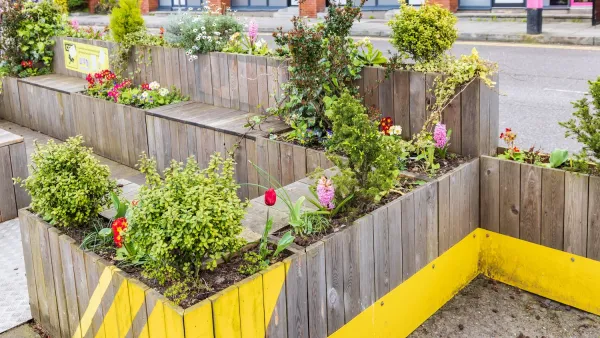
Parklet Symposium Highlights the Success of Shared Spaces
Parklets got a boost during the Covid-19 pandemic, when the concept was translated to outdoor dining programs that offered restaurants a lifeline during the shutdown.
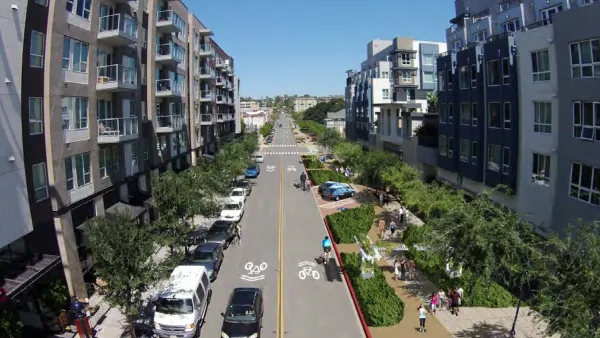
San Diego Swaps Parking Lane for Kid-Friendly Mini Park
The block-long greenway will feature interactive play equipment and landscaping.
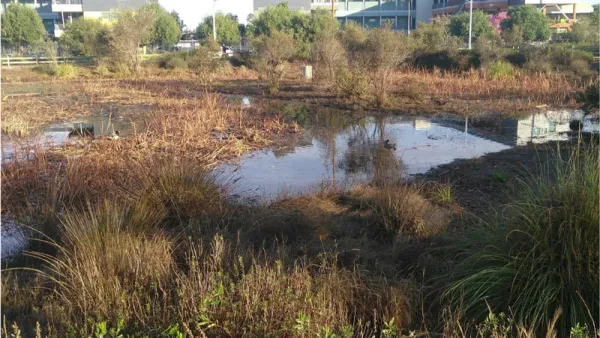
How South LA Green Spaces Power Community Health and Hope
Green spaces like South L.A. Wetlands Park are helping South Los Angeles residents promote healthy lifestyles, build community, and advocate for improvements that reflect local needs in historically underserved neighborhoods.

The state-sanctioned urbicide of Austin
People don’t kill cities. Freeways do.

US to reduce Colorado River water deliveries to Mexico
A new Colorado Treaty amendment reduces Mexico’s Colorado River water allocation by 250,000 acre feet.

New Jersey’s second-largest city bans standalone data centers
Jersey City will continue to allow co-location facilities, such as those meant for research institutions that store their own data.

Amtrak not solely to blame for New Jersey commuter rail's unreliability, report finds
A new study from the Garden State Initiative found that NJ Transit’s budget grew 20% across a 4 year period, but reliability declined significantly over the same period.

EPA erases limits on planet-warming pollution from power plants
Under Monday’s plan, power plants would still have some limits on how much mercury, arsenic and other contaminants they can emit.

Phoenix announces new on-demand transit service, more frequent RAPID buses
Both new services will launch in October, and are part of Phoenix's Project Effective Access Solutions for Easing Congestion.

FREE Course: Walkable City 1: Why Walkability?
After describing his path towards focusing on walkability as the essence of good planning, Jeff Speck marches through his five principal reasons for making more walkable places.
Reinventing Malls: Planning Alchemy—Turning Gray Fields Into Gold
The course focuses on the opportunities and imperatives that shape reinvention of mall sites.

Eagle County Government
Harvard University Graduate School of Design
Nashville Planning Department
The Architects Foundation
University of Cincinnati Online
The Pocatello Development Authority
The Urban Renewal Agency of the City of Pocatello
Journal of the American Planning Association