The city planned to remove a series of concrete planters that prevent cars from entering bike lanes despite their popularity with pedestrians and safety advocates.


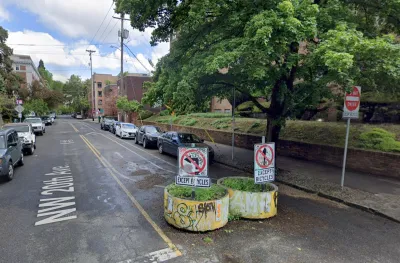
Portland safety advocates have been fighting the Portland Public Environmental Management Office’s effort to remove concrete traffic diverters that many say are making the city’s roads safer.
According to a blog post from Strong Towns, the diverters, heavy concrete planters, are installed on one-way streets to block off one lane from car traffic while still allowing pedestrians and people on bikes to pass through.
“According to city staff, the removal is a matter of public safety. They argue that the diverters make it more difficult for law enforcement to patrol the neighborhood, leading to an increase in drug activity and crime.” Community activists pushed back, saying the traffic safety benefits outweigh other risks and that the concrete planters save lives by physically keeping cars out of bike lanes. “The diverters in Northwest Portland aren’t permanently safe yet. But thanks to residents who organized quickly and spoke up, they’re still standing — and the conversation has shifted to prioritizing safety for all users.”
FULL STORY: Portland Advocates Defend Life-Saving Street Design — and Win a Pause

Portland Traffic Deaths Surpass 2022 Number
This year, 69 people have died in traffic crashes in Portland, Oregon, nearly twice as many as in 2018, when the city began its Vision Zero program.
Audit: Portland’s Vision Zero Needs More Data, Funding
A city audit found that the program has failed to reduce traffic deaths and could benefit from a more systematic approach. Meanwhile, PBOT says it needs more state funding to support road safety projects.
Portland Traffic Deaths Increased Despite Vision Zero Efforts
Traffic deaths in Portland, Oregon almost doubled between 2018 and 2023.

Planetizen Federal Action Tracker
A weekly monitor of how Trump’s orders and actions are impacting planners and planning in America.

The state-sanctioned urbicide of Austin
People don’t kill cities. Freeways do.

US to reduce Colorado River water deliveries to Mexico
A new Colorado Treaty amendment reduces Mexico’s Colorado River water allocation by 250,000 acre feet.

5 New England states march closer to 800 megawatt wind energy project
Securing federal approval for the project may be complicated under the Trump administration, which has historically been hostile towards domestic wind power.

Baltimore to break ground on $50 million Transit Priority Project
The project will bring faster bus trips, safer streets and better bike connections to Baltimore.

Airbnb launches $250 million 'last-dollar financing' housing accelerator, makes first investment in Austin
The company will put $6.4 million towards affordable housing development in Texas’ capital.

FREE Course: Walkable City 1: Why Walkability?
After describing his path towards focusing on walkability as the essence of good planning, Jeff Speck marches through his five principal reasons for making more walkable places.
Reinventing Malls: Planning Alchemy—Turning Gray Fields Into Gold
The course focuses on the opportunities and imperatives that shape reinvention of mall sites.

Eagle County Government
Harvard University Graduate School of Design
Nashville Planning Department
The Architects Foundation
University of Cincinnati Online
The Pocatello Development Authority
The Urban Renewal Agency of the City of Pocatello
Journal of the American Planning Association