Building upon the framework of a local housing panel, Chuck Wolfe suggests that advocacy and policy discussions would be enhanced by a “sherpa mindset” that focuses on lived experiences, facilitates applied knowledge of urban places, and promotes stakeholder discussion.


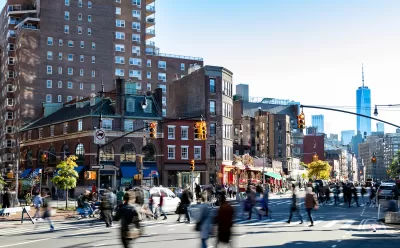
Today, notes Wolfe, city-related dialogues are more focused on day-to-day realities than grand visions of the City Beautiful.
Beyond architecture and urban design critiques, cities and towns face the affordability crisis, the complex push for zoning revisions, and ever-evolving dialogues around public safety. Even the reimagining of downtowns in a post-COVID era now directly confronts these pressing concerns.
For example, last week in Santa Fe, Chainbreaker—a local social justice group—convened a panel on housing and the unhoused. Community members gathered to share their experiences and concerns about housing and homelessness in Santa Fe. A panel discussion (among a journalist, activist, a former unhoused person, and a leading housing organization representative) ranged from the urgent need for increased housing supply to concerns about rising rents and displacement, the prospect of stricter controls on short-term rentals, and the role of pending revisions to the comprehensive plan and land use code.
Noting a rich discussion that lacked the presence of all key stakeholders, Wolfe underscores the challenge around many divisive urban issues: how to bridge divides in a way that might foster true collaboration?
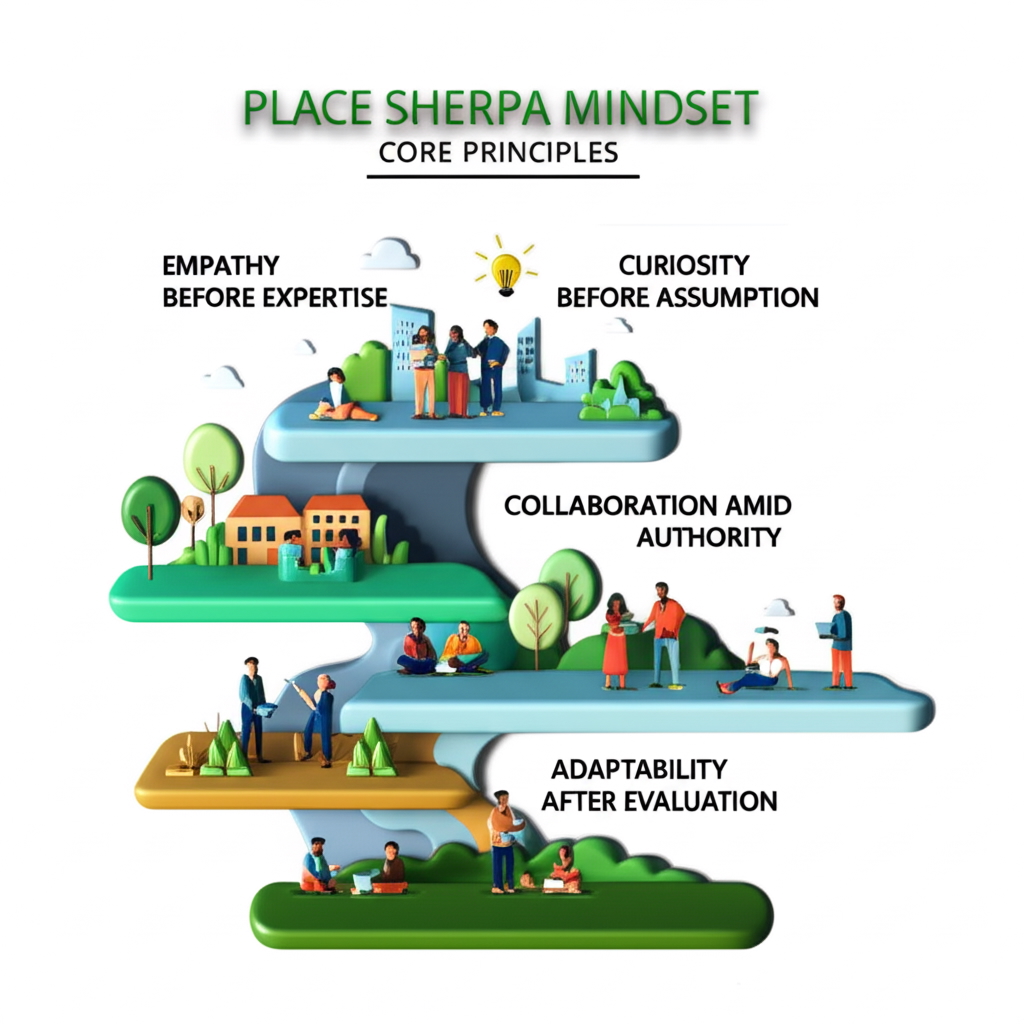
He provides a new name for a fine-tuned approach that centers on proper issue identification, contextual knowledge of a place, and an assurance that the appropriate stakeholders can move forward: the way of the“Place Sherpa,” a specialized urbanist and guide who empowers individuals, organizations, and communities to gain a deep understanding, observe, and collaboratively shape their built environments.
Unlike traditional experts who might primarily diagnose problems and prescribe top-down solutions, a Place Sherpa walks alongside stakeholders, suggests Wolfe:
They provide a toolkit to demystify urban complexities, foster acute observation, and facilitate locally-informed, more innate placemaking. They bridge the gap between expert knowledge and lived experience, ensuring that urban evolution is empathetic, sustainable, and truly beloved by its inhabitants.
If such a Sherpa doesn’t immediately demand a podium or command a climb, and their nature is to walk alongside, patiently ask questions, and share knowledge gleaned from other journeys and examples, one key question is whether planners could add the way of the Sherpa to their professional roles.
Read the full story: The Rise of the Place Sherpa: A Personal Reflection on Co-Creation

Placemaking in the Barrio: Conceptualizing Infill Development in Disenfranchised Communities
How one San Antonio neighborhood could approach sustainable revitalization while supporting the existing community and drawing on its rich and diverse history and cultural resources.
To Create a Great 'Third Place', Get Out of the Way
For far too long, the shaping of public spaces has been left to architects and urban planners, who plan from the top down. The most successful projects involve people directly in deciding how their public spaces will look, feel, and operate.
The Restaurant Industry’s ‘Missing Middle’
Locally owned restaurants affordable to middle-income families are disappearing or being forced to raise prices as costs grow.

Planetizen Federal Action Tracker
A weekly monitor of how Trump’s orders and actions are impacting planners and planning in America.

California plans to bury El Niño’s downpour
If the state plays its cards right, it may be able to store a billion acre-feet of El Niño’s water in aquifers.

Desperate measures: Advocates weigh draining Lake Powell to fill Colorado River
Draining the reservoir could reduce evaporation losses by a couple hundred thousand acre-feet.

Mamdani’s pied-à-terre tax survives legal challenge
A panel of judges found that the plaintiffs failed to demonstrate injury as a result of New York City's implementation of the tax.

Eastern Nebraska is running out of electricity
Data centers and electrification are straining eastern Nebraska’s grid, throttling economic development.

Seattle passes record-breaking transit services expansion
Proposition 1 will double the city’s transit tax to add 95,000 more bus trips and preserve 180,000 bus trips annually.

FREE Course: Walkable City 1: Why Walkability?
After describing his path towards focusing on walkability as the essence of good planning, Jeff Speck marches through his five principal reasons for making more walkable places.
Reinventing Malls: Planning Alchemy—Turning Gray Fields Into Gold
The course focuses on the opportunities and imperatives that shape reinvention of mall sites.

City of Rosemead
Rutgers University, Edward J. Bloustein School of Planning and Public Policy
One Hundred Miles
University of Michigan School for Environment and Sustainability (SEAS)
Hunter College, City University of New York (CUNY)
The Architects Foundation
City of Cambridge
Montrose County
The Pocatello Development Authority