Funds for Safe Streets and other transportation safety and equity programs are being held up by administrative reviews and conflicts with the Trump administration’s priorities.


Despite a stated commitment to streamlining and efficiency in the Department of Transportation and beyond, “it appears that politicized review requirements may be slowing down grant obligations to awarded projects, especially for those related to safety,” writes Corrigan Salerno in a post on Transportation for America.
As Salerno explains, “Transportation projects must clear multiple stages of political and environmental reviews to reach the construction phase, and it becomes especially complicated when they receive federal assistance in the form of a competitive grant. Under a competitive grant award, the awardee and the federal government need to work together to define their work with USDOT before coming to a grant agreement and having their awarded funding obligated to them.”
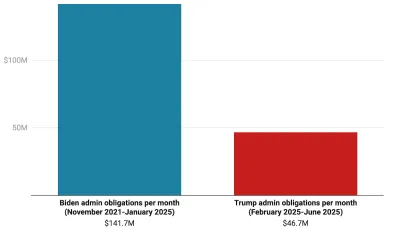
Now, some projects that were previously awarded grants are having their funding clawed back, and reviews are leading to a distribution rate 1/10 that of the Biden administration. Although Secretary Duffy has touted a quick grant “approval” process, that approval does not equal “awarded and obligated” funding.
Transportation for America analyzed funding obligations under several federal grant programs: the Safe Streets and Roads for All grants, RAISE/BUILD program, SMART grants, the Reconnecting Communities Pilot, and the Neighborhood Access and Equity program. While the Biden administration obligated $141.7 million per month, the Trump administration is obligating $46.6 million per month. “The Trump administration is obligating funds for the competitive grant programs below at 33 percent the speed of the Biden administration.”


USDOT Blocks Federal Funding for Traffic Cameras
Applicants to the Safe Streets and Roads for All grant program will not be allowed to use funds for automated traffic enforcement.

DOT withholds $73M from New York over immigrant trucking licenses
The Trump administration is requiring states to revoke the CDLs of non-domiciled drivers without proof of citizenship or risk losing federal funds.
Almost Half of US Roads are Locally Owned, but Receive Just 16% of Federal Funds. Local Leaders Want That to Change.
A coalition of state and local officials is calling on Congress to change how federal transportation funds are allocated to give local governments more control.

Planetizen Federal Action Tracker
A weekly monitor of how Trump’s orders and actions are impacting planners and planning in America.

The state-sanctioned urbicide of Austin
People don’t kill cities. Freeways do.

US to reduce Colorado River water deliveries to Mexico
A new Colorado Treaty amendment reduces Mexico’s Colorado River water allocation by 250,000 acre feet.

5 New England states march closer to 800 megawatt wind energy project
Securing federal approval for the project may be complicated under the Trump administration, which has historically been hostile towards domestic wind power.

Baltimore to break ground on $50 million Transit Priority Project
The project will bring faster bus trips, safer streets and better bike connections to Baltimore.

Airbnb launches $250 million 'last-dollar financing' housing accelerator, makes first investment in Austin
The company will put $6.4 million towards affordable housing development in Texas’ capital.

FREE Course: Walkable City 1: Why Walkability?
After describing his path towards focusing on walkability as the essence of good planning, Jeff Speck marches through his five principal reasons for making more walkable places.
Reinventing Malls: Planning Alchemy—Turning Gray Fields Into Gold
The course focuses on the opportunities and imperatives that shape reinvention of mall sites.

Eagle County Government
Harvard University Graduate School of Design
Nashville Planning Department
The Architects Foundation
University of Cincinnati Online
The Pocatello Development Authority
The Urban Renewal Agency of the City of Pocatello
Journal of the American Planning Association