A veteran political journalist takes stock of the hard-earned ground Georgia stands to lose with slashed environmental protection.


This story is republished from Georgia Recorder. Written by Jay Bookman.
Our lives rely on systems. Flush the toilet, the sewage system takes it away. Flip an electrical switch, the lights turn on. Hit the brake pedal, the system brings the car safely to a halt.
We take those systems for granted, assuming that they’ll operate unseen and in the background, because that’s how we design them and why we build them. We build them so we know they’ll be there when we need them.
But these days, critically important systems are being stressed in ways that they weren’t designed to withstand. In some cases, systems are being dismantled by people who don’t understand what purpose they were created to serve in the first place. Imagine amateur house-flippers, swinging sledgehammers and knocking down interior walls without regard to whether those walls might be load-bearing, then marveling when the roof starts to cave in.
All across the federal government, that’s what we’re now witnessing.
Local Social Security and Small Business Administration offices are being shuttered under the rationale that they are infested with fraud, waste and corruption, and thousands of IRS employees are being fired. The National Weather Service is being slashed, as is funding for cancer research and other forms of science.
The CDC and our public health system, our legal system, our emergency-management system, our political system and economic system, as well as our 80-year-old system of diplomatic and military alliances, all are being stripped of resources, manpower and credibility without much concern for what the consequence might be.
One of President Trump’s biggest targets is the Environmental Protection Agency. At a Cabinet meeting last week, Trump announced that 65% of EPA personnel would likely be fired because they just aren’t needed, although that number was later walked back for the time being. In announcing a major rollback of air, water and climate enforcement programs, EPA Administrator Lee Zeldin last week proclaimed it “the most momentous day in the history of the EPA.”
“Momentous” is probably accurate, but not for the reasons that Zeldin imagines. Let’s take a step back and ponder what we might be doing to ourselves.
Most people don’t remember that as recently as 25 to 30 years ago, the Atlanta metro region had a serious air-pollution and water-pollution problem. On hot summer days, ground-level ozone levels were so bad that going outdoors would make your eyes sting and your throat and lungs hurt. Schools were told to cancel outdoor recess, and parents were warned not to let their kids go outside and play; outdoor workers were warned about possible lung damage. The ozone alerts went on for weeks at a time.
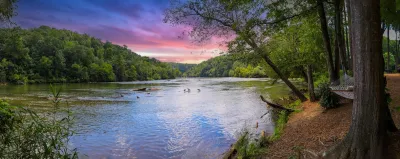
And when a big summer thunderstorm came through and cleared the air, it caused problems of a different sort. Heavy rainfall would swamp the city’s ancient sewer system, sending hundreds of thousands of gallons of raw, untreated sewage into the Chattahoochee River, where our downstream neighbors were understandably displeased.
Under the Clean Air and Clean Water acts, the EPA demanded that those problems be corrected, that systems be created to fix them. State and local officials, egged on by the region’s business community, complained bitterly at the time that what EPA was demanding was impossible. It would be too expensive, they said, and it wouldn’t work anyway because smog was “natural” in this region. Atlanta’s growth, they warned, would have to be stopped dead in its tracks if the federal government got its way.
Since then, though, metro Atlanta has doubled in population. Coal-burning power plants were cleaned up or closed down. Gasoline was reformulated and vehicle inspection programs implemented. Major highway programs such as the Outer Perimeter were canceled, and development alternatives to sprawl were embraced. As a result, bad ozone days, which often numbered over a hundred a year in the ‘90s, are now down to one or two days annually, and Atlanta’s sewage systems are much improved. What some had deemed impossible was instead achieved.
But here’s the thing: For the most part, we don’t have a cultural or institutional memory of those days, even though they were barely a generation ago. The air is clear and breathable, our sewage systems work and we just take it all for granted, as if this is the natural state of things, as if this is how it has always been and always will be.
And it’s just not true. If we don’t take care of our systems, they can’t take care of us.
And of course, it’s not just environmental protection. Through vaccines, better sanitation and the hard work and dedication of the CDC and other agencies, we’ve been so successful at eliminating deadly diseases that we no longer remember how many lives they used to take. We’ve forgotten why we needed vaccines in the first place.
In the world of foreign policy, we haven’t faced a major war for 80 years, so why do we need the NATO alliance. On health care, through Medicare, Medicaid and the Affordable Care Act, more Americans have access to health care than ever before.
But none of this is permanent. We can’t starve those systems and still expect they’ll be there when we need them. It’s as if we’re playing a giant game of Jenga with our country, pulling out a piece here, then a piece there, wondering which piece will be the one that makes the structure fall.
FULL STORY: Bookman: Flushing federal systems down toilet could return Georgia to days of foul water and air

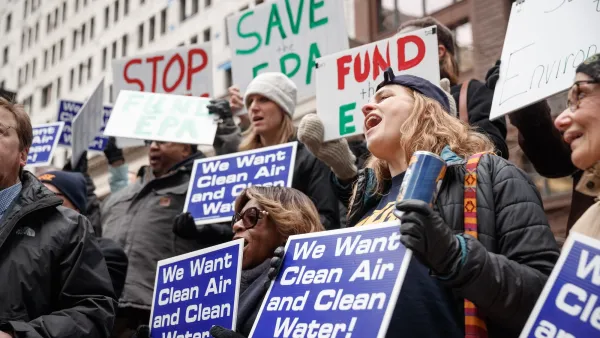
EPA Guts Emissions Regulations
The agency is eliminating the endangerment finding that underpins the agency’s authority to regulate greenhouse gas emissions.
Arizona Environmental Agency Cutbacks Significant, Says Report
A new report says funding and staffing cuts at the state’s environmental protection agency could prevent it from adequately protecting public health and the environment.
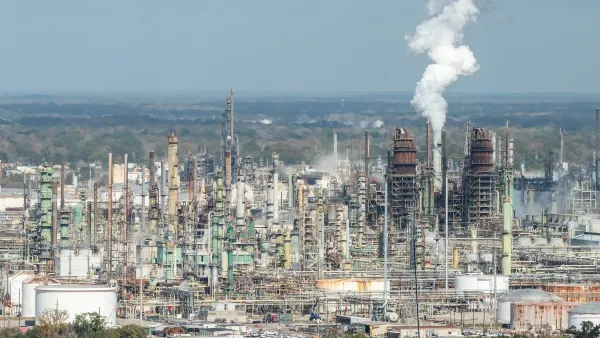
EPA to Stop Considering the Cost of Lives Saved in Setting Pollution Limits
The agency will no longer quantify the monetary gains from health benefits from curbing air pollution.

Planetizen Federal Action Tracker
A weekly monitor of how Trump’s orders and actions are impacting planners and planning in America.

The state-sanctioned urbicide of Austin
People don’t kill cities. Freeways do.

US to reduce Colorado River water deliveries to Mexico
A new Colorado Treaty amendment reduces Mexico’s Colorado River water allocation by 250,000 acre feet.

Mamdani overhauls NYC's Vision Zero plan with 100 new policy goals
The overhaul aims to reduce traffic deaths and make streets safer for pedestrians, cyclists and drivers through lower speed limits, new safety infrastructure and more.

Amtrak not solely to blame for New Jersey commuter rail's unreliability, report finds
A new study from the Garden State Initiative found that NJ Transit’s budget grew 20% across a 4 year period, but reliability declined significantly over the same period.

EPA erases limits on planet-warming pollution from power plants
Under Monday’s plan, power plants would still have some limits on how much mercury, arsenic and other contaminants they can emit.

FREE Course: Walkable City 1: Why Walkability?
After describing his path towards focusing on walkability as the essence of good planning, Jeff Speck marches through his five principal reasons for making more walkable places.
Reinventing Malls: Planning Alchemy—Turning Gray Fields Into Gold
The course focuses on the opportunities and imperatives that shape reinvention of mall sites.

Eagle County Government
Harvard University Graduate School of Design
Nashville Planning Department
The Architects Foundation
University of Cincinnati Online
The Pocatello Development Authority
The Urban Renewal Agency of the City of Pocatello
Journal of the American Planning Association