A new report says funding and staffing cuts at the state’s environmental protection agency could prevent it from adequately protecting public health and the environment.



"Staffing and budget cuts over the last decade have left state environmental protection agencies woefully under-powered, to the detriment of the air we breathe and the water we drink, a new report says. The Arizona Department of Environmental Quality is among the hardest hit," writes Elizabeth Whitman.
The report from the Environmental Integrity Project says funding for pollution control programs dropped by 29 percent and staffing by 32 percent at the Arizona agency. "These figures put Arizona in the top 10 of 48 states whose environmental regulation departments lost the highest proportion of employees (number three in the country) and funding (number seven) between 2008 and 2018," notes Whitman.
State officials say the organizational cutbacks are not affecting the agency’s ability to carry out its work, and they point to organizational efficiencies that have resulted in higher compliance rates and lower permit application times.
"But the report — and [Eric] Schaeffer, the EIP director — rebuffed the notion that increased efficiency compensates for budget and staffing cuts. They disagreed with the idea that faster permitting meant better, safer permitting," says Whitman.
FULL STORY: Report: Underresourced ADEQ Puts Arizona Environment, Public Health at Risk

Comment: EPA Cuts will Send Atlanta Back to Eye-burning Ozone, Lung-damaging Smog, and Raw Sewage in the Chattahoochee River
A veteran political journalist takes stock of the hard-earned ground Georgia stands to lose with slashed environmental protection.
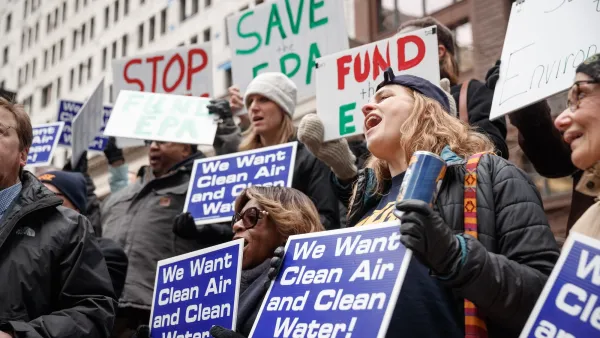
EPA Guts Emissions Regulations
The agency is eliminating the endangerment finding that underpins the agency’s authority to regulate greenhouse gas emissions.

EPA to Stop Considering the Cost of Lives Saved in Setting Pollution Limits
The agency will no longer quantify the monetary gains from health benefits from curbing air pollution.

Planetizen Federal Action Tracker
A weekly monitor of how Trump’s orders and actions are impacting planners and planning in America.

The state-sanctioned urbicide of Austin
People don’t kill cities. Freeways do.

US to reduce Colorado River water deliveries to Mexico
A new Colorado Treaty amendment reduces Mexico’s Colorado River water allocation by 250,000 acre feet.

5 New England states march closer to 800 megawatt wind energy project
Securing federal approval for the project may be complicated under the Trump administration, which has historically been hostile towards domestic wind power.

Baltimore to break ground on $50 million Transit Priority Project
The project will bring faster bus trips, safer streets and better bike connections to Baltimore.

Airbnb launches $250 million 'last-dollar financing' housing accelerator, makes first investment in Austin
The company will put $6.4 million towards affordable housing development in Texas’ capital.

FREE Course: Walkable City 1: Why Walkability?
After describing his path towards focusing on walkability as the essence of good planning, Jeff Speck marches through his five principal reasons for making more walkable places.
Reinventing Malls: Planning Alchemy—Turning Gray Fields Into Gold
The course focuses on the opportunities and imperatives that shape reinvention of mall sites.

Eagle County Government
Harvard University Graduate School of Design
Nashville Planning Department
The Architects Foundation
University of Cincinnati Online
The Pocatello Development Authority
The Urban Renewal Agency of the City of Pocatello
Journal of the American Planning Association