With guidance from the Trust for Public Land, third graders at Overbrook Elementary are leading the redesign of their asphalt schoolyard into a vibrant green space, learning valuable skills and creating lasting community impact in the process.


At Overbrook Elementary School in West Philadelphia, third graders are taking the lead in transforming their asphalt-covered schoolyard into a vibrant green space with support from the Trust for Public Land (TPL). As part of TPL’s participatory design program, students work in teams, study maps of the schoolyard, and brainstorm ideas — ranging from basketball courts to shaded seating areas. As reported by Celia Bernhardt, the initiative is part of a larger effort by TPL to address the lack of green space in low-income neighborhoods, revamping schoolyards into climate-resilient community spaces that serve both students and the wider public.
Through weekly design sessions, students at Overbrook and other participating schools learn about design, collect community input, and contribute to the development of new outdoor spaces. Once plans are finalized, TPL helps fund, design, and construct the projects, which often include features like trees, play equipment, gardens, and even outdoor performance stages. These green schoolyards are seen as critical for public health, promoting physical activity, improving behavior, reducing suspensions, and enhancing academic performance. At Overbrook, where students lack access to amenities like a gym or auditorium, the redesigned yard will provide a safer and more engaging space to learn and play.
The process not only gives students a physical space to enjoy but also instills confidence, communication skills, and a sense of ownership. Educators and experts agree that involving children in decisions fosters agency and self-advocacy, with potential to positively influence other aspects of their education. As they navigate real-world challenges like budgets and community needs, students gain valuable life lessons. For the young designers at Overbrook, the chance to create something lasting for their school and neighborhood is both empowering and transformative—showing that their voices truly matter.
FULL STORY: Overbrook Elementary third graders are working to turn their asphalt schoolyard into a community green space


New York Law Addresses Extreme Heat in Schools
The law calls for heat mitigation measures when temperatures exceed 88 degrees.
Parks Departments Try to Build New Green Spaces on Shrinking Budgets
Even as the role of parks and urban green space in public and ecological health becomes more apparent, city budgets are hard-pressed to meet the costs of park construction and maintenance.
Expanding Schoolyard Greening in California
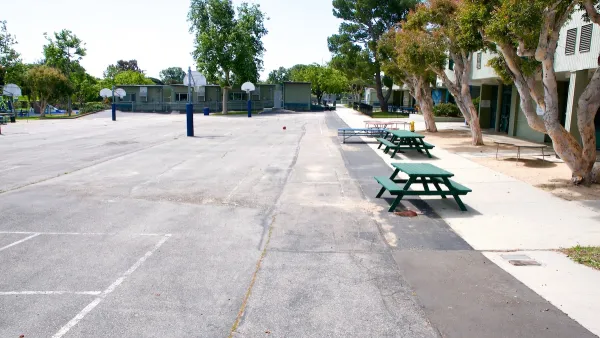
To protect kids from extreme heat, California just distributed another $73 million to local school districts to transform schoolyards by converting blacktops to green spaces, planting trees, and other related efforts.

Planetizen Federal Action Tracker
A weekly monitor of how Trump’s orders and actions are impacting planners and planning in America.

The state-sanctioned urbicide of Austin
People don’t kill cities. Freeways do.

US to reduce Colorado River water deliveries to Mexico
A new Colorado Treaty amendment reduces Mexico’s Colorado River water allocation by 250,000 acre feet.

Mamdani overhauls NYC's Vision Zero plan with 100 new policy goals
The overhaul aims to reduce traffic deaths and make streets safer for pedestrians, cyclists and drivers through lower speed limits, new safety infrastructure and more.

Amtrak not solely to blame for New Jersey commuter rail's unreliability, report finds
A new study from the Garden State Initiative found that NJ Transit’s budget grew 20% across a 4 year period, but reliability declined significantly over the same period.

EPA erases limits on planet-warming pollution from power plants
Under Monday’s plan, power plants would still have some limits on how much mercury, arsenic and other contaminants they can emit.

FREE Course: Walkable City 1: Why Walkability?
After describing his path towards focusing on walkability as the essence of good planning, Jeff Speck marches through his five principal reasons for making more walkable places.
Reinventing Malls: Planning Alchemy—Turning Gray Fields Into Gold
The course focuses on the opportunities and imperatives that shape reinvention of mall sites.

Eagle County Government
Harvard University Graduate School of Design
Nashville Planning Department
The Architects Foundation
University of Cincinnati Online
The Pocatello Development Authority
The Urban Renewal Agency of the City of Pocatello
Journal of the American Planning Association