Why a proposed bill that would require e-bikes, e-scooters, and other motorized mobility devices would be difficult, expensive to enforce, and ineffective.


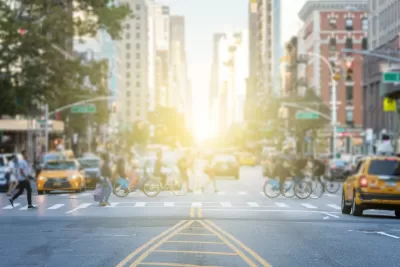
In an op-ed in Streetsblog NYC, Shabazz Stuart argues that a proposed e-bike registration bill would be ineffective.
Stuart writes, “I’ve spent most of my career managing public space at the city’s third-largest Business Improvement District and championing the creation of a regional secure bike parking and charging network with my company, Oonee. As such, I can promise that if this bill becomes law, not only will it fail to achieve its own stated goals, it will stand alone as one of the most regressive urban transportation policies of the 21st century.”
Stuart notes that bike advocates have for decades been calling for more protected bike lanes and other infrastructure that makes it safe for people to ride e-bikes on city streets and not on sidewalks. Requiring all powered bikes, scooters, and other devices including motorized wheelchairs to be registered would be “expensive, difficult to enforce, prejudicial and practically useless.”
Other cities that have attempted bike registration programs have ended them, Stuart points out. “Registration mandates are notoriously difficult to enforce at almost every level of government. The federal government intended Real IDs to be the FAA standard in 2008, but the program suffered from low compliance, even with the full muscle of state DMVs and the specter of not being able to fly. Today, only 56 percent of Americans have converted, 19 years after the original goal of 100 percent.”
FULL STORY: Op-Ed: Council E-Bike Registration Bill Is Impossible to Enforce, Unnecessary … and Won’t Even Work

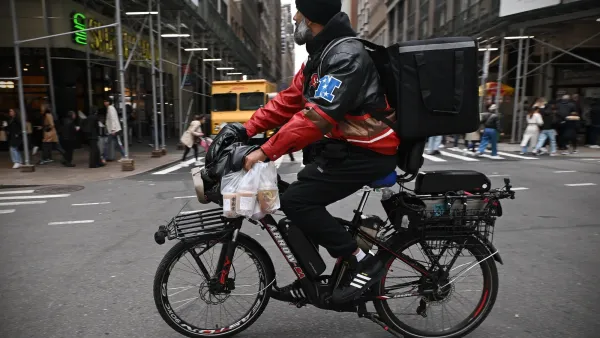
Study: Delivery Workers Are the Safest Cyclists on NYC Roads
A new study shows that delivery workers are more likely to stop at red lights and obey traffic rules than recreational or commuter riders.
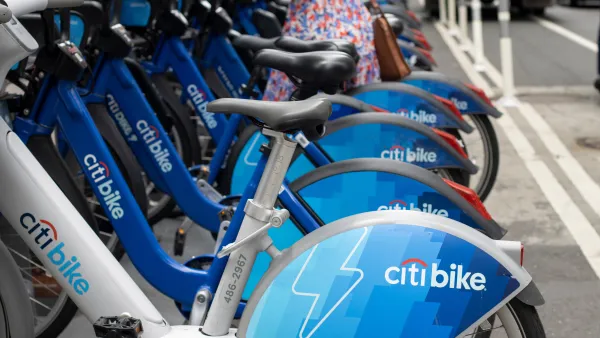
Why Can’t Citi Bike Keep its E-Bikes Running?
Citi Bike’s e-bikes are becoming too popular for their own good as Lyft struggles to keep up with maintenance and charging.

Opinion: Only Slower Traffic Reduces Traffic Deaths
A package of bills in the New York legislature seeks to increase licensing and safety requirements for bikes, e-bikes, and scooters. But research shows speeding and impaired driving are still the top killers of pedestrians and cyclists.

Planetizen Federal Action Tracker
A weekly monitor of how Trump’s orders and actions are impacting planners and planning in America.

The state-sanctioned urbicide of Austin
People don’t kill cities. Freeways do.

US to reduce Colorado River water deliveries to Mexico
A new Colorado Treaty amendment reduces Mexico’s Colorado River water allocation by 250,000 acre feet.

5 New England states march closer to 800 megawatt wind energy project
Securing federal approval for the project may be complicated under the Trump administration, which has historically been hostile towards domestic wind power.

Baltimore to break ground on $50 million Transit Priority Project
The project will bring faster bus trips, safer streets and better bike connections to Baltimore.

Airbnb launches $250 million 'last-dollar financing' housing accelerator, makes first investment in Austin
The company will put $6.4 million towards affordable housing development in Texas’ capital.

FREE Course: Walkable City 1: Why Walkability?
After describing his path towards focusing on walkability as the essence of good planning, Jeff Speck marches through his five principal reasons for making more walkable places.
Reinventing Malls: Planning Alchemy—Turning Gray Fields Into Gold
The course focuses on the opportunities and imperatives that shape reinvention of mall sites.

Eagle County Government
Harvard University Graduate School of Design
Nashville Planning Department
The Architects Foundation
University of Cincinnati Online
The Pocatello Development Authority
The Urban Renewal Agency of the City of Pocatello
Journal of the American Planning Association