Building housing near transportation networks can improve density and walkability, but can also have serious health consequences for residents.


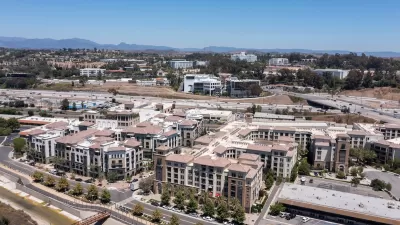
In a piece for Next City, Michael Austin warns that many types of transit-oriented development — which places housing and services near transportation corridors — can have detrimental public health effects when not planned with public health outcomes in mind.
Austin points out that living in close proximity to freeways and major arterial streets is a well-documented health hazard. “Comprehensive articles and academic studies highlight the harmful impacts of living near major roadways, yet development in these areas continues despite known risks.” Even the imminent electrification of the transportation sector, were it to accelerate, wouldn’t completely eliminate emissions, and wouldn’t solve attendant problems such as noise and other sensory impacts.
According to Austin, “When developing TODs along active corridors, it’s important to prioritize housing that’s set no closer than 500 feet — and ideally, 1,000 feet — from major arterials and freeways, as suggested by UCLA researchers and the California Air Resources Board.” He also suggests concentrating commercial, retail, office, and civic uses closer to transit stations.
Austin offers several recommendations for building TOD that takes into account public health: expanding the TOD boundary to include areas farther from major roads; reinforcing health planning through design guidelines; and avoiding housing in active industrial areas.
FULL STORY: Transit-Oriented Housing Development Is Great For Density and Walkability. What About Air Quality?


How Does Air Quality in a Philly Subway Station Compare to the Outdoors?
A team of researchers found much higher levels of particulate matter inside the City Hall subway station than on the street-level sidewalks directly above the station.
Opinion: To Improve Health Outcomes, Invest in Public Transit
A medical student calls for improving public transit to boost the health of people and the environment.
The Relationship Between Walkability and Public Health
New research indicates that improving public health requires targeted investments in more than just pedestrian facilities.

Planetizen Federal Action Tracker
A weekly monitor of how Trump’s orders and actions are impacting planners and planning in America.

The state-sanctioned urbicide of Austin
People don’t kill cities. Freeways do.

US to reduce Colorado River water deliveries to Mexico
A new Colorado Treaty amendment reduces Mexico’s Colorado River water allocation by 250,000 acre feet.

Mamdani overhauls NYC's Vision Zero plan with 100 new policy goals
The overhaul aims to reduce traffic deaths and make streets safer for pedestrians, cyclists and drivers through lower speed limits, new safety infrastructure and more.

Amtrak not solely to blame for New Jersey commuter rail's unreliability, report finds
A new study from the Garden State Initiative found that NJ Transit’s budget grew 20% across a 4 year period, but reliability declined significantly over the same period.

EPA erases limits on planet-warming pollution from power plants
Under Monday’s plan, power plants would still have some limits on how much mercury, arsenic and other contaminants they can emit.

FREE Course: Walkable City 1: Why Walkability?
After describing his path towards focusing on walkability as the essence of good planning, Jeff Speck marches through his five principal reasons for making more walkable places.
Reinventing Malls: Planning Alchemy—Turning Gray Fields Into Gold
The course focuses on the opportunities and imperatives that shape reinvention of mall sites.

Eagle County Government
Harvard University Graduate School of Design
Nashville Planning Department
The Architects Foundation
University of Cincinnati Online
The Pocatello Development Authority
The Urban Renewal Agency of the City of Pocatello
Journal of the American Planning Association