For the first time since 1958, pedestrians in New York City are free to cross the street without adhering to traffic signals or marked crosswalks.


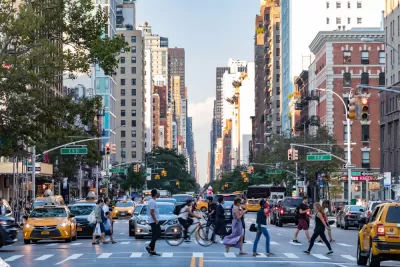
For New York City locals, jaywalking has long-standing — but illegal — practice. But, according to a CNN article by Julianna Bragg, pedestrians in the Big Apple can now, for the first time since 1958, legally cross the street at any time without adhering to traffic signals. The change was made official last week after Mayor Adams neither signed nor vetoed the bill legalizing jaywalking that the city council passed in September.
“Supporters of the bill, including one of the sponsors, Council Member Mercedes Narcisse, believe this legislation is a step toward improving racial justice. New York police officers have historically faced criticism for targeting people of color with jaywalking tickets,” Bragg writes. StreetsblogNYC reported back in May that 92 percent of jaywalking tickets issued in New York City in 2023, which carry up to a $250 fine, were issued to Black and Latino pedestrians.
NYC city officials and police officers initially came out against the bill as it was being considered earlier this summer. The police argued that ticketing jaywalking helps reduce traffic deaths. Bragg reports that over the past five years 200 people have died while crossing the street in the middle of the blog or against traffic signals, accounting for around 34 percent of all pedestrian fatalities. But, as explained by Peter Norton, the 100-year-old effort to first codify “jaywalking” was driven by enterprises with a business interest in automobiles who wanted cars to be the priority road user. Indeed, traffic experts like Angie Schmitt and Charles T. Brown have long argued that jaywalking is a concept developed by auto companies not to keep pedestrians safe but rather to shift the blame away from reckless drivers who kill them.
New York City is now among a handful of states and major U.S. cities that have decriminalized jaywalking in recent years, including California, Virginia, Nevada, Denver, and Kansas City, Missouri.
Read the full story: New Yorkers have jaywalked for decades. It’s now legal, but tourists may want to think twice before following locals into the street

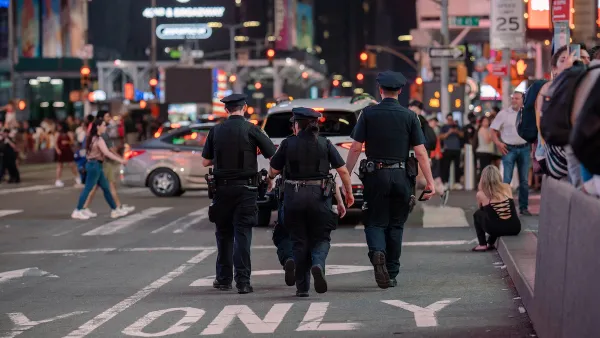
Over 90 Percent of NYC Jaywalking Tickets Issued to Black and Latino Pedestrians
The city’s police force continues its history of disproportionately citing people of color for illegal street crossings.
NYC Officials Split on Jaywalking Decriminalization
While some council members say the ‘outdated’ practice disproportionately impacts Black and Latino residents, law enforcement officials say its a necessary measure for road safety.
Opinion: California Jaywalking Law a Step in Right Direction
A new law doesn’t fully decriminalize jaywalking, but bars law enforcement from issuing citations to pedestrians when crossings aren’t ‘truly dangerous.’

Planetizen Federal Action Tracker
A weekly monitor of how Trump’s orders and actions are impacting planners and planning in America.

Amtrak, CN end decades-long dispute with eight-year agreement
The new operating agreement establishes an updated framework for the companies to work together, including processes to resolve disputes.

Colorado’s Largest Data Center Could Rise Next to Homes — Without a Public Hearing
The proposed campus would consume 11 times the power of Denver International Airport; as it has across the country, opposition mounts.

'This is going to be painful:’ Virginia stares down $1.7 billion funding gap for highway maintenance
The state may address the deficit by shifting $290 million from its construction budget to maintenance projects.

Judges permit Denver to divert 77,000 acre feet from the Colorado River for reservoir expansion
Overuse and climate change have caused the Colorado River’s water levels to plummet.

Amtrak, CN end decades-long dispute with eight-year agreement
The new operating agreement establishes an updated framework for the companies to work together, including processes to resolve disputes.

FREE Course: Walkable City 1: Why Walkability?
After describing his path towards focusing on walkability as the essence of good planning, Jeff Speck marches through his five principal reasons for making more walkable places.
Reinventing Malls: Planning Alchemy—Turning Gray Fields Into Gold
The course focuses on the opportunities and imperatives that shape reinvention of mall sites.

KFH Group Inc.
Greater Baltimore Committee
Eagle County Government
The Architects Foundation
University of Cincinnati Online
The Pocatello Development Authority
The Urban Renewal Agency of the City of Pocatello