The program requires that 40 percent of some federal funds be used to benefit historically disadvantaged communities.


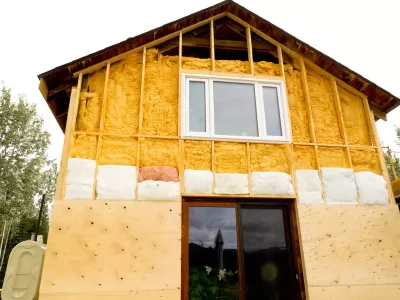
In an article for Blavity, Jeanne Yacoubou outlines how the Biden administration’s Justice40 Initiative, which mandates that 40 percent of certain federal investments go to disadvantaged communities, has affected affordable housing and equity since its creation in 2021.
The program defines ‘disadvantaged’ communities as “those that are marginalized, underserved, and overburdened by pollution while underinvested in housing, transportation, water and wastewater infrastructure, and health care,” Yacoubou explains.
The Green and Resilient Retrofit Program has, so far, installed energy efficiency upgrades in roughly 2,000 multifamily homes occupied by low-income households.
As Yacoubou notes, “The future of the remaining Justice40 funds depends on the results of the 2024 presidential election. Donald Trump has vowed to eliminate all or most of the remaining funds of the IRA climate law calling it a ‘waste’ of money.” Meanwhile, 16 Republican governors want to keep the benefits of the Infrastructure Investment and Jobs Act (IIJA), but called on President Biden to eliminate the environmental justice requirements.
FULL STORY: The Justice40 Initiative And Affordable, Sustainable Housing


Affordable Housing Renovations Halt Mid-Air Amidst DOGE Clawbacks
HUD may rescind over a billion dollars earmarked for green building upgrades.

HUD Resiliency Awards Target Affordable Multifamily Housing
The Green and Resilient Retrofit program aims to reduce vulnerability to climate challenges and improve energy efficiency in multifamily buildings.
Mapping Environmental Justice to Census Tracts
The Climate and Economic Justice Screening Tool, version 1.0, is now available on the internet.

Planetizen Federal Action Tracker
A weekly monitor of how Trump’s orders and actions are impacting planners and planning in America.

The state-sanctioned urbicide of Austin
People don’t kill cities. Freeways do.

US to reduce Colorado River water deliveries to Mexico
A new Colorado Treaty amendment reduces Mexico’s Colorado River water allocation by 250,000 acre feet.

5 New England states march closer to 800 megawatt wind energy project
Securing federal approval for the project may be complicated under the Trump administration, which has historically been hostile towards domestic wind power.

Baltimore to break ground on $50 million Transit Priority Project
The project will bring faster bus trips, safer streets and better bike connections to Baltimore.

Airbnb launches $250 million 'last-dollar financing' housing accelerator, makes first investment in Austin
The company will put $6.4 million towards affordable housing development in Texas’ capital.

FREE Course: Walkable City 1: Why Walkability?
After describing his path towards focusing on walkability as the essence of good planning, Jeff Speck marches through his five principal reasons for making more walkable places.
Reinventing Malls: Planning Alchemy—Turning Gray Fields Into Gold
The course focuses on the opportunities and imperatives that shape reinvention of mall sites.

Eagle County Government
Harvard University Graduate School of Design
Nashville Planning Department
The Architects Foundation
University of Cincinnati Online
The Pocatello Development Authority
The Urban Renewal Agency of the City of Pocatello
Journal of the American Planning Association