Advocates say the proposal would further destabilize the lives of people forced to live in their vehicles.


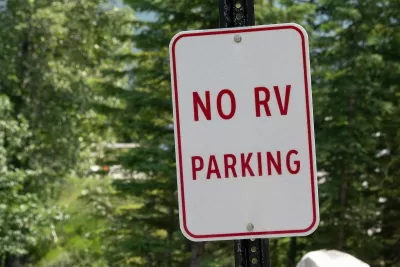
In another move that criminalizes people who are experiencing homelessness, San Francisco is considering a ban on overnight parking of recreational vehicles on the city’s streets.
As Tara Campbell explains in an article for ABC 7 News, “The ban prohibits RVs and other oversized vehicles from parking on city-managed streets from midnight to 6 a.m. and gives the SFMTA the go-ahead to tow vehicles in violation after offering shelters.”
Families who live in their vehicles say the ban will force them to move frequently and lose stability, which is particularly important for school-aged children.
Currently, the city offers one designated safe parking site that can accommodate a few dozen RVs. “Homeless advocates are calling on the city to open more safe parking sites, saying it's a much better step than the ban.”
The mayor’s office says there is no policy change as of now, and the proposal would have to pass a vote by the San Francisco Municipal Transportation Agency (SFMTA) board.
Unhoused people around the country face increasingly punitive responses in the wake of a U.S. Supreme Court decision that allows cities to bar people from sleeping in public spaces even when other shelter is not available.
Read the full story: New San Francisco proposal aims to ban RVs on city-managed streets overnight

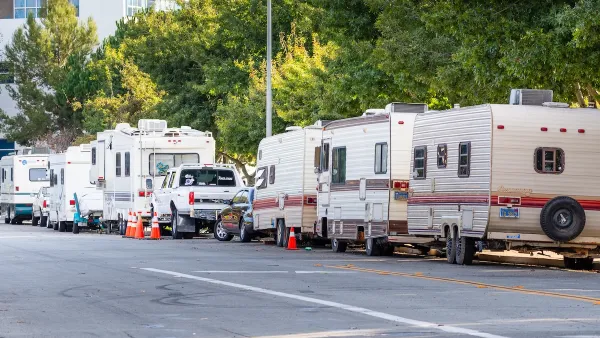
San Francisco Could Redefine RVs to Restrict Living in Vehicles
The SFMTA is considering expanding the definition of RVs to include mobile homes, box trucks, and other campers.

New California Law Lets Counties Seize RVs — Even if Their Owner Lives in Them
Advocates for the homeless say the law could make life harder and more unstable for people who use RVs as shelter.
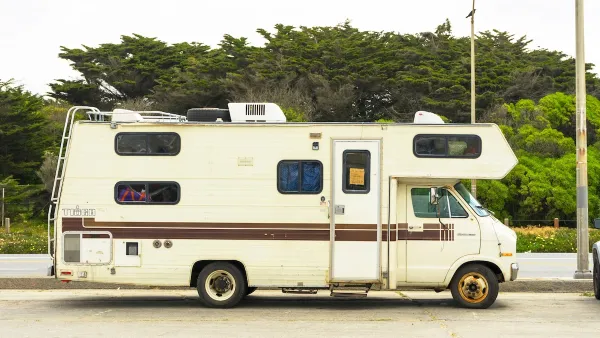
San Francisco Bans Living in RVs, Offers Chatbot for Assistance
The city is testing an AI tool to support its understaffed outreach services department, but advocates worry it won’t be accessible to many vehicle dwellers.

Planetizen Federal Action Tracker
A weekly monitor of how Trump’s orders and actions are impacting planners and planning in America.

California plans to bury El Niño’s downpour
If the state plays its cards right, it may be able to store a billion acre-feet of El Niño’s water in aquifers.

Chicago breaks ground on $3 billion megadevelopment
The new neighborhood, titled Foundry Park, will one day host 3,700 residences.

California High-Speed Rail Authority CEO resigns after $600,000 scandal
Under Ian Choudri, the authority used taxpayer dollars to fund first class flights and trips to nightclubs.

Want to study the Missouri River? Soon, you may need unanimous approval from 10 states
Legislation would require 10 governors’ permission to study or build projects moving water outside the basin.

Desperate measures: Advocates weigh draining Lake Powell to fill Colorado River
Draining the reservoir could reduce evaporation losses by a couple hundred thousand acre-feet.

FREE Course: Walkable City 1: Why Walkability?
After describing his path towards focusing on walkability as the essence of good planning, Jeff Speck marches through his five principal reasons for making more walkable places.
Reinventing Malls: Planning Alchemy—Turning Gray Fields Into Gold
The course focuses on the opportunities and imperatives that shape reinvention of mall sites.

City of Rosemead
Rutgers University, Edward J. Bloustein School of Planning and Public Policy
One Hundred Miles
Hunter College, City University of New York (CUNY)
The Architects Foundation
University of Cincinnati Online
City of Cambridge
Montrose County
The Pocatello Development Authority