Following a key Supreme Court ruling, some cities are imposing more restrictive laws on outdoor sleeping and encampments.


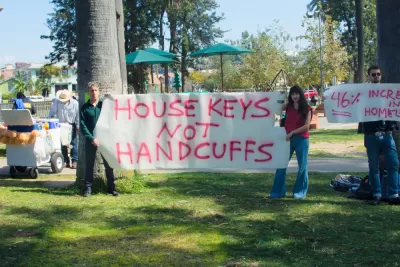
Months after the U.S. Supreme Court ruled that cities can criminalize unhoused residents without providing alternate housing options, over two dozen California cities have “passed, strengthened, or are considering” ordinances that penalize people experiencing homelessness for sleeping in public places.
As Marisa Kendall explains in CALmatters, “Santa Monica is considering barring its homeless residents from using sleeping bags, San Joaquin County is poised to force unhoused people to move 300 feet every hour, and Fresno has made it illegal to camp anywhere at any time — even if no shelter is available.” In Palm Springs, a camping ban on sidewalks, parks, and public spaces won’t go into effect until the city finishes building a new shelter facility.
The policies come as no surprise to advocates who warned that the decision in Grants Pass v. Johnson would pave the way for more punitive laws that criminalize homelessness rather than address its root causes. “Without opening more shelters or affordable housing, breaking up homeless camps will do nothing but shuffle people from one spot to another. Activists say displacing people from encampments can sever their ties to case workers, medical clinics and other vital services.”
Read the full story: No sleeping bags, keep moving: California cities increase crackdown on homeless encampments

Grants Pass to Provide 150 Camping Spaces, $60k in Services After Disability Rights Suit
The city previously made headlines for the U.S. Supreme Court case allowing penalties for camping prohibited by local ordinances.
Study: Anti-Homelessness Laws Don’t Work
Research shows that punitive measures that criminalized unhoused people don’t help reduce homelessness.
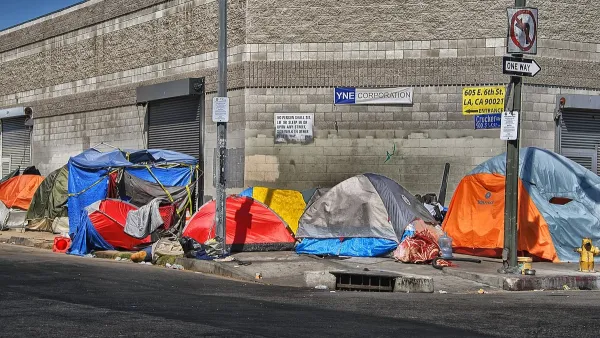
California Homeless Arrests, Citations Spike After Ruling
An investigation reveals that anti-homeless actions increased up to 500% after Grants Pass v. Johnson — even in cities claiming no policy change.

Amtrak, CN end decades-long dispute with eight-year agreement
The new operating agreement establishes an updated framework for the companies to work together, including processes to resolve disputes.

Judges permit Denver to divert 77,000 acre feet from the Colorado River for reservoir expansion
Overuse and climate change have caused the Colorado River’s water levels to plummet.
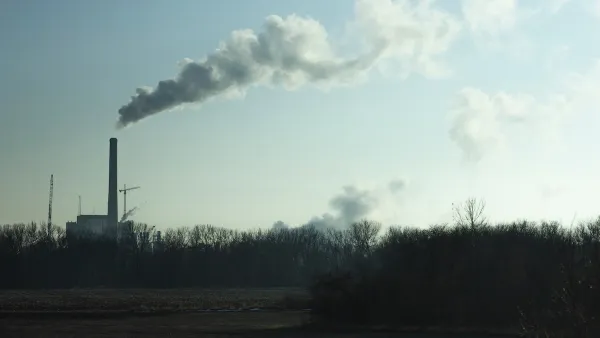
Nation's most wind-powered state turns to coal as data centers increase energy demand
For the first time in decades, Iowa has increased its generation of coal power.

Boston has spent millions making the Green Line more accessible — and there’s no end in sight
While the city has invested millions into expanding and adding platforms to the Green Line to make it more accessible, new train cars set to arrive next year will be too tall for disabled passengers to board without raising the current platforms.

Idaho may see an 18% drop in federal surface transit funding — the largest estimated cut in the US
Transit systems in rural communities are much more reliant on federal funding to provide their services.

How ‘post-disaster gentrification’ alters neighborhoods after natural calamities
After hurricanes, fires or other calamities, the original residents of a community are often replaced by younger, wealthier residents.

FREE Course: Walkable City 1: Why Walkability?
After describing his path towards focusing on walkability as the essence of good planning, Jeff Speck marches through his five principal reasons for making more walkable places.
Reinventing Malls: Planning Alchemy—Turning Gray Fields Into Gold
The course focuses on the opportunities and imperatives that shape reinvention of mall sites.

City of Wisconsin Rapids
Harvard University Graduate School of Design
KFH Group Inc.
The Architects Foundation
University of Cincinnati Online
The Pocatello Development Authority
The Urban Renewal Agency of the City of Pocatello