The 9-mile rail line could be a welcome breath of fresh air for one of the region’s most polluted communities.


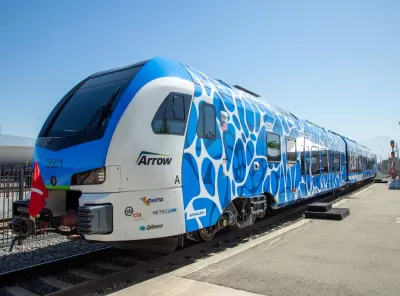
A new train in San Bernardino, California operates on a hybrid hydrogen fuel cell and battery system whose only byproduct is water vapor, reports Jules Feeney in The Guardian.
“The new technology will make Zemu the first hydrogen-powered, zero-emissions passenger train in North America to meet Federal Railroad Administration (FRA) requirements when it goes into service early next year,” Feeney explains.
The train is an experimental project, slated to run on a 9-mile route between San Bernardino and Redlands, two cities east of Los Angeles, and could pave the way for more widespread adoption of the hydrogen system. The region suffers from heavily polluted air due to its role as a major hub for distribution centers.
State transportation leaders are taking note: “After seeing the early success of the Zemu project last year, the state’s department of transportation – known as Caltrans – commissioned Stadler to build longer versions of the hydrogen-powered trains that will run between Merced and Sacramento in the Central Valley on a yet-to-be-built line. So far, Caltrans has ordered 10 units, with the option to buy 19 more under the terms of the $80m contract.”
Feeney notes that widespread use of hydrogen -powered trains will require heavy investment in infrastructure for building trains and producing hydrogen fuel, a process that requires energy itself.
FULL STORY: ‘Transformational’: how a California city launched America’s first hydrogen-powered passenger train

Feds Terminate $7.56 Billion for Clean Energy Projects
The Department of Energy canceled awards to over 200 renewable energy projects.
First US Hydrogen Public Utility to Launch in California
The project will serve as an intermediary between clean hydrogen providers and consumers.
Two New Clean Energy Programs Funded by the Bipartisan Infrastructure Law Unveiled
The U.S. Department of Energy announced two new programs last month that are funded by the $1.2 trillion Infrastructure Investment and Jobs Act: $7 billion to create regional ‘hydrogen hubs’ and $4.9 billion to ‘manage and store carbon pollution.’

Planetizen Federal Action Tracker
A weekly monitor of how Trump’s orders and actions are impacting planners and planning in America.

The state-sanctioned urbicide of Austin
People don’t kill cities. Freeways do.

US to reduce Colorado River water deliveries to Mexico
A new Colorado Treaty amendment reduces Mexico’s Colorado River water allocation by 250,000 acre feet.

Mamdani overhauls NYC's Vision Zero plan with 100 new policy goals
The overhaul aims to reduce traffic deaths and make streets safer for pedestrians, cyclists and drivers through lower speed limits, new safety infrastructure and more.

Amtrak not solely to blame for New Jersey commuter rail's unreliability, report finds
A new study from the Garden State Initiative found that NJ Transit’s budget grew 20% across a 4 year period, but reliability declined significantly over the same period.

EPA erases limits on planet-warming pollution from power plants
Under Monday’s plan, power plants would still have some limits on how much mercury, arsenic and other contaminants they can emit.

FREE Course: Walkable City 1: Why Walkability?
After describing his path towards focusing on walkability as the essence of good planning, Jeff Speck marches through his five principal reasons for making more walkable places.
Reinventing Malls: Planning Alchemy—Turning Gray Fields Into Gold
The course focuses on the opportunities and imperatives that shape reinvention of mall sites.

Eagle County Government
Harvard University Graduate School of Design
Nashville Planning Department
The Architects Foundation
University of Cincinnati Online
The Pocatello Development Authority
The Urban Renewal Agency of the City of Pocatello
Journal of the American Planning Association