Rolling stops by bicyclists get a bad rap, particularly among motorists who perceive them to be breaking the law. But new research shows laws that allow for rolling stops for cyclists do not lead to unsafe behavior by either group.



According to a study out of Oregon State University, “Laws that let bicyclists treat stop signs as yield signs lead neither riders nor motorists to act unsafely,” according to a new story out of the university’s newsroom. According to the study’s leader, David Hurwitz, the findings are important as more and more states consider bicycling rolling-stop legislation. Rolling stop advocates say rolling stops allow riders to keep their momentum through intersections — where nearly half of all bicycle-car crashes happen — “theoretically reducing intersection congestion and crash risk because the cyclists are getting through the intersection faster,” the article explains.
The project was conducted by the OSU College of Engineering and used a “novel experimental technique” of linking separate bicycle and motor vehicle simulators, running 60 subjects in pairs simultaneously, and having each subject interact with an avatar of the other in a virtual world. The pairs went through 16 “live-interaction scenarios related to a bicyclist and motorist encountering one another at a four-way, stop-controlled intersection, according to the article. Study lead Hurwitz said they evaluated safety-relevant behaviors associated with laws stemming from the “Idaho stop,” which was passed in 1982 but largely ignored around the country until 2017 when seven states enacted bicycle rolling stop laws.
“The focus of previous research has been crash-data analysis and why riders are motivated to do a rolling stop even when it’s illegal in their state … No one has looked at how well bicycle rolling-stop laws work, or what happens when you educate people about them. Our networked simulator study design let us evaluate driver and rider behavior and their understanding of the law,” Hurwitz told the Oregon State University Newsroom. Their findings also indicate outreach and education about rolling stops would be useful: After receiving education about rolling-stop laws, Hurwitz said bicyclists preferred to yield rather than stop and went through intersections faster, while drivers approached intersections either more slowly or at a similar speed instead of becoming aggressive toward cyclists they would have previously perceived as breaking the law.
FULL STORY: Bicycle rolling-stop laws don’t lead to unsafe behavior by riders or motorists, research shows

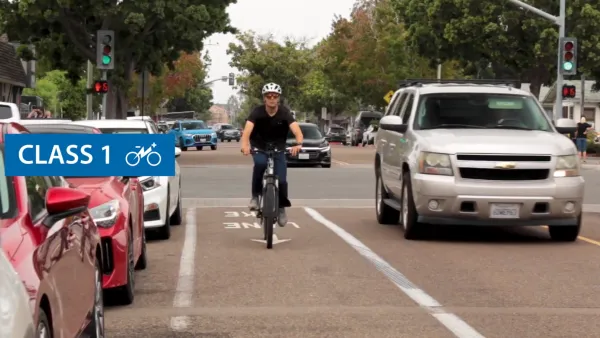
Carlsbad, California Could Set Age Limits for E-bikes
Some California jurisdictions say a minimum age limit is necessary for high-powered e-bikes due to the high number of injuries in recent years.
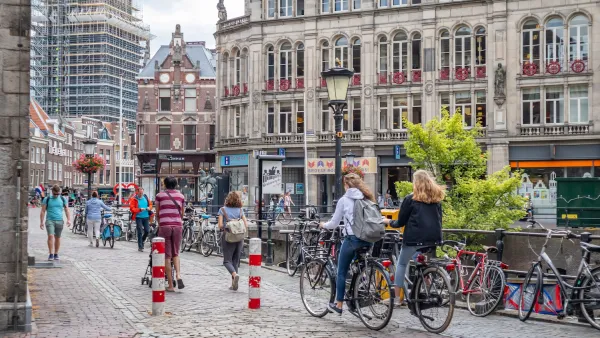
2025's 30 Most Bike-friendly Cities
Copenhagenize has released its list of top cities for cyclists. Spoiler alert: the United States doesn’t make the list.

7 Ways Cyclists are Winning in the AI Revolution
For individual cyclists and transportation planners, AI offers some useful tools for understanding bike riders’ behavior and assessing gaps in a city’s bike infrastructure.

Planetizen Federal Action Tracker
A weekly monitor of how Trump’s orders and actions are impacting planners and planning in America.

The state-sanctioned urbicide of Austin
People don’t kill cities. Freeways do.

US to reduce Colorado River water deliveries to Mexico
A new Colorado Treaty amendment reduces Mexico’s Colorado River water allocation by 250,000 acre feet.

Colorado’s Largest Data Center Could Rise Next to Homes — Without a Public Hearing
The proposed campus would consume 11 times the power of Denver International Airport; as it has across the country, opposition mounts.

5 New England states march closer to 800 megawatt wind energy project
Securing federal approval for the project may be complicated under the Trump administration, which has historically been hostile towards domestic wind power.

Baltimore to break ground on $50 million Transit Priority Project
The project will bring faster bus trips, safer streets and better bike connections to Baltimore.

FREE Course: Walkable City 1: Why Walkability?
After describing his path towards focusing on walkability as the essence of good planning, Jeff Speck marches through his five principal reasons for making more walkable places.
Reinventing Malls: Planning Alchemy—Turning Gray Fields Into Gold
The course focuses on the opportunities and imperatives that shape reinvention of mall sites.

Eagle County Government
Harvard University Graduate School of Design
Nashville Planning Department
The Architects Foundation
University of Cincinnati Online
The Pocatello Development Authority
The Urban Renewal Agency of the City of Pocatello
Journal of the American Planning Association