The $2.4 billion in New Jersey Transportation Trust Fund Authority bonds will fund infrastructure upgrades, including potential improvements for NJ Transit, which has had a summer of service disruptions, fare and tax hikes, and budget woes.


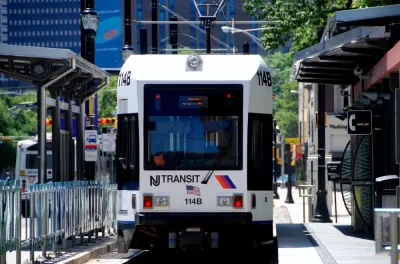
New Jersey is expected to sell $2.4 billion of bonds held by the state’s Transportation Trust Fund Authority to pay for infrastructure upgrades, reports Nikita Biryukov for the New Jersey Monitor. Of that $2.4 billion, $1.3 will be transportation system bonds and roughly $1.1 billion will be transportation program bonds. The article does not say how the state intends to spend the cash but reports that the fund “is charged with modernizing statewide transportation infrastructure like highways and bridges as well as providing additional capital funding for NJ Transit — New Jersey’s public transit agency.”
“The deal comes after NJ Transit was riddled with a spate of cancellations and massive delays earlier this summer, prompting an investigation into its rail infrastructure,” though the cause of the service disruptions has not yet been identified, according to the article. Yesterday marked the announcement of a fare-free week through September 2 as a thank-you to riders for their loyalty, which drew mixed reactions so close to recent 15-percent fare hikes.
The agency approved a $3 billion operating budget in July, as well as $1.7 billion in capital spending for the 2025 fiscal year, according to another New Jersey Monitor article published last month. The operating budget includes the last $750 million of the $4.4 billion in federal COVID relief dollars. “The loss of those funds creates a roughly $767 million fiscal cliff in the agency’s next budget that lawmakers expect to fill with collections from a new corporate business surtax they enacted in late June,” Biryukov reported in July.
NJ Transit isn’t the only transportation agency facing significant budget gaps as the pandemic-era federal aid runs out and ridership rates continue to recover. Planetizen has reported on a few facing fiscal cliffs, including New York, Chicago, Philadelphia, and the states of Maryland and California, as well as other challenges like staffing shortages that threaten service.
Read the full story: NJ Lines Up $2.4 Billion Muni Bond Sale for Transportation Fixes
Analysis: What does America want from surface transportation reauthorization?
Over 13,000 comments were submitted in the federal Request for Information on surface transportation reauthorization. We analyzed all of them.
Five reasons infrastructure costs are spiking
State DOTs face a $86 billion shortfall over the next 10 years.
From Grants to Growth: The Critical Role of Funding in Urban Transportation Projects
How cities are taking innovative approaches and adopting technology to develop sustainable, long-term funding sources for transportation infrastructure.

Planetizen Federal Action Tracker
A weekly monitor of how Trump’s orders and actions are impacting planners and planning in America.

California plans to bury El Niño’s downpour
If the state plays its cards right, it may be able to store a billion acre-feet of El Niño’s water in aquifers.

Desperate measures: Advocates weigh draining Lake Powell to fill Colorado River
Draining the reservoir could reduce evaporation losses by a couple hundred thousand acre-feet.

Chicago voters approve permanent festival grounds, penalty for vacant property owners
Currently, major summer and fall festivals take over public parks for weeks at a time, drawing criticism from nearby residents

NYC votes to cut outdoor dining red tape, speed up permitting
New York City also voted to allow the Department of Transportation to begin work on urgent projects before notifying elected officials.

California appears to reject Prop. 45
The proposition would have expanded the projects that qualify for a streamlined environmental review, effectively paring down the California Environmental Quality Act.

FREE Course: Walkable City 1: Why Walkability?
After describing his path towards focusing on walkability as the essence of good planning, Jeff Speck marches through his five principal reasons for making more walkable places.
Reinventing Malls: Planning Alchemy—Turning Gray Fields Into Gold
The course focuses on the opportunities and imperatives that shape reinvention of mall sites.

City of Rosemead
Rutgers University, Edward J. Bloustein School of Planning and Public Policy
One Hundred Miles
Hunter College, City University of New York (CUNY)
The Architects Foundation
University of Cincinnati Online
City of Cambridge
Montrose County
The Pocatello Development Authority