The decision paves the way for a controversial student housing development.



A plan to build student housing in People’s Park near the University of California, Berkeley will move forward after the state’s Supreme Court ruled in the university’s favor in a suit trying to stop the development. The lawsuit claimed that the EIR for the proposed development was inadequate and did not address potential noise concerns.
As Jessica Garrison and Hannah Wiley note in the Los Angeles Times, “The ruling marks what may — finally — be a decisive final chapter in a land-use saga that began when activists seized the parcel in a moment of 1960s protest and built a park with their own hands, hauling in sod and planting flowers. That launched a 55-year experiment in utopian ideals — and the harsh realities that sometimes trail after them.”
The university argues that the redevelopment project, which will include a supportive housing component, is desperately needed as the housing and homelessness crisis deepens for residents and students. “Campus officials said last year that Berkeley was able to house only 23% of its students, the lowest share among the UC system’s 10 campuses. The scarcity of campus housing has forced many students to cram into shared spaces, commute long distances or live out of their cars.”
FULL STORY: State Supreme Court gives UC Berkeley go-ahead to develop People’s Park, capping decades-long battle

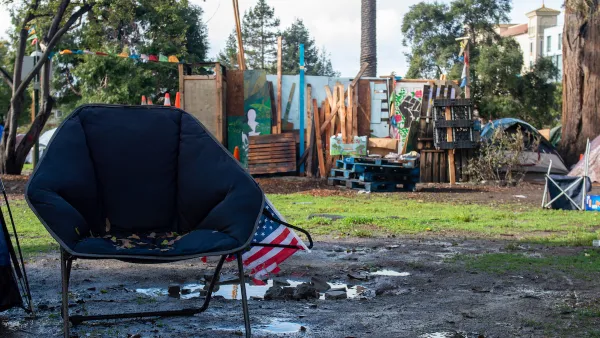
UC Berkeley Says Supportive Housing ‘Inseparable’ Part of People’s Park Project
The park remains closed to the public as a court weighs a decision on the university’s proposed housing development.
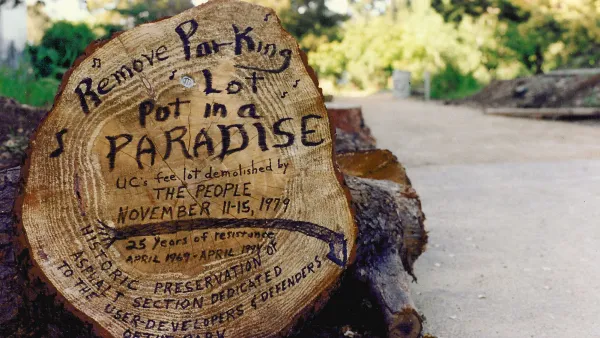
A Fight For the Future of People's Park
Community groups are fighting a plan to build student housing in the historic People's Park.
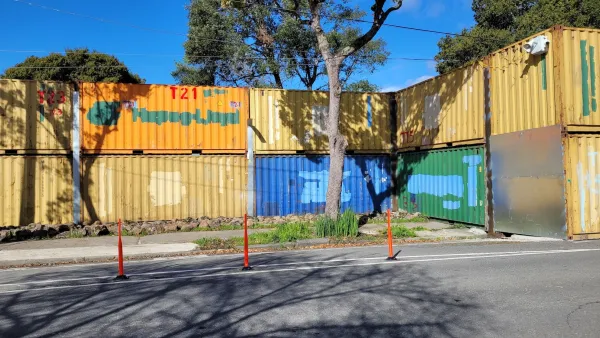
Berkeley promised to build supportive housing in People's Park. Where is it?
More than two years after People's Park was cordoned off, there is no word on a timeline for a promised affordable housing project.

Planetizen Federal Action Tracker
A weekly monitor of how Trump’s orders and actions are impacting planners and planning in America.

The state-sanctioned urbicide of Austin
People don’t kill cities. Freeways do.

US to reduce Colorado River water deliveries to Mexico
A new Colorado Treaty amendment reduces Mexico’s Colorado River water allocation by 250,000 acre feet.

5 New England states march closer to 800 megawatt wind energy project
Securing federal approval for the project may be complicated under the Trump administration, which has historically been hostile towards domestic wind power.

Baltimore to break ground on $50 million Transit Priority Project
The project will bring faster bus trips, safer streets and better bike connections to Baltimore.

Airbnb launches $250 million 'last-dollar financing' housing accelerator, makes first investment in Austin
The company will put $6.4 million towards affordable housing development in Texas’ capital.

FREE Course: Walkable City 1: Why Walkability?
After describing his path towards focusing on walkability as the essence of good planning, Jeff Speck marches through his five principal reasons for making more walkable places.
Reinventing Malls: Planning Alchemy—Turning Gray Fields Into Gold
The course focuses on the opportunities and imperatives that shape reinvention of mall sites.


Eagle County Government
Harvard University Graduate School of Design
Nashville Planning Department
The Architects Foundation
University of Cincinnati Online
The Pocatello Development Authority
The Urban Renewal Agency of the City of Pocatello
Journal of the American Planning Association