The U.S. Corps of Engineers and Redington Shores, Florida are at a standstill: The Corps won’t spend public money to restore private beaches, and homeowners are refusing to grant public access to the beaches behind their home in return for federal assistance.


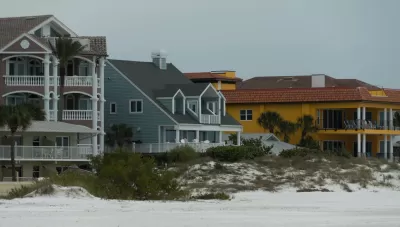
Redington Shores, Florida, a “well-heeled beach town in Pinellas County” have a problem: the beach between them and the Gulf of Mexico is disappearing fast. According to a Grist article by Jake Bittle, “A series of storms, culminating in last fall’s Hurricane Idalia, have eroded most of the sand that protects Redington Shores and the towns around it, leaving residents just one big wave away from water overtaking their homes.”
The federal government, specifically the U.S. Corps of Engineers, has offered to haul in $42 million of new sand on the condition that 461 of waterfront homeowners provide public points of access to the beaches behind their homes. Pinnellas County officials tried to get homeowners to sign the easements, but half of the homeowners refuse.
“This situation highlights growing tensions between the federal government and homeowners in coastal areas that are threatened by climate change. As sea levels have risen and strong storms have caused greater damage than ever before, the costs of protecting and insuring beachfronts in Florida and other states have increased rapidly,” Bittle writes. He reports that the Corps put the easement policy in place decades ago so that it didn’t spent public money to restore private beaches.
Local and federal officials worry that Redington Shores, Florida, and areas like it where homeowners are more concerned about views and privacy than their homes being decimated are “sitting ducks for the next climate-fueled storm.” But for now, neither the Corps nor the coastal homeowners are willing to budge.
Updated on June 7, 2024 at 4:30 Eastern to reflect that the story was originally published by Grist. We first attributed it to Fast Company, which ran the it as a reprint.
FULL STORY: The homeowner mutiny leaving Florida cities defenseless against hurricanes

Will Hurricanes Drive Away Florida’s Retirees?
Some children of Florida retirees are urging their parents to leave hurricane-prone areas for safer regions.

Why Texas's $29 Billion Coastal Protection Plan Is Needed
The Houston Chronicle editorial board argues for the construction of the so-called 'Ike Dike,' but warns that more investment is needed to protect the South Texas coast from future storms.

Who is allowed to walk on the beach? It depends on where you live
Debate over who has the right to access beaches has sparked a slew of legal cases.

Planetizen Federal Action Tracker
A weekly monitor of how Trump’s orders and actions are impacting planners and planning in America.

The state-sanctioned urbicide of Austin
People don’t kill cities. Freeways do.

US to reduce Colorado River water deliveries to Mexico
A new Colorado Treaty amendment reduces Mexico’s Colorado River water allocation by 250,000 acre feet.

Mamdani overhauls NYC's Vision Zero plan with 100 new policy goals
The overhaul aims to reduce traffic deaths and make streets safer for pedestrians, cyclists and drivers through lower speed limits, new safety infrastructure and more.

Amtrak not solely to blame for New Jersey commuter rail's unreliability, report finds
A new study from the Garden State Initiative found that NJ Transit’s budget grew 20% across a 4 year period, but reliability declined significantly over the same period.

EPA erases limits on planet-warming pollution from power plants
Under Monday’s plan, power plants would still have some limits on how much mercury, arsenic and other contaminants they can emit.

FREE Course: Walkable City 1: Why Walkability?
After describing his path towards focusing on walkability as the essence of good planning, Jeff Speck marches through his five principal reasons for making more walkable places.
Reinventing Malls: Planning Alchemy—Turning Gray Fields Into Gold
The course focuses on the opportunities and imperatives that shape reinvention of mall sites.

Eagle County Government
Harvard University Graduate School of Design
Nashville Planning Department
The Architects Foundation
University of Cincinnati Online
The Pocatello Development Authority
The Urban Renewal Agency of the City of Pocatello
Journal of the American Planning Association