The city is looking for ways to boost housing production, anticipating a growing population.



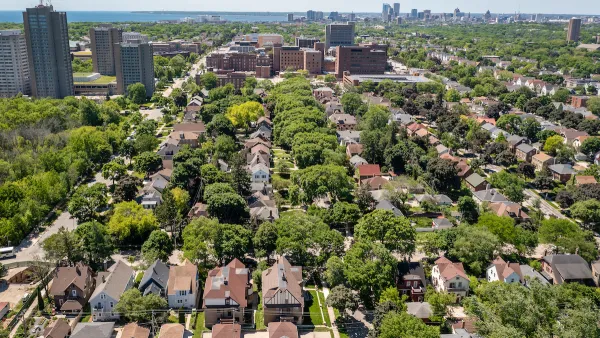
According to an article by Tom Daykin in the Milwaukee Journal Sentinel, Milwaukee officials are considering changing the city’s zoning code to encourage more housing production in commercial areas. “Those revisions, which need approval from the Common Council and Mayor Cavalier Johnson, would be a first step towards Johnson’s vision of eventually increasing Milwaukee’s population to 1 million.”
Proposals also include upzoning — increasing the allowable density — single-family neighborhoods to permit duplexes, townhouses, and other small multi-family housing types, and permitting accessory dwelling units (ADUs) more widely.
Another proposal would eliminate floor area ratio (FAR) in favor of height limits, setbacks, and other standards that limit the size of developments.
Industry experts say the city could also cut development costs by offering pre-approved plans and creating more tax incremental financing districts. “Those districts use property tax revenue from new developments to pay their costs.”
FULL STORY: Milwaukee wants 1 million people and more housing. Zoning code changes are a first step


‘Growing MKE’ Zoning Reform Plan Would Expand Milwaukee Housing Options
Proponents of the plan say the changes would help reverse decades of discriminatory housing policies.
A Look at Milwaukee’s Proposed Zoning Reform
The proposed changes would permit more flexible housing development while limiting changes in historic neighborhoods and on smaller streets.

Ohio Lawmakers Propose Incentivizing Housing Production
A proposed bill would take a carrot approach to stimulating housing production through a grant program that would reward cities that implement pro-housing policies.

The state-sanctioned urbicide of Austin
People don’t kill cities. Freeways do.

US to reduce Colorado River water deliveries to Mexico
A new Colorado Treaty amendment reduces Mexico’s Colorado River water allocation by 250,000 acre feet.

New Jersey’s second-largest city bans standalone data centers
Jersey City will continue to allow co-location facilities, such as those meant for research institutions that store their own data.

Amtrak not solely to blame for New Jersey commuter rail's unreliability, report finds
A new study from the Garden State Initiative found that NJ Transit’s budget grew 20% across a 4 year period, but reliability declined significantly over the same period.

EPA erases limits on planet-warming pollution from power plants
Under Monday’s plan, power plants would still have some limits on how much mercury, arsenic and other contaminants they can emit.

Phoenix announces new on-demand transit service, more frequent RAPID buses
Both new services will launch in October, and are part of Phoenix's Project Effective Access Solutions for Easing Congestion.

FREE Course: Walkable City 1: Why Walkability?
After describing his path towards focusing on walkability as the essence of good planning, Jeff Speck marches through his five principal reasons for making more walkable places.
Reinventing Malls: Planning Alchemy—Turning Gray Fields Into Gold
The course focuses on the opportunities and imperatives that shape reinvention of mall sites.

Eagle County Government
Harvard University Graduate School of Design
Nashville Planning Department
The Architects Foundation
University of Cincinnati Online
The Pocatello Development Authority
The Urban Renewal Agency of the City of Pocatello
Journal of the American Planning Association