Locals are employing a tool historically used for sports stadiums to ensure they benefit from the new project as much as the companies do.


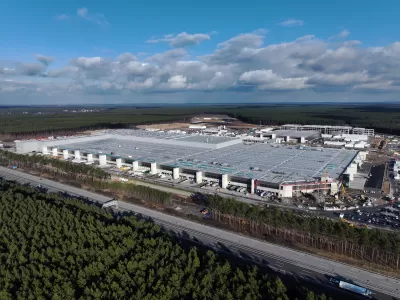
Auto manufacturer Ford and a Korean company called SK Innovation have proposed an electric vehicle manufacturing complex in rural western Tennessee. Despite being promised 6,000 good-paying jobs, residents of surrounding towns are wary that the development will “change the community, suck up water and electricity, and prompt an influx of newcomers and development,” according to Katie Myers, a climate solutions fellow for Grist.
“They are only the latest to face uncertainties with energy transition projects, which, from solar fields to wind farms, have prompted reservations about their size, industrial activity, and environmental impacts. But rather than accept their fate, the constellation of towns orbiting Stanton are sitting down with Ford and SK to negotiate a binding agreement that will ensure they benefit from Blue Oval City as much as the companies do,” writes Myers.
The community benefit agreement—a tool historically used by communities dealing by entertainment and sports developments—is a binding contract between a corporation and a coalition of local organizations that gives the community legal leverage to make sure commitments are kept.
Myers reports that CBAs are increasingly being used to address clean energy developments like this one, with several being signed just in the last three years. “The contracts resulted in projects agreeing to give preference to local hires, and in companies sharing revenue with the county in which they operate. An offshore wind facility in Maine even underwrote rural broadband access.”
Stipulations these rural Tennessee communities want Ford/Blue Oval SK to abide by include resources like youth facilities, road maintenance support, and apprenticeship pathways run by local union chapter, as well as binding assurance of proper waste disposal.
Vonda McDaniel, the president of the Central Labor Council of Nashville and Middle Tennessee, who is helping to formulate Blue Oval agreement, CBAs are a great tool to “help ensure a measure of democracy in a part of the country where voter disenfranchisement, especially in rural, Black communities, is high and private interests have the ear of state government,” writes Myers.
However, for a CBA to be successful, a company has to sit down with the community—a step that hasn’t happened yet, though the local coalition are hopeful they’ll have an agreement drafted and sit down with Ford in the new year.
Read the full story: A huge EV factory is coming to west Tennessee. Here’s how locals are ensuring they benefit.

Swapping your gas car for an EV is greener than keeping it, research shows
An EV repays the 'carbon debt' caused by building it after 4,400 miles.

Florida wants to shift its entire EV charger budget to air taxi 'vertiports'
FDOT argues the private sector is already building out the state's fast-charging infrastructure, so the state could redirect those funds elsewhere.
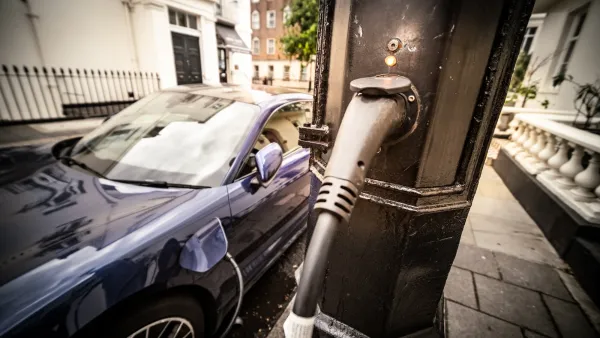
DC light poles will soon charge your electric car
The city awarded three grants to companies that will install more publicly available EV chargers.

Planetizen Federal Action Tracker
A weekly monitor of how Trump’s orders and actions are impacting planners and planning in America.

California plans to bury El Niño’s downpour
If the state plays its cards right, it may be able to store a billion acre-feet of El Niño’s water in aquifers.

Desperate measures: Advocates weigh draining Lake Powell to fill Colorado River
Draining the reservoir could reduce evaporation losses by a couple hundred thousand acre-feet.

Mamdani’s pied-à-terre tax survives legal challenge
A panel of judges found that the plaintiffs failed to demonstrate injury as a result of New York City's implementation of the tax.

Eastern Nebraska is running out of electricity
Data centers and electrification are straining eastern Nebraska’s grid, throttling economic development.

Seattle passes record-breaking transit services expansion
Proposition 1 will double the city’s transit tax to add 95,000 more bus trips and preserve 180,000 bus trips annually.

FREE Course: Walkable City 1: Why Walkability?
After describing his path towards focusing on walkability as the essence of good planning, Jeff Speck marches through his five principal reasons for making more walkable places.
Reinventing Malls: Planning Alchemy—Turning Gray Fields Into Gold
The course focuses on the opportunities and imperatives that shape reinvention of mall sites.

City of Rosemead
Rutgers University, Edward J. Bloustein School of Planning and Public Policy
One Hundred Miles
University of Michigan School for Environment and Sustainability (SEAS)
Hunter College, City University of New York (CUNY)
The Architects Foundation
City of Cambridge
Montrose County
The Pocatello Development Authority