The law calls for buildings larger than 20,000 square feet to eliminate fossil fuels by 2050.


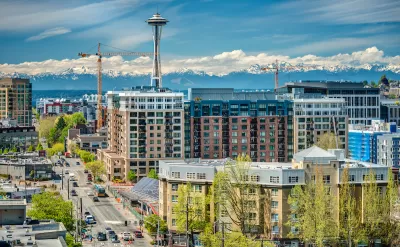
Seattle building owners and managers will be tasked with developing plans to decarbonize their buildings by 2050 under a new city law that is expected to reduce building emissions by 27 percent by 2050, reports Amanda Zhou of The Seattle Times in Governing.
“The law, which Seattle City Council members voted unanimously to approve, applies to about 4,100 buildings that are 20,000 square feet or larger, including skyscrapers, retail stores, research facilities, community centers, offices and some low-rise apartment buildings.” These buildings, Zhou explains make up 3 percent of the city’s building stock but produce more than one-third of total building emissions.
Building owners will get assistance through a city program designed to help them transition funded by federal dollars and $4.5 million in city funds. The program includes a wide array of exceptions and delayed deadlines, including buildings with industrial and manufacturing uses, affordable housing and human services buildings, and buildings facing “high vacancy rates or financial distress.”
FULL STORY: Seattle to Phase Out Large Building Emissions by 2050


LA’s Trees Absorb More Carbon Than Expected, But Can’t Do It Alone
A USC study finds that Los Angeles’ urban trees absorb more carbon than expected, but while they provide crucial environmental benefits, they cannot replace the urgent need for systemic emissions reductions.

USDOT Unveils Strategies to Achieve Near-Zero Transportation Emissions
Three key strategies — reducing travel distances, increasing energy-efficient travel modes, and transitioning to zero-emission vehicles and fuels — are recommended to meet national climate goals under the Paris Agreement.
How Cities Can Curb Climate Change and Protect Vulnerable Residents
A new U.N. report urges cities to upgrade their infrastructure to bolster climate resilience and build more sustainable, climate-friendly places.

Planetizen Federal Action Tracker
A weekly monitor of how Trump’s orders and actions are impacting planners and planning in America.

The state-sanctioned urbicide of Austin
People don’t kill cities. Freeways do.

US to reduce Colorado River water deliveries to Mexico
A new Colorado Treaty amendment reduces Mexico’s Colorado River water allocation by 250,000 acre feet.

5 New England states march closer to 800 megawatt wind energy project
Securing federal approval for the project may be complicated under the Trump administration, which has historically been hostile towards domestic wind power.

Baltimore to break ground on $50 million Transit Priority Project
The project will bring faster bus trips, safer streets and better bike connections to Baltimore.

Airbnb launches $250 million 'last-dollar financing' housing accelerator, makes first investment in Austin
The company will put $6.4 million towards affordable housing development in Texas’ capital.

FREE Course: Walkable City 1: Why Walkability?
After describing his path towards focusing on walkability as the essence of good planning, Jeff Speck marches through his five principal reasons for making more walkable places.
Reinventing Malls: Planning Alchemy—Turning Gray Fields Into Gold
The course focuses on the opportunities and imperatives that shape reinvention of mall sites.

Eagle County Government
Harvard University Graduate School of Design
Nashville Planning Department
The Architects Foundation
University of Cincinnati Online
The Pocatello Development Authority
The Urban Renewal Agency of the City of Pocatello
Journal of the American Planning Association