Cities often fail to effectively manage parking—and the public pays for it.



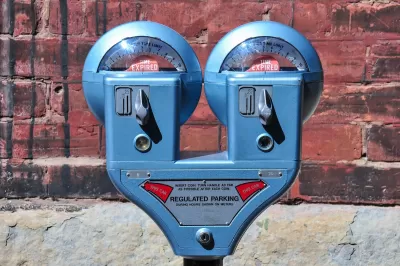
It is another Friday night, you are driving downtown to eat with your friends, but wait! There is no parking! How is this possible? It’s always the same! You cruise around the block for what feels like an eternity—still no parking. You’ve had this experience innumerable times, yet you keep repeating it. This is an unpleasant experience, but usually when people say “there is no parking,” they mean there is no free parking.
While free on-street parking usually stays filled to capacity—if not over capacity—off-street paid parking underperforms. And it makes sense: Why would you pay for parking when you can have it for free? A parking utilization study by the Metropolitan Area Planning Council across six municipalities around Boston, Massachusetts, found that “61% of the off-street parking spaces were utilized during peak hours” (p.3). Even when demand was at its highest the utilization rate was still just 49 percent for off-street parking spaces.
If anything is true in this life, it is that nothing is free, and that includes parking. But in the United States, “free” parking is heavily subsidized by the government. According to “parking guru” Donald Shoup, an urban planning professor at the University of California, Los Angeles known for his book The High Cost of Free Parking, the United States spends between $102 and $374 billion on free parking! Shoup writes that this is around the amount of what the nation spends for national defense and Medicare. This begins to explain the toll that free parking takes on American taxpayers.
As if that’s not bad enough, free parking also contributes to traffic congestion. In a journal article by Robert C. Hampshire and Donald Shoup, the authors analyzed 22 studies of cruising in 15 cities, across 4 continents, from 1927 to 2015. It was found that, on average, the share of traffic due to cruising for parking was 34 percent. This is due to induced demand (yes it is also a thing for parking). And it makes sense. In the words of journalist Henry Grabar, author of Paved Paradise (one of Planetizen’s Top Planning Books of 2023), “Providing more parking does not actually make it easier to park. If parking actually encourages people to drive, then more parking is actually going to create more traffic, not soak up the traffic of people looking for parking”. So free parking not only costs the nation dozens of billions of dollars, but it also induces traffic.
Free on-street parking inevitably causes unevenly distributed parking demand, concentrating most drivers in a specific area. Combine this with the fact that most towns have an oversupply of parking and you get an inefficient system in which no one wins. Obvious questions arise: What is the solution? Do we need to build more parking? Or do we need to learn how to manage it? Of course, the latter is the most efficient answer. We know that off-street parking is underutilized, but the trend of parking underutilization is bigger than off-street parking alone. In general, there is no lack of parking, and in many cases, there is too much parking. According to a report by the National League of Cities, the city of Bastrop, Texas, found in a parking study that there was a 76 percent parking vacancy rate at any given time. And this is not something concentrated in one region of the country. Cities all around the United States have an underutilization of parking. A special report by the Research Institute for Housing America found that all five cities studied showed low parking utilization rates. If we remember that most of that parking is probably free, that means a huge financial cost for parking no one uses.
Free and vast parking is an issue that needs to be addressed. It is damaging to society, and we need to get rid of it. It is important to understand that charging for parking is not unfair. Unlike a city’s sidewalks or parks, parking is not a public good: Not everyone can use it, as it is limited to people who own cars. Yet everyone has to pay for it. As Donald Shoup points out, directly charging drivers for their parking is fairer than obligating everyone to subsidize it indirectly.
Opponents of abolishing free parking will say it is not fair for lower-income individuals, and that charging for parking will disproportionately impact them and limit their mobility. But the truth is that low-income individuals, who disproportionately do not own motor vehicles, are the ones who pay the biggest toll for free parking. Charging for parking would reduce these indirect costs on lower-income households, making their lives easier.
Charging for parking is the right thing to do. For instance, charging for on-street parking could reduce traffic congestion. A great example is San Francisco's SFpark program. The program varies the cost of on-street parking in commercial areas to maintain an occupancy between 60 and 80 percent at any given time. This helps solve the common issue of unevenly distributed parking. In a study of the same program by Adam Millard-Ball, et al., it was found that after two years of the program, cruising was reduced by 50 percent.
On the other coast, New York City is trying to implement parking management programs. In 2009, the New York City Department of Transportation launched its second variable-price parking pilot project, finding that traffic volumes declined by 7 percent. While 7 percent is not as substantial as the 50 percent reduction found in the SFpark program, it is is still significant, especially in a city as large as New York. According to an article by Transportation Alternatives, 97 percent of New York City's on-street parking is free. Imagine the impact it would have on the city if it all was priced parking instead.
These programs show how paid parking programs can improve parking accessibility and reduce congestion and emissions. In this way, cities and municipalities can avoid spending public funds on the construction of new garages, which, on average, cost almost $10 million to build. The solution might be as easy as just charging for parking. The new revenue could be used to fund local infrastructure and maintenance of the same parking spots. Programs such as parking benefit districts (PBD) are incredibly useful to gain political and local support as the earnings obtained from parking meters are used for visible local improvements.
Of course, like most urban issues, parking is not an isolated problem. If smart parking programs are implemented but road design and policies still encourage motor vehicle use, the efficiency of parking programs will be limited by the intrinsic political and physical nature of each location. Nevertheless, free parking is a nuisance and a massive cost to the public, especially lower-income individuals, causing congestion and ultimately reducing mobility. Research shows that charging for parking makes the most out of parking spaces in a given area, and makes the process of maintaining parking fairer by charging its users instead of everyone indiscriminately. Cities should understand and take advantage of the great amount of information and case studies on parking strategies now available and implement their own programs to the benefit of their residents. Changing the paradigm and gaining public support might be difficult at first, but parking reform is making headway in dozens of cities. Hopefully, it is only a matter of time until the whole country catches up.

Watch: How to Remove Thousands of Parking Spaces
What the city of Amsterdam will gain by removing cars from on-street parking space.
Demand-Based Pricing for On-Street Parking Pilot Finds Success in D.C.
It's rare to see a policy so effective in achieving its goals.
New Hampshire House Passes Parking Reform Bill
The revised bill, which caps parking requirements at one spot per residential unit and eliminates exemptions, will go back to the Senate for a new vote.

Planetizen Federal Action Tracker
A weekly monitor of how Trump’s orders and actions are impacting planners and planning in America.

The state-sanctioned urbicide of Austin
People don’t kill cities. Freeways do.

US to reduce Colorado River water deliveries to Mexico
A new Colorado Treaty amendment reduces Mexico’s Colorado River water allocation by 250,000 acre feet.

Baltimore to break ground on $50 million Transit Priority Project
The project will bring faster bus trips, safer streets and better bike connections to Baltimore.

Airbnb launches $250 million 'last-dollar financing' housing accelerator, makes first investment in Austin
The company will put $6.4 million towards affordable housing development in Texas’ capital.

Guerilla urbanists are building DIY bus stop benches in Chicago
A before-and-after of one of the bus stops with a new bench. The new benches are not officially sanctioned or permitted, but the residents who placed them hope they will be the start of a network of DIY benches across the city.

FREE Course: Walkable City 1: Why Walkability?
After describing his path towards focusing on walkability as the essence of good planning, Jeff Speck marches through his five principal reasons for making more walkable places.
Reinventing Malls: Planning Alchemy—Turning Gray Fields Into Gold
The course focuses on the opportunities and imperatives that shape reinvention of mall sites.

Eagle County Government
Harvard University Graduate School of Design
Nashville Planning Department
The Architects Foundation
University of Cincinnati Online
The Pocatello Development Authority
The Urban Renewal Agency of the City of Pocatello
Journal of the American Planning Association

