The way we build cities can have significant impacts on public health and equity.



In an article in Colorado Newsline, Julia Perbohner calls attention to an “often overshadowed” tool in the fight against climate change: urban design.
Proper urban planning can act as both a shield and sword against climate change, mitigating its effects while adapting to its challenges. The potency of urban green spaces in providing essential ecosystem services — from regulating urban temperatures and water flows to tempering environmental extremes — cannot be emphasized enough.
Perbohner explains that “By integrating thermoregulation elements, such as pergolas, shade-providing trees, and light-colored pavements, we can combat the menacing urban heat island effect.” The way cities are built can reduce the impacts of heat, direct stormwater runoff more efficiently, and improve air quality and public health.
The article notes that policymakers must not be blind to potential displacement. “Yet, as we march towards this sustainable design utopia, a critical watchword must be equity. The beauty of design lies in its universality; it should uplift, not displace.”
FULL STORY: The power of design in sustainable, equitable solutions

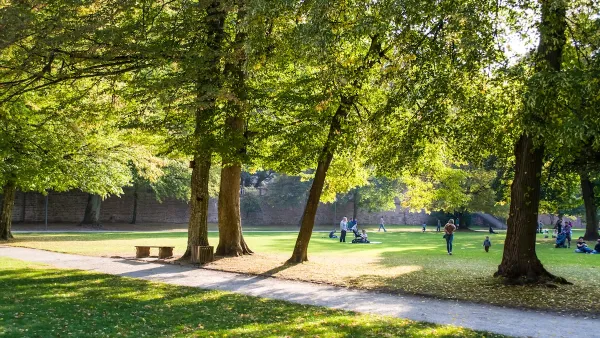
Advancing Sustainability and Resilience Through Parks
The Urban Land Institute offers fact sheets describing five innovative ways that parks can reduce carbon emissions and mitigate climate threats while advancing health, equity, and quality of life in urban areas.

How Extreme Heat Impacts Heart Health
A higher number of high heat days correlates with more cardiovascular deaths, according to new research.
Copenhagen is losing its cool
In a city long designed to maximize light during dark Scandinavian winters, climate change is forcing the Danish capital to rethink its relationship with the sun.

Planetizen Federal Action Tracker
A weekly monitor of how Trump’s orders and actions are impacting planners and planning in America.

The state-sanctioned urbicide of Austin
People don’t kill cities. Freeways do.

US to reduce Colorado River water deliveries to Mexico
A new Colorado Treaty amendment reduces Mexico’s Colorado River water allocation by 250,000 acre feet.

Colorado’s Largest Data Center Could Rise Next to Homes — Without a Public Hearing
The proposed campus would consume 11 times the power of Denver International Airport; as it has across the country, opposition mounts.

5 New England states march closer to 800 megawatt wind energy project
Securing federal approval for the project may be complicated under the Trump administration, which has historically been hostile towards domestic wind power.

Baltimore to break ground on $50 million Transit Priority Project
The project will bring faster bus trips, safer streets and better bike connections to Baltimore.

FREE Course: Walkable City 1: Why Walkability?
After describing his path towards focusing on walkability as the essence of good planning, Jeff Speck marches through his five principal reasons for making more walkable places.
Reinventing Malls: Planning Alchemy—Turning Gray Fields Into Gold
The course focuses on the opportunities and imperatives that shape reinvention of mall sites.

Eagle County Government
Harvard University Graduate School of Design
Nashville Planning Department
The Architects Foundation
University of Cincinnati Online
The Pocatello Development Authority
The Urban Renewal Agency of the City of Pocatello
Journal of the American Planning Association