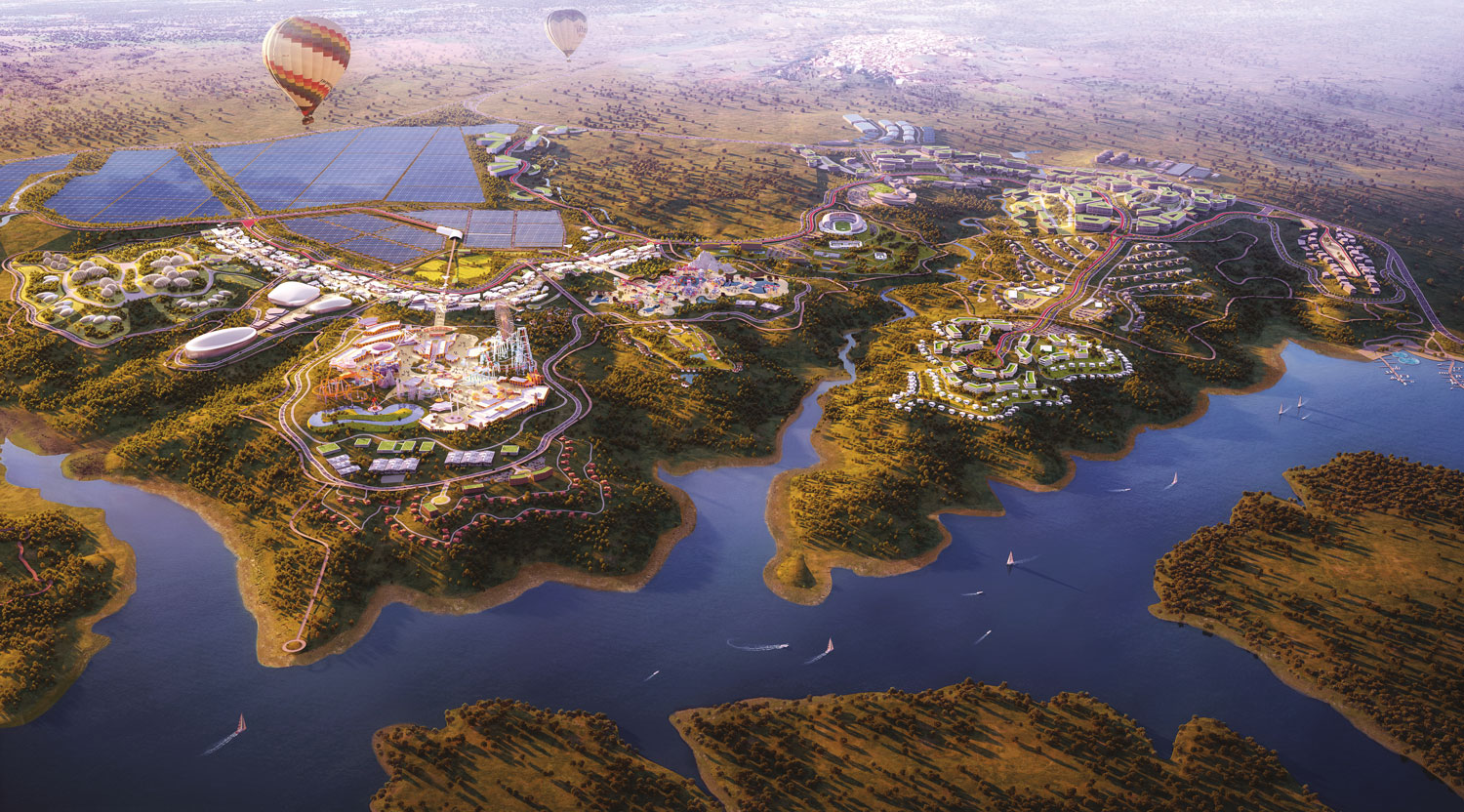
The development proposes a from-scratch sustainable community built on brand new land at the edge of a reservoir.



In the tradition of built-from-scratch ‘cities,’ a new development in Spain purports to be Europe’s first foray into the literal construction of new land on the edge of a reservoir, reports Elissaveta M. Brandon in Fast Company.
Elysium City, as it is called, is billed as Europe’s first circular city to be built from the ground up, following a masterplan by global architecture firm Gensler. It will span 2,900 acres (about 4.5 square miles) and is expected to be completed in 20 years, with the first phase opening in about 5.
The article notes the similarities to Saudi Arabi’s Neom. “Both are described as sustainable havens with solar farms, a rail network, and electric vehicles.” However, Brandon explains that Elysium could avoid some of the pitfalls of Neom. For one, “It promises to work with nature, not against it.”
Originally conceived as a glittering luxury gambling haven—“Eurovegas”—the project was reimagined after the Covid-19 pandemic as a solar-powered, all-electric, sustainable community. But “construction is set to begin on the most economically profitable district of them all—entertainment—because [developer Francisco Nuchera] faced pressured from the local government to create jobs.” This means “the city will most likely look like Eurovegas before it looks like Elysium.”
FULL STORY: Spain is building a city from scratch. Can it avoid the mistakes of Saudi Arabia’s line-shaped metropolis?

Brownfield Playground
Ecopolis Plaza is a former industrial site that has become an inventive children's park, located roughly 12 miles from the center of Madrid. Nicole Jewell checks it out.

Swapping your gas car for an EV is greener than keeping it, research shows
An EV repays the 'carbon debt' caused by building it after 4,400 miles.

Climate change could double household water costs in some cities, study finds
New research suggests that climate change-related stressors are straining municipal water systems.

Planetizen Federal Action Tracker
A weekly monitor of how Trump’s orders and actions are impacting planners and planning in America.

The state-sanctioned urbicide of Austin
People don’t kill cities. Freeways do.

US to reduce Colorado River water deliveries to Mexico
A new Colorado Treaty amendment reduces Mexico’s Colorado River water allocation by 250,000 acre feet.

LA Metro’s ultimatum: no extra buses for LA28 if federal funding isn’t imminently secured
If Metro does not provide additional buses, LA28 organizers will have to find a new way to manage Olympic traffic. LA28’s budget does not include a line item for transit.

Colorado’s Largest Data Center Could Rise Next to Homes — Without a Public Hearing
The proposed campus would consume 11 times the power of Denver International Airport; as it has across the country, opposition mounts.

5 New England states march closer to 800 megawatt wind energy project
Securing federal approval for the project may be complicated under the Trump administration, which has historically been hostile towards domestic wind power.

FREE Course: Walkable City 1: Why Walkability?
After describing his path towards focusing on walkability as the essence of good planning, Jeff Speck marches through his five principal reasons for making more walkable places.
Reinventing Malls: Planning Alchemy—Turning Gray Fields Into Gold
The course focuses on the opportunities and imperatives that shape reinvention of mall sites.

Eagle County Government
Harvard University Graduate School of Design
Nashville Planning Department
The Architects Foundation
University of Cincinnati Online
The Pocatello Development Authority
The Urban Renewal Agency of the City of Pocatello
Journal of the American Planning Association