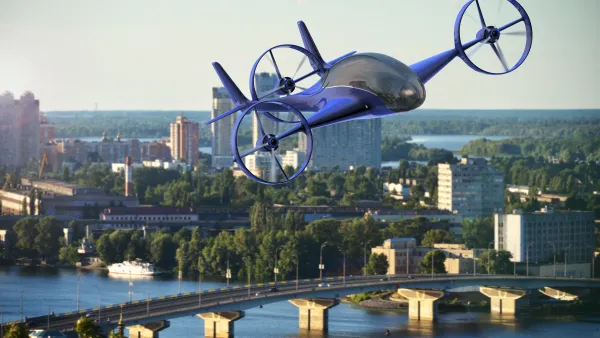
A $300,00 electric flying car has been cleared for test flights in the United States.



Federal regulators have granted a first-of-its-kind approval for a flying car.
“Alef Aeronautics, a Californian automaker, said in a press release it had received a Special Airworthiness Certification from the Federal Aviation Administration (FAA),” according to an article by Ryan Hogg.
“It's the first such approval for a flight-capable car, according to the startup, which has been backed by the likes of SpaceX,” adds Hogg.
The Federal Aviation Administration published an “Urban Air Mobility” concept of operations report in April 2023 that will limit the locations and purposes of the test flights.
As for the critical stats on the electric flying car, Hogg Reports that the Alef car “is able to take off vertically or horizontally, and can carry up to two people,” and “It's expected to have a road range of 200 miles and a flying range of 110 miles.” The price tag for the vehicle is also expected to be $300,000.
Read the full story: A $300,000 electric flying car just won approval for test flights
Minnesota Legalizes Flying Cars
A new Minnesota law outlines state registration of “roadable aircraft” and legalizes their use on state roads and highways.

This Flying Car Could Hit the Market by 2017
Bloomberg reports that the dream vehicle of commuters everywhere—a flying car—might be available on the market within three years.

Swapping your gas car for an EV is greener than keeping it, research shows
An EV repays the 'carbon debt' caused by building it after 4,400 miles.

Planetizen Federal Action Tracker
A weekly monitor of how Trump’s orders and actions are impacting planners and planning in America.

California plans to bury El Niño’s downpour
If the state plays its cards right, it may be able to store a billion acre-feet of El Niño’s water in aquifers.

Desperate measures: Advocates weigh draining Lake Powell to fill Colorado River
Draining the reservoir could reduce evaporation losses by a couple hundred thousand acre-feet.

Mamdani’s pied-à-terre tax survives legal challenge
A panel of judges found that the plaintiffs failed to demonstrate injury as a result of New York City's implementation of the tax.

Eastern Nebraska is running out of electricity
Data centers and electrification are straining eastern Nebraska’s grid, throttling economic development.

Seattle passes record-breaking transit services expansion
Proposition 1 will double the city’s transit tax to add 95,000 more bus trips and preserve 180,000 bus trips annually.

FREE Course: Walkable City 1: Why Walkability?
After describing his path towards focusing on walkability as the essence of good planning, Jeff Speck marches through his five principal reasons for making more walkable places.
Reinventing Malls: Planning Alchemy—Turning Gray Fields Into Gold
The course focuses on the opportunities and imperatives that shape reinvention of mall sites.

City of Rosemead
Rutgers University, Edward J. Bloustein School of Planning and Public Policy
One Hundred Miles
University of Michigan School for Environment and Sustainability (SEAS)
Hunter College, City University of New York (CUNY)
The Architects Foundation
City of Cambridge
Montrose County
The Pocatello Development Authority