Legislators in a state that so often touts its policies as the opposite of California’s defeated several bills that would have made housing construction easier, leading to concerns that a constricted housing market may exacerbate the housing crisis.


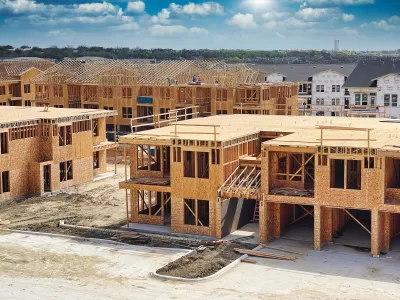
For decades, Texas land use and zoning policy has gone in a different direction than much of California, writes Duncan Hosie in an opinion piece for The Dallas Morning News. “Its land use and zoning regulations are less stringent. And affluent homeowners and bureaucrats have less power to block housing. As a result, more housing gets built every year in Texas than anywhere else, and far fewer people are rent burdened.”
But after the failure of several zoning-related bills to pass in the state legislature, Hosie charges Texas state legislators with being “all hat, no cattle” when it comes to their staunch opposition to ‘California-style’ policies, noting that NIMBY obstructionism and the unintended consequences of the California Environmental Quality Act (CEQA) have led to one of the nation’s worst housing crises.
The Texas bills in question would have permitted accessory dwelling units (ADUs), reduced minimum lot-size regulations, and “curbed so-called compatibility restrictions that limit the height of apartment buildings near single-family homes.” Hosie writes that “Disturbingly, many Democrats and Republicans in Texas trotted out the noxious NIMBY arguments that have reigned supreme in California to sink these proposals.”
According to Hosie, “while California offers a cautionary tale of bad housing policy, its growing YIMBY movement is charting a different course.” Texas legislators may want to look to this movement as a more effective model to “avoid the mistakes of its archrival.”
FULL STORY: Texas is going California on its housing policy


Montana Supreme Court Upholds Zoning Reform Bills
The decision invalidates a preliminary injunction that blocked two key housing bills.

A Look at Milwaukee’s Zoning Reform Proposal
The ‘Growing MKE’ plan calls for allowing ADUs, reducing barriers to new construction, and expanding the types of housing available in the city’s residential areas.

ADU Demand Grows Across the West Coast
In communities from California to Washington, permit applications for accessory dwelling units outpace the ability of permitting and construction to keep pace.

The state-sanctioned urbicide of Austin
People don’t kill cities. Freeways do.

US to reduce Colorado River water deliveries to Mexico
A new Colorado Treaty amendment reduces Mexico’s Colorado River water allocation by 250,000 acre feet.

New Jersey’s second-largest city bans standalone data centers
Jersey City will continue to allow co-location facilities, such as those meant for research institutions that store their own data.

Amtrak not solely to blame for New Jersey commuter rail's unreliability, report finds
A new study from the Garden State Initiative found that NJ Transit’s budget grew 20% across a 4 year period, but reliability declined significantly over the same period.

EPA erases limits on planet-warming pollution from power plants
Under Monday’s plan, power plants would still have some limits on how much mercury, arsenic and other contaminants they can emit.

Phoenix announces new on-demand transit service, more frequent RAPID buses
Both new services will launch in October, and are part of Phoenix's Project Effective Access Solutions for Easing Congestion.

FREE Course: Walkable City 1: Why Walkability?
After describing his path towards focusing on walkability as the essence of good planning, Jeff Speck marches through his five principal reasons for making more walkable places.
Reinventing Malls: Planning Alchemy—Turning Gray Fields Into Gold
The course focuses on the opportunities and imperatives that shape reinvention of mall sites.

Eagle County Government
Harvard University Graduate School of Design
Nashville Planning Department
The Architects Foundation
University of Cincinnati Online
The Pocatello Development Authority
The Urban Renewal Agency of the City of Pocatello
Journal of the American Planning Association