A new study by SPUR and the Urban Land Institute’s San Francisco chapter estimates a specific number of apartment units that could be built from vacant office units in the city.


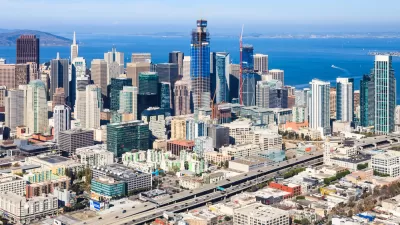
San Francisco is one of the prime examples of downtowns in need of reinvention from office-centric to housing-rich. As documented by recent articles shared by Planetizen, it’s not easy to convert office buildings to residential units, though there’s major potential benefit to identifying the kinds of buildings that can be converted.
Enter a new study by SPUR and the San Francisco Chapter of the Urban Land Institute, detailed in a paywalled article by John King for the San Francisco Chronicle. The two organizations are also hosting an event to dig into the study’s findings in a sold out event on March 28.
The analysis “suggests more than 10,000 housing units could be created within the shells of older office buildings — but only if the city primes the pump by lowering fees and affordable housing requirements,” reports King.
The structures that are the most promising candidates for conversion, according to the summary, are high-rises where the upper floors are no more than 20,000 square feet, roughly equal to the towers of One Market Plaza at the foot of Market Street. There should be an ample number of elevators, and they shouldn’t be too far from the outer windows. There also should be a good mix of views.
The study also includes recommendations for how to make these units make financial sense for developers, including removing or reducing “the current standard that new housing downtown must provide 75 square feet of outdoor space for each residential unit” and removing city requirements that “21.5% of new rental housing must be reserved for lower-income residents.”
“Some changes already are in the works: Mayor London Breed and Supervisor Aaron Peskin on Monday, for instance, announced they’ve crafted a proposed zoning update that would loosen current requirements that all multi-family housing projects include a sizable number of two- and three-bedroom units,” reports King. “It also would allow housing above the first floor of retail buildings in the Union Square district.”
While the full study will be published later this spring, a “Summary of Findings” is already available to read online.
Read the full story: S.F.’s empty office space could hold 11,000 new homes — but only with City Hall’s help, report says

Office Conversion Sees No Sign of Slowing
The adaptive reuse of office buildings for residential and other uses will grow by as much as 63 percent in 2024 over last year.
NYC Mayor Proposes Office Conversion Plan
Proposed zoning updates that would make it easier to convert office buildings in commercial districts to housing and other uses could yield up to 20,000 new housing units in the next decade.
Fourplexes on the Legislative Agenda in San Francisco
San Francisco, the poster child for runaway housing costs and displacement of existing residential populations, could be on the cusp of a change of plans.

Planetizen Federal Action Tracker
A weekly monitor of how Trump’s orders and actions are impacting planners and planning in America.

California plans to bury El Niño’s downpour
If the state plays its cards right, it may be able to store a billion acre-feet of El Niño’s water in aquifers.

Chicago breaks ground on $3 billion megadevelopment
The new neighborhood, titled Foundry Park, will one day host 3,700 residences.

Satanic place names
From streams and lakes to valleys and canyons, I mapped more than 1,000 places named after the Devil.

California High-Speed Rail Authority CEO resigns after $600,000 scandal
Under Ian Choudri, the authority used taxpayer dollars to fund first class flights and trips to nightclubs.

Want to study the Missouri River? Soon, you may need unanimous approval from 10 states
Legislation would require 10 governors’ permission to study or build projects moving water outside the basin.

FREE Course: Walkable City 1: Why Walkability?
After describing his path towards focusing on walkability as the essence of good planning, Jeff Speck marches through his five principal reasons for making more walkable places.
Reinventing Malls: Planning Alchemy—Turning Gray Fields Into Gold
The course focuses on the opportunities and imperatives that shape reinvention of mall sites.

City of Rosemead
Rutgers University, Edward J. Bloustein School of Planning and Public Policy
One Hundred Miles
Hunter College, City University of New York (CUNY)
The Architects Foundation
University of Cincinnati Online
City of Cambridge
Montrose County
The Pocatello Development Authority