The Bi-State Development Agency received roughly $7.4 million for efforts to expand the city’s MetroLink train system.


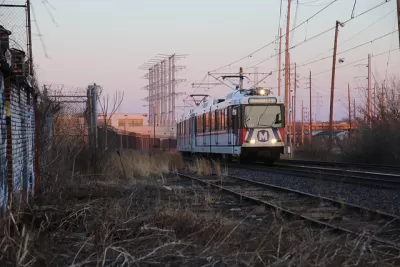
“About $7.4 million in federal pandemic aid allotted to the Bi-State Development Agency will pay for the next round of planning for a potential expansion of MetroLink” in St. Louis, according to an article by Mark Schlinkmann in the St. Louis Post-Dispatch. “Taulby Roach, the agency’s CEO, said the next phase would include seeking public opinion on the possible stations along the revised route for the line, which would run along Jefferson Avenue from Chippewa Street to the National Geospatial-Intelligence Agency headquarters.”
The estimated cost for the project is $850 million. “Information developed in the next phase of planning will be used to base an application to the federal government for 60% of the project cost,” Schlinkmann writes. “Meanwhile, St. Louis County and AECOM are researching a potential extension of the city’s northside-southside line into North County. Four alternative routes were announced last month.”
FULL STORY: Federal pandemic aid to pay for next round of planning for MetroLink expansion

Mass Transit Wins Big in St. Louis County
A half-cent sales tax increase to fund transit passed handily yesterday in St. Louis County, Missouri.

Portland gathers to pay respects to the last of its original light rail cars
The TriMet agency has fully replaced its aging fleet of Type 1 cars.

Despite 47% growth in ridership, Caltrain could close a third of its stations
Riders can currently travel up to 79 miles between San Francisco and Gilroy, California.

Planetizen Federal Action Tracker
A weekly monitor of how Trump’s orders and actions are impacting planners and planning in America.

The state-sanctioned urbicide of Austin
People don’t kill cities. Freeways do.

US to reduce Colorado River water deliveries to Mexico
A new Colorado Treaty amendment reduces Mexico’s Colorado River water allocation by 250,000 acre feet.

5 New England states march closer to 800 megawatt wind energy project
Securing federal approval for the project may be complicated under the Trump administration, which has historically been hostile towards domestic wind power.

Baltimore to break ground on $50 million Transit Priority Project
The project will bring faster bus trips, safer streets and better bike connections to Baltimore.

Airbnb launches $250 million 'last-dollar financing' housing accelerator, makes first investment in Austin
The company will put $6.4 million towards affordable housing development in Texas’ capital.

FREE Course: Walkable City 1: Why Walkability?
After describing his path towards focusing on walkability as the essence of good planning, Jeff Speck marches through his five principal reasons for making more walkable places.
Reinventing Malls: Planning Alchemy—Turning Gray Fields Into Gold
The course focuses on the opportunities and imperatives that shape reinvention of mall sites.

Eagle County Government
Harvard University Graduate School of Design
Nashville Planning Department
The Architects Foundation
University of Cincinnati Online
The Pocatello Development Authority
The Urban Renewal Agency of the City of Pocatello
Journal of the American Planning Association