Residents of Los Angeles who drive less are exposed to higher rates of air pollution due to policies that have encouraged commuting through low-income neighborhoods.


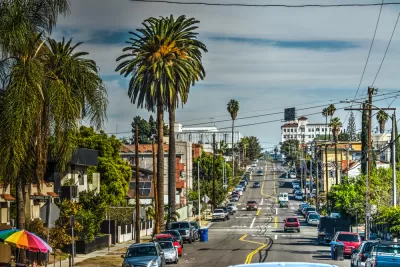
“Los Angelenos who drive less are exposed to more air pollution, as commuters from predominantly white neighborhoods travel through non-white areas,” according to a new study from the USC Sol Price School of Public Policy. A larger share of the city’s non-white residents experience air pollution than their white peers, regardless of their income.
As Christian Hetrick explains, this is in large part a result of historical planning decisions that discriminated against communities of color. “Twentieth-century planners bulldozed urban areas to build freeways for suburban residents to drive to job centers. Although whiter and wealthier areas like Beverly Hills successfully blocked such projects, similar opposition efforts failed in less-white and less-wealthy parts of L.A., such as Boyle Heights, which was carved up by five freeways and two enormous interchanges.”
The study’s authors suggest some policy fixes that could begin undoing these inequities. These include raising fuel efficiency standards and promoting cleaner transportation, enacting congestion pricing and promoting remote work to reduce driving, and reforming zoning laws to permit more housing construction in job-rich areas and less polluted neighborhoods.
Read the full story: Pollution Paradox: Study finds L.A. residents who drive less are exposed to more air pollution

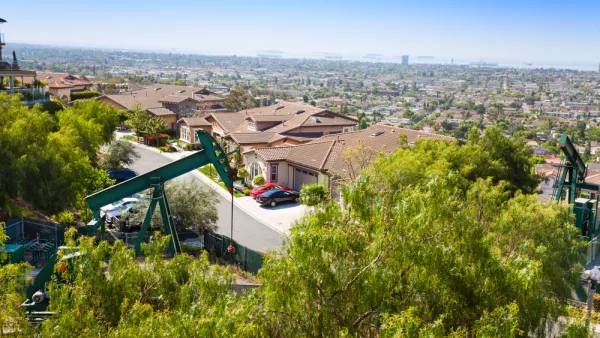
Study: L.A. County's Urban Oil Wells Are Too Close to Homes and Schools
The Department of Public Health recommends taking action to better protect residents from oil operations that are sometimes only a few feet from where people live, work, eat, play and study.
A 'Good News' Air Pollution Study for a Change
Too often we report on new studies showing how air pollution worsens public health, often causing premature death. For a change, here's a study showing how efforts to improve air quality in Southern California have boosted public health in children.
Under Pressure, EPA Tightens Soot Standard
In what could be viewed as a classic environmentalist vs. business showdown, the EPA tightened by 20% the annual standard for soot over the objection of industry and some in Congress who fear it will dampen economic growth.

Planetizen Federal Action Tracker
A weekly monitor of how Trump’s orders and actions are impacting planners and planning in America.

The state-sanctioned urbicide of Austin
People don’t kill cities. Freeways do.

US to reduce Colorado River water deliveries to Mexico
A new Colorado Treaty amendment reduces Mexico’s Colorado River water allocation by 250,000 acre feet.

Nation's most wind-powered state turns to coal as data centers increase energy demand
For the first time in decades, Iowa has increased its generation of coal power.

NYC cools commuters with city's first rain garden above a bus stop
New York City officials say the plants in the rain garden can absorb 16 gallons of rainwater during heavy storms.

Brightline West’s future may rely on $6 billion federal loan
The company has until Nov. 2 to make a $400 million equity investment into its proposed high-speed rail line.

FREE Course: Walkable City 1: Why Walkability?
After describing his path towards focusing on walkability as the essence of good planning, Jeff Speck marches through his five principal reasons for making more walkable places.
Reinventing Malls: Planning Alchemy—Turning Gray Fields Into Gold
The course focuses on the opportunities and imperatives that shape reinvention of mall sites.

Greater Baltimore Committee
Eagle County Government
Harvard University Graduate School of Design
The Architects Foundation
University of Cincinnati Online
The Pocatello Development Authority
The Urban Renewal Agency of the City of Pocatello
Journal of the American Planning Association