How can we get more accessory dwelling units built, keep them affordable, and make them a force for increasing racial equity?


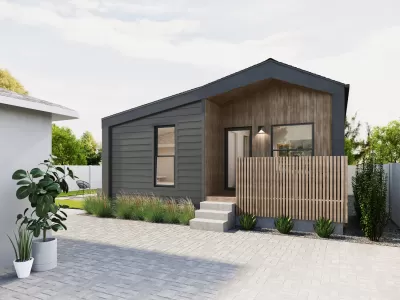
Accessory dwelling units, or ADUs, have become one piece of an answer to building a housing system that has enough housing, at the right cost, for everyone. Because they tend to be smaller, ADUs are theoretically more affordable. These smaller units can be added to current single-family homes—in backyards, basements, or over garages—and they don’t add to sprawl. They bring rental options to places that lack them, and can give homeowners a little additional cash flow.
But as Shelterforce explored last year in the Under the Lens series ADUs Explained, it’s not quite as simple to implement as it sounds.
Shelterforce’s Miriam Axel-Lute recently moderated a conversation about accessory dwelling units during Next City’s Solutions of the Year convening.
Miriam Axel-Lute: There are three separate questions when it comes to ADUs, affordability, and equity. First, how to get them built in any quantity. But then there are two other intertwining questions that are of central importance. One, how to make building an ADU feasible for and accessible to the lower-income homeowners who could use the cash flow the most and to the homeowners of color who’ve been excluded from building the kind of equity in their homes that would make financing an ADU easier, and also how to create ADU units that are themselves accessible and affordable to the lower-income renters. Our speakers today are working on these questions, but especially those last two, coming at it from different angles in different parts of the country.
I’m going to start off our discussion by turning things over to Nikki Beasley and Domanic Green, who work with the Keys to Equity program in California.
Nikki Beasley: We have been on the mark of creating innovation, as it relates to figuring this thing out, and it’s good to know we are not alone. We sit in the city of Richmond, California, supporting Alameda, Contra Costa, and Solano counties.
The Keys to Equity program is specific to the city of Oakland homeowners, with a guided principle of helping the Black homeowner. It is not an exclusive program, but some of the data shows that the Black homeowner definitely deserves the opportunity to have some focus. Since 2011, rent in the city has increased over 72 percent. Eighty percent of Oakland’s lowest-income households are cost burdened as relates to the amount of their income going to their rental housing, and as many Bay Area cities have acknowledged, there’s been an exodus of the African American community in the city of Oakland, and in the Bay Area. Oakland at one time had the highest concentration of Blacks, but it is now transitioned.
Because of that, we wanted to think through our approach. This whole program was started early 2020. The city of Oakland reached out to the Chan Zuckerberg [Initiative] and said, “Hey, we have an idea. What if we try to bring accessory dwelling units to the homeowners with the explicit purpose of focus on the Black homeowner?”
Through that process an RFP was created. Richmond Neighborhood Housing Services, along with other community partners, came up with an idea. It was selected, and then in 2021, we worked on the execution, and this program officially launched in October 2021. And the strategic approach is continuing to work with public private partnerships because it is very clear that there are many moving parts to the work. So it’s imperative that we have ...
Please see the source article to continue reading.
Read the full story: Taking the ADU Model to the Next Level, a Shelterforce and Next City Webinar


Federal Rule Change Lets Banks Include ADU Income in Mortgage Decisions
A policy change from the Federal Housing Administration is designed to spur more rental housing construction and bring homeownership within reach of more U.S. households.
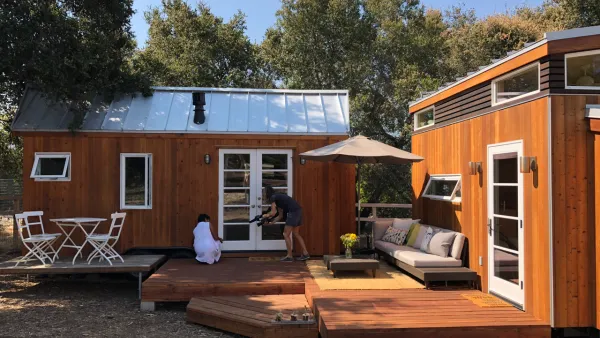
How One Town Solved its ADU Regulation Challenges
Against opposition, the town of Durango, Colorado has successfully found a way to permit accessory dwelling units and legalize those that already existed under the radar.

ADUs account for nearly 28% of Bay Area housing permits
In Hillsborough, 56 of 58 homes permitted in 2025 were ADUs.

Planetizen Federal Action Tracker
A weekly monitor of how Trump’s orders and actions are impacting planners and planning in America.

Amtrak, CN end decades-long dispute with eight-year agreement
The new operating agreement establishes an updated framework for the companies to work together, including processes to resolve disputes.

Judges permit Denver to divert 77,000 acre feet from the Colorado River for reservoir expansion
Overuse and climate change have caused the Colorado River’s water levels to plummet.

NYC DOT wants faster, more permanent street upgrades
The city is examining ways to build more concrete infrastructure without getting entangled in 'decades-long' projects.

'Something we’ve never seen before:' rising utility rates could strain city finances nationwide
Data centers, climate change and other factors have caused utility rates in the United States to increase by 38% since 2020.

Trump to overrule local leaders, lease millions of acres of America’s Pacific Island territories’ seafloors to mining companies
International law says that the Indigenous people of America’s territories have a right to prior and informed consent regarding projects that impact their countries.

FREE Course: Walkable City 1: Why Walkability?
After describing his path towards focusing on walkability as the essence of good planning, Jeff Speck marches through his five principal reasons for making more walkable places.
Reinventing Malls: Planning Alchemy—Turning Gray Fields Into Gold
The course focuses on the opportunities and imperatives that shape reinvention of mall sites.

Harvard University Graduate School of Design
KFH Group Inc.
Greater Baltimore Committee
The Architects Foundation
University of Cincinnati Online
The Pocatello Development Authority
The Urban Renewal Agency of the City of Pocatello