The city hopes to improve the speed of its notoriously slow buses by using traffic cameras to ticket drivers who drive or park in dedicated bus lanes.


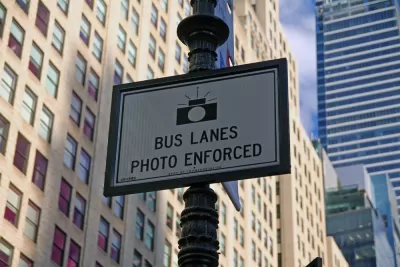
“Despite New York’s 140 miles of dedicated bus lanes, other large U.S. cities put it to shame when it comes to average bus speed,” writes Danielle Muoio Dunn in Politico, with some buses clocking in at half the average speed of other major cities. “Despite having dedicated access, vehicles parked in bus lanes continue to mar the city’s efforts to dramatically improve speeds and service reliability.”
Now, the city plans to use traffic cameras to issue citations for the notoriously common practice of blocking bus lanes. “During a 20-minute ride along the entire 42nd Street bus lane on a Thursday afternoon in August, POLITICO counted 11 vehicles idling or parked in the busway — including a UPS truck, taxis and SUVs and a commercial delivery van. One car used the bus lane to cut ahead of the gridlock traffic in Times Square, temporarily blocking access as it attempted to merge back into the crowded lane.”
After convening at a Transit Improvement Summit, transit officials committed to installing 50 additional cameras in bus lanes. “Meanwhile, the MTA recently awarded a contract to California tech startup Hayden AI to mount 300 more cameras on buses — bringing its automated enforcement program to 473 buses by the end of this year.” In 2021, the camera program captured more than 600,000 violations.
The article notes that “The tickets have an impact. Less than 20 percent of drivers who are issued a bus lane violation go on to commit another, according to the MTA, which started tracking the data in 2019 when it began mounting cameras on buses. Only 8 percent of motorists have gone on to commit more than two violations.”
FULL STORY: Can camera enforcement speed up New York's sluggish buses?

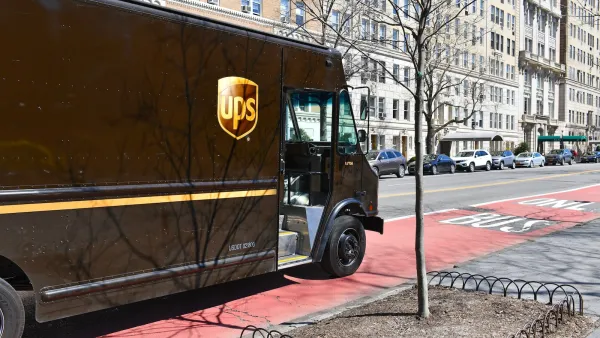
UPS trucks blocked NYC bus lanes 25,000 times last year
The city recorded 843,000 bus lane violations in 2025.
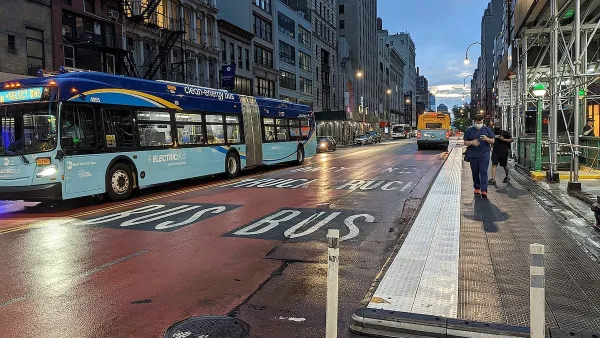
NYC Politicians, Public Rally in 'Outrage' to Save Bus Lane Killed by Trump
City officials say the project complies with all applicable laws and should go forward as planned.
NYC Camera Program Captures 400,000 Bus Lane Violations
Bus speeds increased by as much as 25 percent on some routes after enforcement began last August.

Planetizen Federal Action Tracker
A weekly monitor of how Trump’s orders and actions are impacting planners and planning in America.

The state-sanctioned urbicide of Austin
People don’t kill cities. Freeways do.

US to reduce Colorado River water deliveries to Mexico
A new Colorado Treaty amendment reduces Mexico’s Colorado River water allocation by 250,000 acre feet.

5 New England states march closer to 800 megawatt wind energy project
Securing federal approval for the project may be complicated under the Trump administration, which has historically been hostile towards domestic wind power.

Baltimore to break ground on $50 million Transit Priority Project
The project will bring faster bus trips, safer streets and better bike connections to Baltimore.

Airbnb launches $250 million 'last-dollar financing' housing accelerator, makes first investment in Austin
The company will put $6.4 million towards affordable housing development in Texas’ capital.

FREE Course: Walkable City 1: Why Walkability?
After describing his path towards focusing on walkability as the essence of good planning, Jeff Speck marches through his five principal reasons for making more walkable places.
Reinventing Malls: Planning Alchemy—Turning Gray Fields Into Gold
The course focuses on the opportunities and imperatives that shape reinvention of mall sites.

Eagle County Government
Harvard University Graduate School of Design
Nashville Planning Department
The Architects Foundation
University of Cincinnati Online
The Pocatello Development Authority
The Urban Renewal Agency of the City of Pocatello
Journal of the American Planning Association