In a letter to city officials, a law firm called on the city to lift restrictions on food trucks, saying the ban “smacks of protectionism” and could violate equal protection guarantees.



A nonprofit law firm is warning Denver officials that the city’s ban on food trucks in the Lower Downtown district could be unconstitutional, according to an article by Joe Rubino in the Denver Post. “The Institute for Justice, a Virginia-based, nonprofit law firm, sent a letter to Denver City Council members on Wednesday urging the “repeal” of the ban that bars food trucks from portions LoDo on Thursday, Friday and Saturday nights.” As the article notes, the city clarified that the ban only applies on Friday and Saturday.
“The firm’s lawyers argue the Denver ban ‘smacks of protectionism’ because businesses with permanent storefronts aren’t subject to the same rules. The letter also points to previous Institute for Justice research that indicates food trucks enhance public safety by making streets more inviting and providing more eyes and ears.”
According to the letter, the firm, which has “sued numerous jurisdictions whose laws have impermissibly restricted vendors’ right to economic liberty as guaranteed by the U.S. Constitution and the respective state constitutions,” also works with local governments to “craft vending laws that ensure the public’s health and safety while maximizing opportunities for vendors and consumers alike.”
The Denver Police Department and the Department of Transportation and Infrastructure instituted the ban in July, citing security concerns, but is now considering rolling back the ban “in a limited fashion.”
FULL STORY: Denver’s LoDo food truck ban is likely unconstitutional, law firm warns city leaders

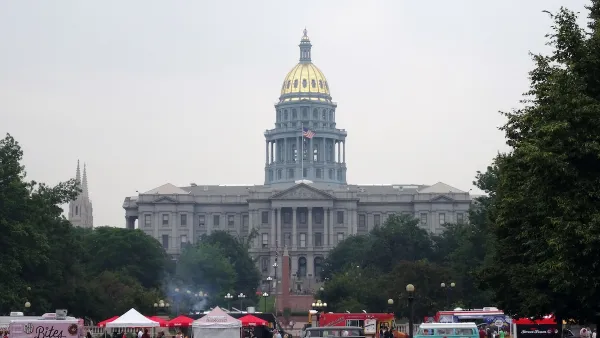
Denver Bans Downtown Food Trucks — Again
City officials say the controversial policy, first enacted in 2022, is an effort to reduce crime in the nightlife district.

Food Trucks, Already an Industry Force, Set for More Growth
A new report details the state of the mobile food vending industry and makes predictions for the short-term future.
New York City Sidewalks Overflowing with Vibrancy, and Conflict
Jeremy Smerd describes the competition over sidewalk space in New York, as commerce overflows out of buildings and into public space.

Planetizen Federal Action Tracker
A weekly monitor of how Trump’s orders and actions are impacting planners and planning in America.

The state-sanctioned urbicide of Austin
People don’t kill cities. Freeways do.

US to reduce Colorado River water deliveries to Mexico
A new Colorado Treaty amendment reduces Mexico’s Colorado River water allocation by 250,000 acre feet.

5 New England states march closer to 800 megawatt wind energy project
Securing federal approval for the project may be complicated under the Trump administration, which has historically been hostile towards domestic wind power.

Baltimore to break ground on $50 million Transit Priority Project
The project will bring faster bus trips, safer streets and better bike connections to Baltimore.

Airbnb launches $250 million 'last-dollar financing' housing accelerator, makes first investment in Austin
The company will put $6.4 million towards affordable housing development in Texas’ capital.

FREE Course: Walkable City 1: Why Walkability?
After describing his path towards focusing on walkability as the essence of good planning, Jeff Speck marches through his five principal reasons for making more walkable places.
Reinventing Malls: Planning Alchemy—Turning Gray Fields Into Gold
The course focuses on the opportunities and imperatives that shape reinvention of mall sites.

Eagle County Government
Harvard University Graduate School of Design
Nashville Planning Department
The Architects Foundation
University of Cincinnati Online
The Pocatello Development Authority
The Urban Renewal Agency of the City of Pocatello
Journal of the American Planning Association