Jeremy Smerd describes the competition over sidewalk space in New York, as commerce overflows out of buildings and into public space.


12,750 miles of New York City sidewalk may sound like a lot. Pedestrian traffic is up 10% since 2007, however, and increases in pedestrian activity have ramped up the street vendor and sidewalk cafe market. Add to this the everyday scaffolding obstacles and sidewalk closures, plus amenities like streetscaping, pay phones and, soon enough, bike-share racks scattered across the city and even a couple thousand miles of space can start to feel crowded. The former commissioner of the Department of Transportation, Alex Mautner, explains the unfolding challenges:
"Sidewalk activity is what makes New York vibrant. The question is, how do you harness it and how do you bring a modicum of decorum to the streets so that it functions?"
Fred Kent, with the Project for Public Spaces, argues that the only reasonable solution is to make sidewalks bigger. In order to harness the power of the pedestrian, Kent suggests cutting into parking and vehicle lanes to make room for wider sidewalks because, as he points out, "cars don't shop".
Thanks to Jessica Brent
FULL STORY: Herds on the street


Denver Food Truck Ban Could be Unconstitutional
In a letter to city officials, a law firm called on the city to lift restrictions on food trucks, saying the ban “smacks of protectionism” and could violate equal protection guarantees.
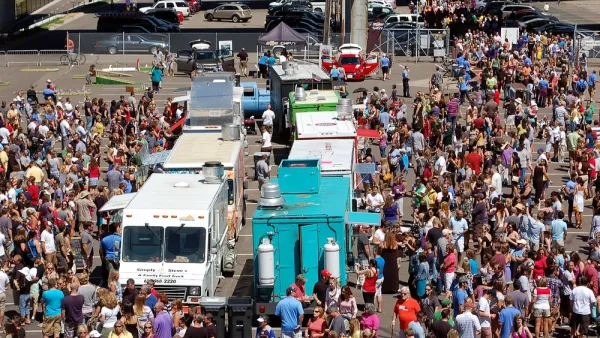
Food Trucks, Already an Industry Force, Set for More Growth
A new report details the state of the mobile food vending industry and makes predictions for the short-term future.
The Growing Food Truck Industrial Complex
The food truck phenomenon is here to stay and stimulating tangential industries that include truck outfitters, permit expediters, lawyers lobbyists, website designers, and marketing professionals.

Planetizen Federal Action Tracker
A weekly monitor of how Trump’s orders and actions are impacting planners and planning in America.

The state-sanctioned urbicide of Austin
People don’t kill cities. Freeways do.

US to reduce Colorado River water deliveries to Mexico
A new Colorado Treaty amendment reduces Mexico’s Colorado River water allocation by 250,000 acre feet.

5 New England states march closer to 800 megawatt wind energy project
Securing federal approval for the project may be complicated under the Trump administration, which has historically been hostile towards domestic wind power.

Baltimore to break ground on $50 million Transit Priority Project
The project will bring faster bus trips, safer streets and better bike connections to Baltimore.

Airbnb launches $250 million 'last-dollar financing' housing accelerator, makes first investment in Austin
The company will put $6.4 million towards affordable housing development in Texas’ capital.

FREE Course: Walkable City 1: Why Walkability?
After describing his path towards focusing on walkability as the essence of good planning, Jeff Speck marches through his five principal reasons for making more walkable places.
Reinventing Malls: Planning Alchemy—Turning Gray Fields Into Gold
The course focuses on the opportunities and imperatives that shape reinvention of mall sites.

Eagle County Government
Harvard University Graduate School of Design
Nashville Planning Department
The Architects Foundation
University of Cincinnati Online
The Pocatello Development Authority
The Urban Renewal Agency of the City of Pocatello
Journal of the American Planning Association