The e-commerce giant has been quietly buying up massive swaths of property as the company works to reduce shipping times as dramatically as possible.


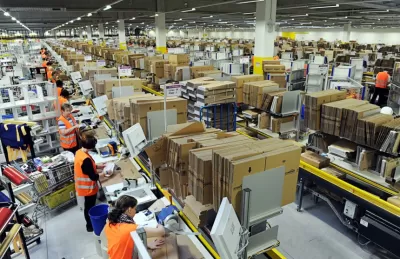
A Bloomberg article by Spencer Soper and Natalie Wong explains the growth of Amazon’s real estate holdings. “Starting about three years ago, the Seattle-based colossus quietly began searching for property in key US markets such as Southern California, Texas, Illinois, Florida and the Bay Area. Between 2020 and 2022, Amazon tripled the amount of built industrial space it owns in North America, according to company filings.”
As the authors note, “It’s a potentially risky strategy that exposes Amazon to the vagaries of the industrial real estate market. The company also overbuilt during the pandemic and is saddled with too much warehouse space now that the surge in online shopping has decelerated.” Yet “Executives remain committed to securing land in the right locations to fulfill founder Jeff Bezos’ vision of making an online purchase as instantly gratifying as a trip to the store.”
However, “Buying land is risky. Developing it is even more so because Amazon itself must negotiate the local bureaucracy and politics. But executives feel they have no choice, according to people familiar with the strategy, because the new generation of fulfillment centers are several orders of magnitude more complicated than the 40-foot boxes currently dotted around the country.”
According to the article, the company is already hedging its bets, slowing down their plans as online sales slow and a recession looms on the horizon. “The question now is how Amazon will adapt a boom-era strategy to current economic conditions.”
FULL STORY: Amazon Builds Property Empire, Quietly Buying Land Across the US

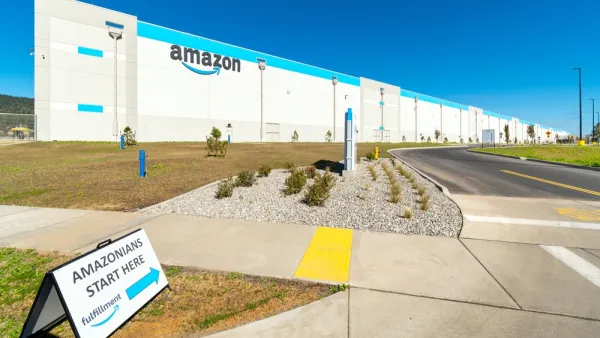
Amazon Plans for More Massive Warehouses
The company is building its biggest-ever distribution centers in New York, Colorado, and California.
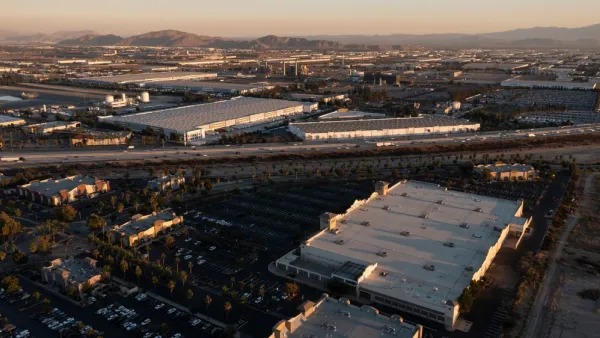
Communities Near Warehouses Unprotected by Outdated Zoning Codes
Today’s massive modern distribution centers have outsized impacts on adjacent neighborhoods. But outdated zoning codes often let them slip through the cracks with no environmental review.
Amazon Plans Further Expansion
On the heels of building its HQ2 facility in Arlington, Amazon continues to expand its hubs in cities spread out across the country.

The state-sanctioned urbicide of Austin
People don’t kill cities. Freeways do.

US to reduce Colorado River water deliveries to Mexico
A new Colorado Treaty amendment reduces Mexico’s Colorado River water allocation by 250,000 acre feet.

New Jersey’s second-largest city bans standalone data centers
Jersey City will continue to allow co-location facilities, such as those meant for research institutions that store their own data.

Amtrak not solely to blame for New Jersey commuter rail's unreliability, report finds
A new study from the Garden State Initiative found that NJ Transit’s budget grew 20% across a 4 year period, but reliability declined significantly over the same period.

EPA erases limits on planet-warming pollution from power plants
Under Monday’s plan, power plants would still have some limits on how much mercury, arsenic and other contaminants they can emit.

Phoenix announces new on-demand transit service, more frequent RAPID buses
Both new services will launch in October, and are part of Phoenix's Project Effective Access Solutions for Easing Congestion.

FREE Course: Walkable City 1: Why Walkability?
After describing his path towards focusing on walkability as the essence of good planning, Jeff Speck marches through his five principal reasons for making more walkable places.
Reinventing Malls: Planning Alchemy—Turning Gray Fields Into Gold
The course focuses on the opportunities and imperatives that shape reinvention of mall sites.

Eagle County Government
Harvard University Graduate School of Design
Nashville Planning Department
The Architects Foundation
University of Cincinnati Online
The Pocatello Development Authority
The Urban Renewal Agency of the City of Pocatello
Journal of the American Planning Association