Twitter is changing, not in the way Elon Musk wants it to, but it’s still perhaps the most useful social media platform for planners looking for education and engagement.


The List
If you’re looking for recommendations for Twitter follows to level up your planning knowledge, check out the new "Planning Twitter 2022" list. The methodology for the list and links to additional planning-relevant Twitter lists follow below.
Elon Musk and Twitter Discontent
Elon Musk keeps finding ways to enter the planning chat. In years past, the PayPal co-founder leveraged his fame and wealth to achieve new levels of fame and wealth with companies like SpaceX and Tesla. The latter has been the most frequent contributor to planning debates, for its extra-legal rollout of autonomous vehicle technology, penchant for distracting interior features, and dubious claims on sustainability.
In more recent years, Musk has pivoted to tunnels, with the Boring Company, and a yet-unrealized transportation system called the Hyperloop, losing friends and making enemies among the planning profession while somehow winning contracts from politicians and bureaucrats.
Musk’s latest skirmish with the planning profession has been tangential to his recent flirtation with the idea of buying Twitter, a long-time forum for planning conversation, news, and debate, like it is for so many other niches of public interest. Although it now looks like Musk’s attempt to buy the social media platform is falling apart (see the latest reporting by The Washington Post, Associated Press, CBS News, and Bloomberg for more on how Musk is retreating from the idea), the mere idea of Musk taking over Twitter sent users streaming for the exits. Of course, some previous users had already left, after the company decided to ban former President Donals Trump from the platform for his role in the January 6, 2021 attack on the U.S. Capitol Building.
The controversy over Trump's ouster seems to be one of Musk's motivations for buying Twitter. Musk has stated he would reinstate Trump on Twitter if he bought the company (although the former president might not accept the invitation given his obligations to the new social media platform, Truth Social). For now, at least, Twitter is noticeably Trump-free compared to 2015-2021.
Despite its new role as a bargaining chip in the culture wars of the 21st century, Twitter is still one of the most valuable tools for planners. That value depends far less on the involvement of Elon Musk or Donald Trump than it does the involvement of millions of passionate, well informed, curious individuals and organizations. While Musk can certainly do damage to the platform through poor choices regarding challenging issues like chronological timelines, advertising, tweet editing, or Donald Trump, the worst thing he can do is drive people from the platform.
Twitter is often touted as a key tool for contemporary community engagement practices, allowing planners to ask and find specific answers to questions that might otherwise go unrepresented during in-person public hearings. I’m not sure Twitter is the best resource for community engagement, given the many other rival social media platforms and how they go in and out of fashion with the general public as technology changes and generations age. Twitter is still, however, most valuable as a tool for learning. A thoughtful, studious approach to Twitter can make an expert and an effective advocate out of anyone.
While many critics balked at the idea of Musk spending $41 billion to buy Twitter, for the rest of us, Twitter is priceless.
Doomscrolling and How to Avoid It
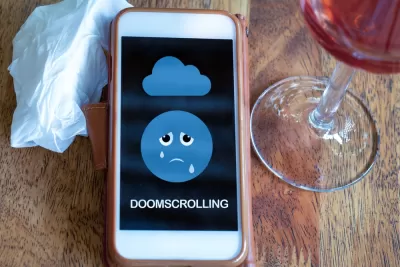
There have been many significant changes to Twitter over the years—even since Planetizen last published a Top Twitter list at the beginning of 2020. Donald Trump may be gone, but there is still plenty of anxiety to go around, thanks to daily confrontations with mass shootings, war, climate change, or the occasional violent insurrection. The outset of the Covid pandemic proved a tipping point for the vibe of Twitter, pushing many users into a form of addictive behavior on the site that came to be known colloquially as “doomscrolling”—i.e., “When you keep scrolling through all of your social media feeds, looking for the most recent upsetting news about the latest catastrophe. The amount of time spent doing this is directly proportional to how much worse you're going to feel after you're done” (according to the Urban Dictionary).
To a lesser degree than world events, recent changes on the platform have also contributed to doomscrolling. such as the non-chronological timeline generated by Twitter’s algorithm, and some of these changes can be undone. It is possible, I can say from experience, to spend an entire evening reading the same tweets over and over again, even after hours have passed.
In lieu of just putting the phone down, there are steps to take to return the feed to a more chronological, less algorithmically manipulated timeline.
First of all, you can always make liberal use of the mute function to silence trolls, edgelords, and racists. Say you wanted to mute Elon Musk, for example: follow the instruction provided by Twitter to make sure you never see any posts by Elon Musk. Or you can even mute the words “Elon Musk” to make sure you never see any tweets that mention Elon Musk, as explained in an article by Barbara Krasnoff. You might still see screengrabs of Elon Musk tweets, but then you can always mute the people who share screengrabs of Elon Musk.
Then there is the non-chronological timeline that allows Twitter’s algorithm to make sometimes questionable, repetitive, and unsanctioned choices about what you see and read when you open the app. As explained in this article by Brad Stephenson, the process of mitigating the Twitter algorithm’s fingerprint on your Twitter feed requires returning your timeline to chronological view and getting rid of Twitter's promoted tweets, random tweets liked by people you follow, conversation threads, "In case you missed it," and account recommendations.
To remove that latter group of tweets, Stephenson and this Twitter user recommend the use of Twitter Lists. I have a “News” list that I have cultivated for years to help me do more job efficiently and effectively.
My steady attention to my news list list over the years has informed many of the selections in the new the “Planning Twitter 2022” list.
To create, I also poured through the “Urbanist Leaders of Color” list by Lynn Ross (@mslynnross), the “Planning Faculty” list generated by the research of Tom Sanchez in 2019, and the “Planning Twitter 2020.”
The Planning Twitter 2022 list is far from comprehensive, although I did spend hours cultivating the list based on relevance, activity, authority, and authority. With so many intersections, sub-fields, organizations, institutions, and representations contributing to the field, a compressive list is almost impossible, so I apologize if I missed anyone or any organization critical to planning Twitter. I will continue to refine the 2022 list for the next few months, so please let me know if I missed anything.


Is Twitter Still an Effective Planning Tool?
Twitter has been a daily dose of drama and upheaval ever since Elon Musk offered to pay over $40 billion to buy the social media platform. Media outlets and public transit agencies had been abandoning the social media platform—should planners?

Twitter for Urban Planning
Few social media sites offer the same kind of diversity of information and opinion to a field of study than Twitter does for planning.

Which Urban Planning Academics Use Twitter and How
About 1/3 of planning faculty members use Twitter in a professional capacity. Semantic and network analysis of their Twitter use is helpful for reading the pulse of the field.

Planetizen Federal Action Tracker
A weekly monitor of how Trump’s orders and actions are impacting planners and planning in America.

California plans to bury El Niño’s downpour
If the state plays its cards right, it may be able to store a billion acre-feet of El Niño’s water in aquifers.

Chicago breaks ground on $3 billion megadevelopment
The new neighborhood, titled Foundry Park, will one day host 3,700 residences.

Satanic Place Names
From streams and lakes to valleys and canyons, I mapped more than 1,000 places named after the Devil.

California High-Speed Rail Authority CEO resigns after $600,000 scandal
Under Ian Choudri, the authority used taxpayer dollars to fund first class flights and trips to nightclubs.

Want to study the Missouri River? Soon, you may need unanimous approval from 10 states
Legislation would require 10 governors’ permission to study or build projects moving water outside the basin.

FREE Course: Walkable City 1: Why Walkability?
After describing his path towards focusing on walkability as the essence of good planning, Jeff Speck marches through his five principal reasons for making more walkable places.
Reinventing Malls: Planning Alchemy—Turning Gray Fields Into Gold
The course focuses on the opportunities and imperatives that shape reinvention of mall sites.

City of Rosemead
Rutgers University, Edward J. Bloustein School of Planning and Public Policy
One Hundred Miles
Hunter College, City University of New York (CUNY)
The Architects Foundation
University of Cincinnati Online
City of Cambridge
Montrose County
The Pocatello Development Authority

