The U.S. transportation sector is on track to reduce emissions by 19 percent by the end of the decade, but a new report indicates the public and private sectors could implement policies that would cut emissions by as much as 34 percent.



An analysis from America Is All In states that the U.S. could cut emissions in the transportation sector by up to 34 percent by 2030 if federal, state, and local governments, as well as the private sector, ramp up their current efforts, which are currently on track to reduce emissions by 19 percent by the end of the decade. Dan Zukowski describes the report, whose author notes that “additional action could further reduce transport emissions, bringing the country closer to meeting President Joe Biden’s overall goal of a 50% to 52% reduction in U.S. carbon emissions by 2030.”
The report cites specific steps that can be taken at each level. The federal government should continue its electric vehicle tax credit and purpose increased fuel economy standards. Cities and states can boost their efforts to electrify municipal fleets, reduce vehicle use, and improve EV charging infrastructure. The private sector can “invest in research and development of alternative fuels” that can help decarbonize the electric grid.
“Separately on [April 21], the Federal Highway Administration announced a new program, part of the bipartisan infrastructure law, called the Carbon Reduction Program, making available $6.4 billion in formula funding for states and localities over five years.” The program will fund projects such as bus rapid transit, micromobility, bike infrastructure, and congestion pricing.
FULL STORY: US transportation sector could cut carbon emissions 34% by 2030: analysis

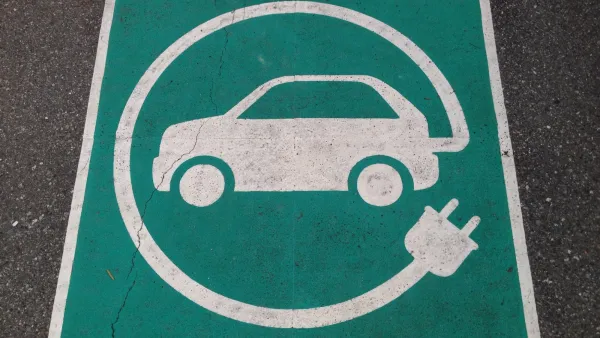
'Charging as a Service' Could Accelerate Decarbonization
The proliferation of private EV charging services, coupled with federal investment in charging stations, has the potential to reduce 'charging anxiety' and encourage a faster switch to electric vehicles.

Decarbonizing Transportation at the Federal Level
A new report shows that long-term federal investments in electric vehicles could promote significant growth in the sector as the nation moves toward reducing GHG emissions.

First Federal Funding for Hydrogen Hubs Awarded to California and Pacific Northwest
The U.S. Department of Energy announced on July 17 that the first grant to build the nation's seven proposed 'hydrogen hubs' would go to California. The ultimate goal is to decarbonize transportation fuels used in port operations.

Planetizen Federal Action Tracker
A weekly monitor of how Trump’s orders and actions are impacting planners and planning in America.

The state-sanctioned urbicide of Austin
People don’t kill cities. Freeways do.

US to reduce Colorado River water deliveries to Mexico
A new Colorado Treaty amendment reduces Mexico’s Colorado River water allocation by 250,000 acre feet.

5 New England states march closer to 800 megawatt wind energy project
Securing federal approval for the project may be complicated under the Trump administration, which has historically been hostile towards domestic wind power.

Baltimore to break ground on $50 million Transit Priority Project
The project will bring faster bus trips, safer streets and better bike connections to Baltimore.

Airbnb launches $250 million 'last-dollar financing' housing accelerator, makes first investment in Austin
The company will put $6.4 million towards affordable housing development in Texas’ capital.

FREE Course: Walkable City 1: Why Walkability?
After describing his path towards focusing on walkability as the essence of good planning, Jeff Speck marches through his five principal reasons for making more walkable places.
Reinventing Malls: Planning Alchemy—Turning Gray Fields Into Gold
The course focuses on the opportunities and imperatives that shape reinvention of mall sites.

Eagle County Government
Harvard University Graduate School of Design
Nashville Planning Department
The Architects Foundation
University of Cincinnati Online
The Pocatello Development Authority
The Urban Renewal Agency of the City of Pocatello
Journal of the American Planning Association