The total estimated cost of the NFL stadium planned for the Buffalo Bills in Orchard Park, south of Buffalo, New York, comes to $1.4 billion—including $850 million in public funding.


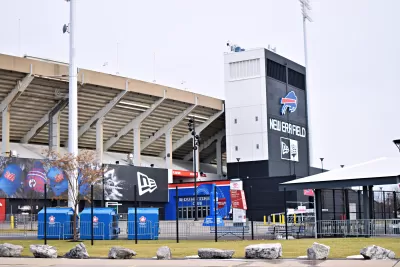
Publicly funded stadiums for privately owned professional sports teams are facing increasing amounts of criticism for draining public coffers to the benefit of wealthy team owners. Three cities—Oakland, California, San Diego, California, and St. Louis, Missouri—found themselves on the losing end in 2016 after facing expensive demands from National Football League teams.
Buffalo, New York is choosing the other path by devoting major financial support to keep their beloved franchise local. A plan for a Downtown Stadium, proposed in August 2014, failed.
"After months of negotiations, the National Football League team has reached an agreement with New York State and Erie County to build an open-air stadium in Orchard Park," report Tim O'Shei and Jason Wolf for the Buffalo News. "New York is slated to contribute $600 million and Erie County $250 million toward construction."
The $850 million in taxpayer funding attached the stadium's price tag is less than anticipated, according to a soundbite from the article attributed to New York Governor Kathy Hochul.
The article also includes planning details for the new stadium, including a superlative: "The new stadium will be built directly across the street on Abbott Road, adjacent to Erie Community College’s South Campus, in what Hochul called 'the largest construction project in Western New York history.'"
More details on the stadium project can be read on the Buffalo Bills website.
Read the full story: Buffalo Bills, New York State, Erie County reach 'ironclad' 30-year deal to build $1.4 billion stadium
A Proposal for an NFL Stadium in Downtown Buffalo
Few cities have such a passionate love affair with their NFL franchise as does Buffalo with its Bills. Given the current questions about ownership and the age of its current stadium, could a new stadium help revitalize the city?
Buffalo Hospital to Become 80 Housing Units
The former Millard Fillmore Gates Circle hospital building is part of a larger development aimed at bringing affordable housing to western New York.

Environmentalists Urge Hochul to Rethink Congestion Pricing
Evergreen Action, the Sierra Club, Earthjustice, Environmental Defense Fund, and the League of Conservation Voters have joined the movement to urge NY Gov. Kathy Hochul to reverse her decision to terminate the New York congestion pricing project.

Planetizen Federal Action Tracker
A weekly monitor of how Trump’s orders and actions are impacting planners and planning in America.

California plans to bury El Niño’s downpour
If the state plays its cards right, it may be able to store a billion acre-feet of El Niño’s water in aquifers.

Desperate measures: Advocates weigh draining Lake Powell to fill Colorado River
Draining the reservoir could reduce evaporation losses by a couple hundred thousand acre-feet.

In Texas, data centers are swallowing promised parkland
Residents who moved to Taylor, Texas for a rural community now have to contend with three data centers in their backyard.

How a Chicago-sized wind farm beat the odds and powered on
The project spanned five presidential administrations and a standoff with a U.S. military base.

MTA gives itself 30 days to transform pit into basketball court
The site has been under construction since 2022; the city originally estimated it would finish the court in 2024.

FREE Course: Walkable City 1: Why Walkability?
After describing his path towards focusing on walkability as the essence of good planning, Jeff Speck marches through his five principal reasons for making more walkable places.
Reinventing Malls: Planning Alchemy—Turning Gray Fields Into Gold
The course focuses on the opportunities and imperatives that shape reinvention of mall sites.

City of Rosemead
Rutgers University, Edward J. Bloustein School of Planning and Public Policy
One Hundred Miles
Hunter College, City University of New York (CUNY)
The Architects Foundation
University of Cincinnati Online
City of Cambridge
Montrose County
The Pocatello Development Authority