The decision could signal a new reluctance to allow development in wildland areas at high risk for fires.


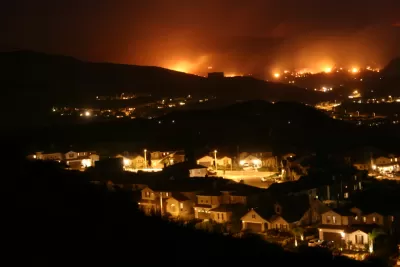
Despite the destruction caused by increasingly large and long-lasting wildfires in California in recent years, writes Thomas Elias, "development continued virtually unabated" in the state's wildland-urban interface. "Until early this year, when a judge in sparsely populated Lake County said 'No!' to a 16,000-acre luxury mixed-use project on land partly singed by past fires and partly deemed likely to flare up in future ones."
As Elias reports, "The judge ruled in a lawsuit brought by state Atty. Gen. Rob Bonta and several environmental groups claiming the project could prove disastrous to both its own future residents and guests but also to present area residents." Explaining his ruling, Lake County Superior Court Judge J. David Markham said that "the development could close off or overcrowd fire evacuation routes, dooming many to death, as happened during the 2018 Camp Fire in Butte County."
Elias criticizes state legislation that eliminates single-family zoning and permits increased density without requiring developers or property owners to build additional infrastructure to support extra housing units. Elias writes that infill development, and potentially the conversion of office buildings vacated during the pandemic into housing, should take priority over new development that puts communities at risk for natural disasters.
FULL STORY: As California continues to burn, finally a pushback against wildland development

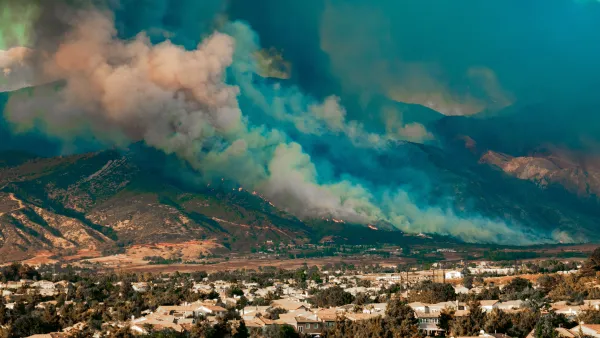
Home Insurers Are Fleeing California
Homeowners in the state are finding it increasingly difficult to secure insurance policies thanks to the growing risks of wildfire, drought, and other climate threats.

$50 Billion 'Wildfire Risk Strategy' Targets the Wildland-Urban Interface
The U.S. Department of Agriculture in January announced an ambitious, and only partially funded, new plan to reduce wildfire risks for communities around the United States.
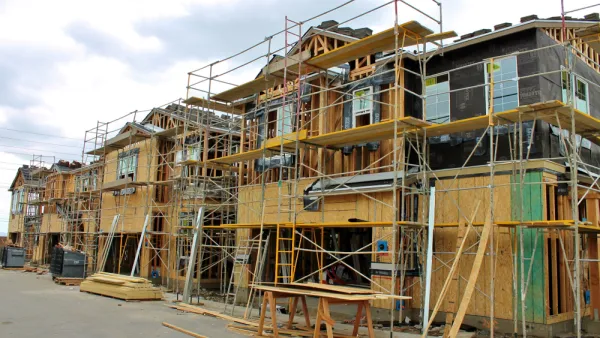
California Governor's Budget Supports Infill Development
Governor Newsom's new budget proposes incentives for developers to build housing in existing urban areas away from fire-prone zones to reduce fire risk and add to the state's insufficient housing stock.

Planetizen Federal Action Tracker
A weekly monitor of how Trump’s orders and actions are impacting planners and planning in America.

The state-sanctioned urbicide of Austin
People don’t kill cities. Freeways do.

US to reduce Colorado River water deliveries to Mexico
A new Colorado Treaty amendment reduces Mexico’s Colorado River water allocation by 250,000 acre feet.

5 New England states march closer to 800 megawatt wind energy project
Securing federal approval for the project may be complicated under the Trump administration, which has historically been hostile towards domestic wind power.

Baltimore to break ground on $50 million Transit Priority Project
The project will bring faster bus trips, safer streets and better bike connections to Baltimore.

Airbnb launches $250 million 'last-dollar financing' housing accelerator, makes first investment in Austin
The company will put $6.4 million towards affordable housing development in Texas’ capital.

FREE Course: Walkable City 1: Why Walkability?
After describing his path towards focusing on walkability as the essence of good planning, Jeff Speck marches through his five principal reasons for making more walkable places.
Reinventing Malls: Planning Alchemy—Turning Gray Fields Into Gold
The course focuses on the opportunities and imperatives that shape reinvention of mall sites.


Eagle County Government
Harvard University Graduate School of Design
Nashville Planning Department
The Architects Foundation
University of Cincinnati Online
The Pocatello Development Authority
The Urban Renewal Agency of the City of Pocatello
Journal of the American Planning Association