The zero-emissions bus is part of a regional fleet called the Clean Air Express that connects Santa Barbara County towns and employment centers.


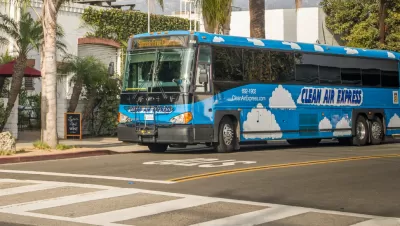
According to an article in The Santa Barbara Independent, the region has introduced an all-electric bus to its intercity service, the Clean Air Express, which encourages residents to commute via bus rather than cars. The zero-emissions bus, like others in the Clean Air Express fleet, will travel between Santa Maria, Lompoc, and other major employment centers in Santa Barbara County.
"A switch to cleaner, quieter, and smoother public transit options is a switch in the right direction, one that is imperative for our future – for our children and neighbors. Today we see just how the zero-emission vehicle industry’s evolving technology is changing the game for long-range transportation options improving the efficiency, experience, and commuter benefits to save energy and the environment," said Santa Barbara County Association of Governments (SBCAG) Board of Directors Chair Das Williams.
Operated by SBCAG, the Clean Air Express serves roughly 7,000 riders per month with a fleet of 17 buses. "Of the $850,000 cost of the all-electric bus, Caltrans provided $500,000 in SB 1 funds from the State Rail Assistance Program. SB 1 provides $5 billion in transportation funding annually split between the state and local agencies."
Read the full story: All-Electric, Zero-Emissions Intercity Bus Makes Its Debut in Santa Barbara County
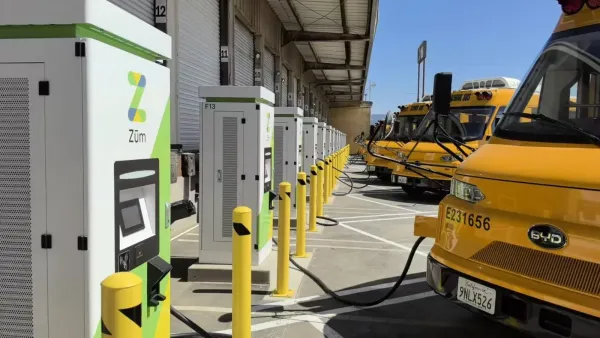
In California, electric school buses are powering 1,000 homes — and turning a profit
Tellus Power, the charging equipment manufacturer behind the project, is also helping school buses connect to the power grid in Vermont, Illinois and San Francisco.
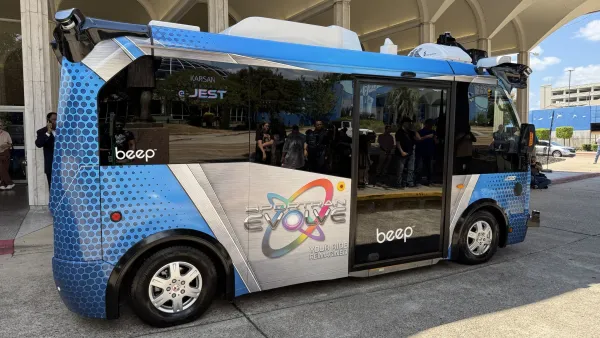
Louisiana gets state’s first self-driving bus
Eventually, 15 autonomous buses will serve Shreveport, Louisiana.

In Poland, you can ride bus #666 to Hel
FlixBus is resurrecting a marketing gimmick that garnered backlash from religious groups.

Planetizen Federal Action Tracker
A weekly monitor of how Trump’s orders and actions are impacting planners and planning in America.

California plans to bury El Niño’s downpour
If the state plays its cards right, it may be able to store a billion acre-feet of El Niño’s water in aquifers.

Desperate measures: Advocates weigh draining Lake Powell to fill Colorado River
Draining the reservoir could reduce evaporation losses by a couple hundred thousand acre-feet.

Mamdani’s pied-à-terre tax survives legal challenge
A panel of judges found that the plaintiffs failed to demonstrate injury as a result of New York City's implementation of the tax.

Eastern Nebraska is running out of electricity
Data centers and electrification are straining eastern Nebraska’s grid, throttling economic development.

Seattle passes record-breaking transit services expansion
Proposition 1 will double the city’s transit tax to add 95,000 more bus trips and preserve 180,000 bus trips annually.

FREE Course: Walkable City 1: Why Walkability?
After describing his path towards focusing on walkability as the essence of good planning, Jeff Speck marches through his five principal reasons for making more walkable places.
Reinventing Malls: Planning Alchemy—Turning Gray Fields Into Gold
The course focuses on the opportunities and imperatives that shape reinvention of mall sites.

City of Rosemead
Rutgers University, Edward J. Bloustein School of Planning and Public Policy
One Hundred Miles
University of Michigan School for Environment and Sustainability (SEAS)
Hunter College, City University of New York (CUNY)
The Architects Foundation
City of Cambridge
Montrose County
The Pocatello Development Authority