More and more U.S. transit agencies are rolling out electric buses, and the recently approved federal infrastructure bill could make it easier than ever to buy zero emission electric buses.


Dan Zukowski reports for Smart Cities Dive:
A silent revolution is underway on city streets as transit agencies large and small replace noisy, polluting diesel buses with clean, quiet electric vehicles. But agencies and bus manufacturers alike warn that the transition is not as simple as signing a procurement order for new battery-powered buses.
Calstart, a national nonprofit focused on advancing clean transportation technology, gathers data on the state of electric buses every year. CalStart's latest report, published on January 5, 2022, documents big growth in the number of Zero Emissions Buses (ZEBs) on the roads. "Full-size ZEBs have grown to 3,533 buses nationally, an increase of 27% since the 2020 count," according to the press release announcing the report.
Zukowski, however, focuses on Calstart's data on Battery Electric Buses (BEBs): " The number of battery-electric transit buses (BEBs) currently on order or operating in the U.S. grew 112% from 2018 to 2021," according to Zukowski. "California leads the nation with almost 1,400 on the road or on order, followed by Washington, New York and Florida."
As noted by both the article and the press release, the Infrastructure Investment and Jobs Act (IIJA) passed last year by Congress could accelerate the adoptions of ZEBs and BEBs. The IIJA "increased funding for the Federal Transit Administration's (FTA) Low or No Emission Vehicle Grant Program and for the Buses and Bus Facilities Program, under which transit agencies can procure zero-emission buses," reports Zukowski.
Read the full story: More electric buses join transit fleets as costs and technology improve


$1.66 Billion in Federal Infrastructure Funding Awarded to U.S. Bus Systems
The Federal Transit Administration announced the winners in the Bus and Bus Facilities and Low or No Emission Vehicle (Low-No Program) programs in August.
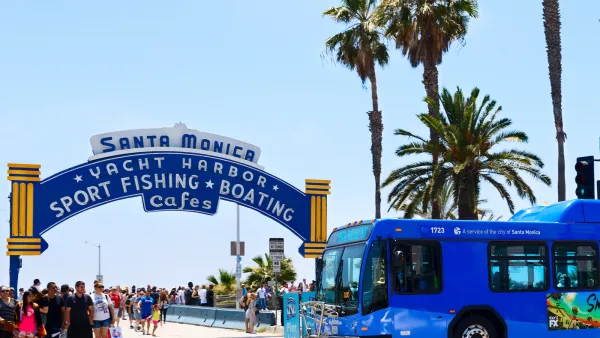
Santa Monica starts work on $56M electric bus project
Big Blue Bus plans to fully electrify its fleet by 2032.
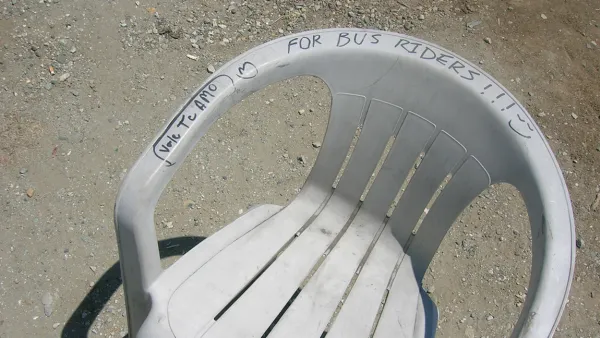
Federal Infrastructure Funding a Rare Opportunity to Improve the Nation’s Bus Shelters
Transit systems faced with decreasing ridership could accommodate access to the most widely available form of transit by building bus shelters. The federal infrastructure bill provides a big opportunity to do so.

Planetizen Federal Action Tracker
A weekly monitor of how Trump’s orders and actions are impacting planners and planning in America.

California plans to bury El Niño’s downpour
If the state plays its cards right, it may be able to store a billion acre-feet of El Niño’s water in aquifers.

Chicago breaks ground on $3 billion megadevelopment
The new neighborhood, titled Foundry Park, will one day host 3,700 residences.

Satanic Place Names
From streams and lakes to valleys and canyons, I mapped more than 1,000 places named after the Devil.

California High-Speed Rail Authority CEO resigns after $600,000 scandal
Under Ian Choudri, the authority used taxpayer dollars to fund first class flights and trips to nightclubs.

Want to study the Missouri River? Soon, you may need unanimous approval from 10 states
Legislation would require 10 governors’ permission to study or build projects moving water outside the basin.

FREE Course: Walkable City 1: Why Walkability?
After describing his path towards focusing on walkability as the essence of good planning, Jeff Speck marches through his five principal reasons for making more walkable places.
Reinventing Malls: Planning Alchemy—Turning Gray Fields Into Gold
The course focuses on the opportunities and imperatives that shape reinvention of mall sites.


City of Rosemead
Rutgers University, Edward J. Bloustein School of Planning and Public Policy
One Hundred Miles
Hunter College, City University of New York (CUNY)
The Architects Foundation
University of Cincinnati Online
City of Cambridge
Montrose County
The Pocatello Development Authority