The newly built Water Works Park and Pavilion incorporates elements of historic mills and provides amenities long absent from the city's waterfront.


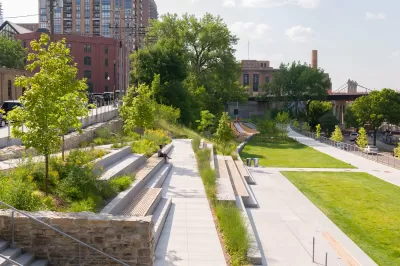
Architecture critic Linda Mack describes Minneapolis' newest park, a "triumph" of redevelopment on the Mississippi River waterfront that finally gives residents a way to enjoy the view while having access to amenities like seating and public restrooms.
Built within the walls of two former mills, Water Works Park and Pavilion features walkways, benches, a playground, and the city's first Native American restaurant, a fitting tenant for a site that was sacred to the Dakota before white settlers came to the area. The development blends old and new elements to preserve sections of the historic buildings and utilize the remnants of the old mills to highlight the site's history as the engine of the city's economic growth. Mack writes,
Damon Farber Landscape Architects led the design team with HGA designing the pavilion, MacDonald and Mack as historic consultants, and the 106 Group as archaeologists. The Healing Place Collaborative brought in Dakota artists and language experts to design covers for the fire pits and interpret the rainwater collection and use of Native plants.
The property was purchased by the Minneapolis Park and Recreation Board in 1987, but sat in disrepair until a plan to build the park and pavilion finally took shape in 2011.
FULL STORY: Minneapolis’ newest park is like a front porch on the Mississippi River


Madison approves hundreds of affordable apartments as deadline for federal funding looms
A recently approved project will bring 163 affordable units to the north side.

LA approves $2B 'urban village' plan for former cold storage facilities
The project promises an interconnected neighborhood with a focus on public space.

Historic Bank in Pittsfield, Massachusetts to Become Mixed-income Housing
The bank redevelopment project is part of a $140 million state affordable housing initiative.

Planetizen Federal Action Tracker
A weekly monitor of how Trump’s orders and actions are impacting planners and planning in America.

The state-sanctioned urbicide of Austin
People don’t kill cities. Freeways do.

US to reduce Colorado River water deliveries to Mexico
A new Colorado Treaty amendment reduces Mexico’s Colorado River water allocation by 250,000 acre feet.

Colorado’s Largest Data Center Could Rise Next to Homes — Without a Public Hearing
The proposed campus would consume 11 times the power of Denver International Airport; as it has across the country, opposition mounts.

5 New England states march closer to 800 megawatt wind energy project
Securing federal approval for the project may be complicated under the Trump administration, which has historically been hostile towards domestic wind power.

Baltimore to break ground on $50 million Transit Priority Project
The project will bring faster bus trips, safer streets and better bike connections to Baltimore.

FREE Course: Walkable City 1: Why Walkability?
After describing his path towards focusing on walkability as the essence of good planning, Jeff Speck marches through his five principal reasons for making more walkable places.
Reinventing Malls: Planning Alchemy—Turning Gray Fields Into Gold
The course focuses on the opportunities and imperatives that shape reinvention of mall sites.


Eagle County Government
Harvard University Graduate School of Design
Nashville Planning Department
The Architects Foundation
University of Cincinnati Online
The Pocatello Development Authority
The Urban Renewal Agency of the City of Pocatello
Journal of the American Planning Association